Fill in the blanks in this summary map to help you review the key concepts of cellular respiration.
검증된 단계별 안내
1
Identify the three stages of cellular respiration: Glycolysis, Citric Acid Cycle (Krebs Cycle), and Oxidative Phosphorylation.
Fill in (a) with 'Glycolysis' as it is the first stage that produces some ATP.
Fill in (b) with 'Citric Acid Cycle' as it produces many ATP molecules.
Fill in (c) with 'Oxidative Phosphorylation' as it is the stage where the majority of ATP is produced through the electron transport chain and chemiosmosis.
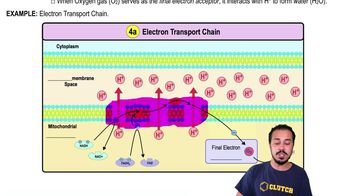
Fill in (d) with 'Electron Transport Chain' as it pulls electrons down to oxygen, which is the final electron acceptor.
비슷한 문제에 대한 검증된 영상 답변:
이 영상 해법은 위 문제에 도움이 된다고 튜터들이 추천한 것입니다.
영상 길이:
3m
영상 재생:
0 댓글
주요 개념
질문에 올바르게 답하기 위해 반드시 이해해야 하는 핵심 개념들은 다음과 같습니다.
Cellular Respiration
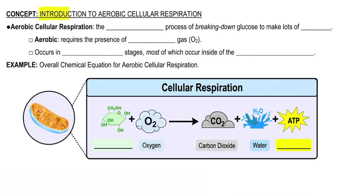
Cellular respiration is a metabolic process that converts glucose and other organic fuels into ATP, the energy currency of the cell. It occurs in three main stages: glycolysis, the citric acid cycle, and oxidative phosphorylation. Each stage plays a crucial role in breaking down glucose and harnessing energy, ultimately producing ATP for cellular work.
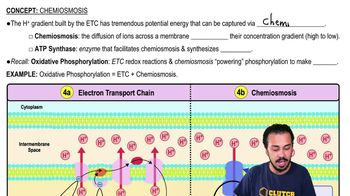
Chemiosmosis is the process by which ATP is produced in the mitochondria during oxidative phosphorylation. It involves the movement of protons (H+) across a membrane, creating a proton gradient. This gradient drives the synthesis of ATP as protons flow back through ATP synthase, an enzyme that catalyzes the conversion of ADP and inorganic phosphate into ATP.
The electron transport chain (ETC) is a series of protein complexes located in the inner mitochondrial membrane that facilitate the transfer of electrons derived from NADH and FADH2. As electrons move through the chain, they release energy used to pump protons into the intermembrane space, contributing to the proton gradient essential for ATP production via chemiosmosis.

 3:08분
3:08분
 검증된 단계별 안내
 03:38
03:38