 뒤로
뒤로Anatomy & Physiology 1: Exam Review Chapters 1–4 Study Guide
스터디 가이드 - 스마트 노트
 자료에 맞춘 맞춤형 노트, 핵심 정의, 예시, 맥락을 확장해 제공합니다.
Chapter 1: The Human Body – An Orientation
Topics of Anatomy
Anatomy is the study of the structure of the human body, organized into several branches based on the scale and method of study.
Gross (macroscopic) anatomy: Study of structures visible to the naked eye.
Regional anatomy: All structures in a specific body region.
Systemic anatomy: All structures in a body system.
Microscopic anatomy: Study of structures too small to be seen unaided.
Cytology: Study of individual cells.
Histology: Study of tissues.
Developmental anatomy: Study of structural changes throughout life; embryology focuses on development before birth.
Specialized branches:
Pathological anatomy: Structural changes due to disease.
Radiographic anatomy: Internal structures visualized by imaging techniques.
Levels of Structural Organization
The human body is organized into hierarchical levels, each building upon the previous.
Chemical level: Atoms combine to form molecules, which form organelles.
Cellular level: Cells are the smallest unit of life, varying in size and function.
Tissue level: Groups of similar cells performing a common function.
Organ level: Discrete structures performing specific functions.
Organ system level: Groups of organs working together for a purpose.
Organism level: The sum of all structural levels working together.
Organ Systems Overview
The body comprises 11 organ systems, each with distinct functions.
Integumentary system: External body covering, protection.
Skeletal system: Support, protection, blood cell formation.
Muscular system: Movement, posture, heat production.
Nervous system: Fast-acting control, response to stimuli.
Endocrine system: Hormone secretion, regulation.
Cardiovascular system: Blood transport, oxygen/nutrient delivery.
Lymphatic/immune systems: Fluid return, debris removal, immunity.
Respiratory system: Oxygen supply, carbon dioxide removal.
Digestive system: Food breakdown, absorption, waste elimination.
Urinary system: Waste elimination, water/ion balance.
Reproductive systems: Gamete production, offspring support.
Homeostasis
Homeostasis is the body's ability to maintain a stable internal environment despite external changes.
Receptor: Monitors environment, responds to stimuli.
Control center: Determines set point, analyzes input, directs response.
Effector: Carries out response, feeds back to control center.
Negative feedback: Opposes stimulus, maintains stability (e.g., blood glucose regulation).
Positive feedback: Amplifies stimulus, used for processes needing rapid change (e.g., labor contractions).
Feedforward (anticipatory) responses: Prepares for anticipated changes.
Anatomical Position and Directional Terms
The anatomical position is a standardized posture used as a reference for describing locations and relationships of body parts.
Body erect, palms forward, thumbs outward.
Provides a common reference for anatomical terminology.
Directional Terms Table
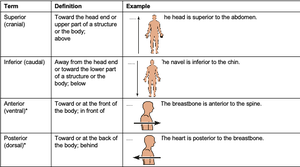
Directional terms describe the location of one body part relative to another.
Term | Definition | Example |
|---|---|---|
Superior (cranial) | Toward the head end or upper part of a structure or the body | The head is superior to the abdomen. |
Inferior (caudal) | Away from the head end or toward the lower part of a structure or the body | The navel is inferior to the chin. |
Anterior (ventral) | Toward or at the front of the body; in front of | The breastbone is anterior to the spine. |
Posterior (dorsal) | Toward or at the back of the body; behind | The heart is posterior to the breastbone. |
Term | Definition | Example |
|---|---|---|
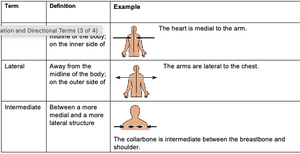
Medial | Toward the midline of the body; on the inner side | The heart is medial to the arm. |
Lateral | Away from the midline of the body; on the outer side | The arms are lateral to the chest. |
Intermediate | Between a more medial and a more lateral structure | The collarbone is intermediate between the breastbone and shoulder. |
Term | Definition | Example |
|---|---|---|
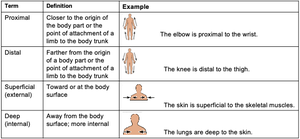
Proximal | Closer to the origin of the body part or point of attachment | The elbow is proximal to the wrist. |
Distal | Farther from the origin of the body part or point of attachment | The knee is distal to the thigh. |
Superficial (external) | Toward or at the body surface | The skin is superficial to the skeletal muscles. |
Deep (internal) | Away from the body surface; more internal | The lungs are deep to the skin. |
Regional Terms
Regional terms specify areas of the body, divided into axial (head, neck, trunk) and appendicular (limbs) parts.
Cephalic: Head and face (frontal, orbital, nasal, buccal, oral, mental).
Cervical: Neck.
Thoracic: Chest (sternal, axillary, mammary).
Abdominal: Abdomen (umbilical).
Pelvic: Pelvis (inguinal).
Pubic: Genital area.
Upper limb: Arm regions (acromial, brachial, antecubital, olecranon, antebrachial, carpal).
Manus: Hand regions (pollex, metacarpal, palmar, digital).
Lower limb: Leg regions (coxal, femoral, patellar, popliteal, crural, sural, fibular/peroneal).
Pedal: Foot regions (tarsal, calcaneal, metatarsal, digital, plantar, hallux).
Body Planes and Sections
Body planes are imaginary lines used to divide the body for anatomical study.
Sagittal plane: Vertical, divides body into right and left parts.
Midsagittal: Directly on midline.
Parasagittal: Off midline.
Frontal (coronal) plane: Vertical, divides body into anterior and posterior parts.
Transverse (horizontal) plane: Horizontal, divides body into superior and inferior parts; also called cross section.
Body Cavities
The body contains two main cavities, each with subdivisions and specific organs.
Dorsal cavity:
Cranial cavity: Protects the brain.
Vertebral (spinal) cavity: Encloses the spinal cord.
Ventral cavity:
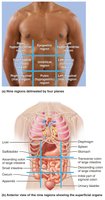
Thoracic cavity: Surrounded by ribs and chest muscles; includes pleural cavities (lungs) and pericardial cavity (heart).
Abdominopelvic cavity: Separated by diaphragm; includes abdominal cavity (digestive organs, spleen) and pelvic cavity (urinary, reproductive organs, rectum).
Chapter 2: Chemistry Comes Alive
Elements and Atoms
Elements are unique substances that cannot be broken down further. Four elements (carbon, hydrogen, oxygen, nitrogen) make up most of the body.
Atoms: Composed of protons (positive), neutrons (neutral), and electrons (negative).
Molecules: Two or more atoms bonded together.
Compounds: Molecules formed from different atoms.
Chemical Bonds
Chemical bonds are forces holding atoms together in molecules.
Ionic bonds: Transfer of electrons; forms cations (positive) and anions (negative).
Covalent bonds: Sharing of electrons; can be nonpolar (equal sharing) or polar (unequal sharing).
Hydrogen bonds: Weak attractions between hydrogen and electronegative atoms; important for water properties and molecular structure.
Chemical Reactions
Chemical reactions involve the making or breaking of bonds.
Synthesis (anabolic): Formation of bonds, building molecules.
Decomposition (catabolic): Breaking bonds, breaking down molecules.
Exergonic: Release energy; products have lower energy than reactants.
Endergonic: Absorb energy; products have higher energy than reactants.
Factors Affecting Reaction Rate
Temperature (higher = faster)
Concentration (higher = faster)
Particle size (smaller = faster)
Catalysts (increase rate without being consumed)
Water, Acids, and Bases
Water is the most important inorganic molecule, with unique properties essential for life.
High heat capacity and vaporization
Polar solvent qualities
Reactivity and cushioning
Acids: Proton donors, release H+ ions.
Bases: Proton acceptors, release OH- ions.
pH scale: Measures H+ concentration; 0–14, 7 is neutral, below 7 acidic, above 7 basic.
Macromolecules
Carbohydrates: Energy source; monosaccharides, disaccharides, polysaccharides.
Lipids: Insoluble in water; triglycerides (energy, insulation), phospholipids (cell membranes), steroids (hormones), eicosanoids (regulation).
Proteins: Structural material; made of amino acids, enzymes are biological catalysts.
Nucleic acids: DNA and RNA; genetic information.
ATP: Primary energy transfer molecule; phosphorylation releases energy.
Chapter 3: Cells – The Living Units
Cell Structure
Human cells have three main parts: plasma membrane, cytoplasm, and nucleus.
Plasma membrane: Double layer of phospholipids with proteins; selectively permeable.
Cytoplasm: Intracellular fluid with organelles.
Nucleus: Controls cellular activity.
Membrane Transport
Simple diffusion: Movement of small, nonpolar molecules through membrane.
Facilitated diffusion: Movement of larger or charged molecules via carriers or channels.
Osmosis: Movement of water across membrane.
Active transport: Uses ATP to move substances against gradient.
Vesicular transport: Uses vesicles for large particles/macromolecules.
Endocytosis: Into cell (phagocytosis, pinocytosis, receptor-mediated).
Exocytosis: Out of cell.
Cell Organelles
Mitochondria: ATP production.
Ribosomes: Protein synthesis.
Endoplasmic reticulum (ER): Rough ER (protein synthesis), smooth ER (lipid metabolism, detoxification).
Golgi apparatus: Modifies, packages proteins/lipids.
Lysosomes: Digestive enzymes, breakdown particles.
Peroxisomes: Detoxification.
Endomembrane system: Produces, stores, exports molecules.
Cytoskeleton: Structural support, movement (microfilaments, intermediate filaments, microtubules).
Centrosome/centrioles: Organize microtubules, mitotic spindle.
Cell Division
Mitosis: Nuclear division (prophase, metaphase, anaphase, telophase).
Cytokinesis: Cytoplasmic division.
Chapter 4: Tissue – The Living Fabric
Classification of Epithelia
Epithelial tissues are classified by layers and cell shape.
Simple epithelia: One layer; absorption, secretion, filtration.
Stratified epithelia: Multiple layers; protection.
Cell shapes: Squamous (flat), cuboidal (cube), columnar (tall).
Types of Epithelia
Simple squamous: Filtration/exchange.
Simple cuboidal: Ducts, kidney tubules.
Simple columnar: Digestive tract.
Pseudostratified columnar: Respiratory tract.
Stratified squamous: Skin, body openings.
Stratified cuboidal/columnar: Gland ducts, pharynx, urethra.
Transitional: Urinary organs, stretchable.
Glandular Epithelia
Endocrine glands: Ductless, secrete hormones into blood/lymph.
Exocrine glands: Have ducts, secrete onto surfaces or into cavities.
Connective Tissue
All connective tissues arise from embryonic mesenchyme and have three main components: ground substance, fibers, and cells.
Ground substance: Fluid, proteins, proteoglycans.
Fibers: Collagen (strength), elastic (stretch), reticular (network).
Cells: Immature (-blast) and mature (-cyte) forms.
Types of Connective Tissue
Loose connective: Areolar (packing), adipose (fat storage), reticular (framework).
Dense connective: Regular (tendons/ligaments), irregular (dermis), elastic (stretchable).
Cartilage: Hyaline (support), elastic (stretch), fibrocartilage (pressure).
Bone: Support/protection; osteoblasts (matrix production), osteocytes (maintenance), osteons (structural units).
Muscle Tissue
Skeletal muscle: Long, multinucleate fibers; voluntary movement.
Cardiac muscle: Striated, branched, uninucleate; heart only; intercalated discs.
Smooth muscle: Unstriated, spindle-shaped; walls of hollow organs.
Membranes
Cutaneous membrane: Skin; keratinized stratified squamous epithelium.
Mucous membranes: Line cavities open to exterior; moist.
Serous membranes: Line closed cavities; moist; pleurae (lungs), pericardium (heart), peritoneum (abdomen).
Tissue Repair
Inflammation: Prepares area for repair.
Organization: Replaces clot with granulation tissue.
Regeneration and fibrosis: Restore tissue.
