 뒤로
뒤로Anatomy & Physiology 1 - Chapter 2: Biological Chemistry
스터디 가이드 - 스마트 노트
 자료에 맞춘 맞춤형 노트, 핵심 정의, 예시, 맥락을 확장해 제공합니다.
Body Cavities and Planes
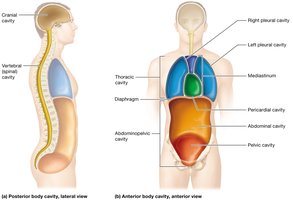
Major Body Cavities
The human body contains several major cavities that house and protect internal organs. Understanding these cavities is fundamental to anatomical study.
Cranial Cavity: Contains the brain, protected by the skull.
Vertebral (Spinal) Cavity: Contains the spinal cord, protected by the vertebral column.
Thoracic Cavity: Contains the lungs and heart, divided into pleural, pericardial, and mediastinal regions.
Abdominopelvic Cavity: Contains digestive, urinary, and reproductive organs, further divided into abdominal and pelvic cavities.
Anatomical Planes
Anatomical planes are imaginary lines used to divide the body for study and description.
Sagittal Plane: Divides the body into left and right sections.
Midsagittal Plane: Divides the body into equal left and right halves.
Frontal (Coronal) Plane: Divides the body into anterior (front) and posterior (back) sections.
Transverse Plane: Divides the body into superior (upper) and inferior (lower) sections.
Biological Chemistry
Elements in the Human Body
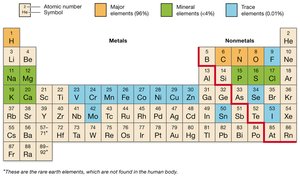
Elements are pure substances that cannot be broken down by chemical means. The human body is composed primarily of four major elements, with several mineral and trace elements contributing to physiological functions.
Major Elements: Oxygen (O), Carbon (C), Hydrogen (H), Nitrogen (N)
Mineral Elements: Sodium (Na), Potassium (K), Calcium (Ca), Chlorine (Cl), Magnesium (Mg), Phosphorus (P), Sulfur (S)
Trace Elements: Iron (Fe), Copper (Cu), Iodine (I), Zinc (Zn), and others
Atomic Structure
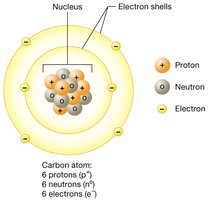
An atom consists of a nucleus containing protons and neutrons, surrounded by electrons in shells. The atomic number is determined by the number of protons.
Protons: Positively charged particles
Neutrons: Neutral particles
Electrons: Negatively charged particles
Valence Electrons: Electrons in the outermost shell, important for chemical bonding
Electron Shells and Stability
Atoms are most stable when their valence shell is full. The octet rule states that atoms are stable with eight electrons in their valence shell, while the duet rule applies to atoms with only two electrons in their first shell.
Chemical Bonds
Chemical bonds form when atoms interact to achieve stability. The main types are ionic, covalent, and hydrogen bonds.
Ionic Bonds: Formed by transfer of electrons, resulting in charged ions (cations and anions)
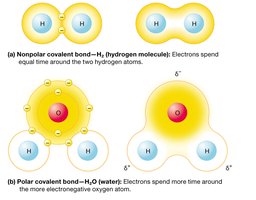
Covalent Bonds: Formed by sharing electrons between atoms
Polar Covalent Bonds: Unequal sharing of electrons, creating partial charges
Nonpolar Covalent Bonds: Equal sharing of electrons
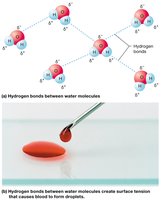
Hydrogen Bonds
Hydrogen bonds are weak attractions between the partial positive charge of hydrogen and the partial negative charge of another atom, often oxygen or nitrogen. They are crucial for the properties of water and the structure of biological molecules.
Mixtures in the Human Body
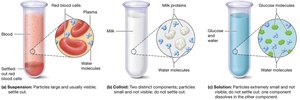
Mixtures are combinations of substances physically intermixed. The three main types are suspensions, colloids, and solutions.
Suspensions: Large particles settle out (e.g., blood)
Colloids: Small particles do not settle out (e.g., milk)
Solutions: Solute dissolves in solvent, usually water (e.g., sugar water)
Properties of Water
Water is essential for life due to its unique properties:
Absorbs heat without significant temperature change
Carries heat during evaporation
Cushions and protects organs
Acts as a lubricant
Hydrophilic vs. Hydrophobic Compounds
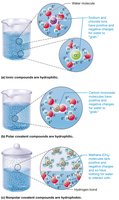
Compounds interact with water based on their polarity:
Hydrophilic: Water-loving; ionic and polar covalent compounds dissolve in water
Hydrophobic: Water-fearing; nonpolar covalent compounds do not dissolve in water
Acids, Bases, and pH
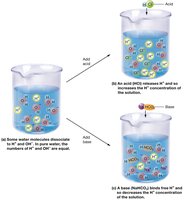
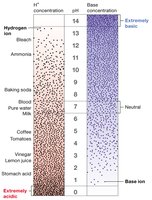
Acids donate hydrogen ions (H+), while bases accept them. The pH scale measures the concentration of H+ ions, ranging from 0 (acidic) to 14 (basic). Buffers help maintain stable pH in the body.
Acid: H+ donor
Base: H+ acceptor
Buffer: Resists changes in pH
Organic Molecules
Carbohydrates
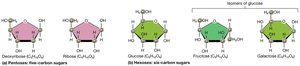
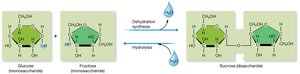
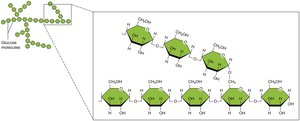
Carbohydrates are hydrophilic molecules composed of monosaccharides (monomers), disaccharides, and polysaccharides (polymers). They serve as energy sources and structural components.
Monosaccharides: Simple sugars (e.g., glucose)
Disaccharides: Two monosaccharides linked (e.g., sucrose)
Polysaccharides: Chains of monosaccharides (e.g., glycogen)
Lipids
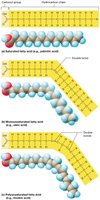
Lipids are hydrophobic molecules, including fatty acids, triglycerides, phospholipids, and steroids. They function in energy storage, membrane structure, and signaling.
Fatty Acids: Monomers; can be saturated, monounsaturated, or polyunsaturated
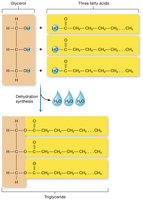
Triglycerides: Three fatty acids bonded to glycerol; main fat storage form
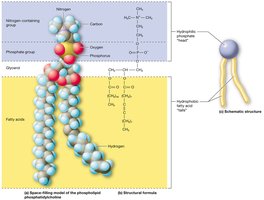
Phospholipids: Amphiphilic molecules forming cell membranes
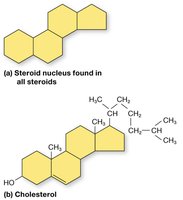
Steroids: Four-ring structure; includes cholesterol and hormones
Proteins
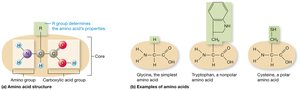
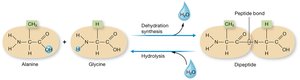
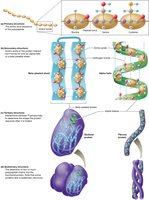
Proteins are polymers of amino acids, folded into specific structures for diverse functions such as enzymes, hormones, and structural components.
Amino Acids: Monomers; each has a unique R group
Peptides: Short chains of amino acids
Polypeptides: Long chains; fold into fibrous or globular proteins
Nucleic Acids
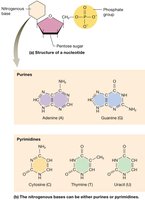
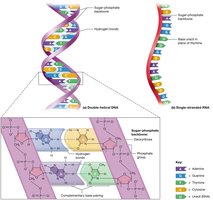
Nucleic acids are polymers of nucleotides, essential for genetic information storage and transfer. DNA and RNA are the two main types.
Nucleotides: Monomers composed of a phosphate group, pentose sugar, and nitrogenous base
DNA: Double helix; stores genetic information
RNA: Single strand; involved in protein synthesis
Adenosine Triphosphate (ATP)
ATP is the primary energy carrier in cells. Energy is stored by adding a phosphate group to ADP, forming ATP.
ATP: Three phosphate groups; stores energy
ADP: Two phosphate groups; can be converted to ATP
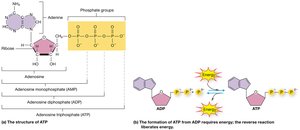
Table: Overview of Major Organic Compounds
Type | Monomer | Polymer | Function | Example |
|---|---|---|---|---|
Carbohydrates | Monosaccharide | Polysaccharide | Energy, structure | Glucose, glycogen |
Lipids | Fatty acid | Triglyceride, phospholipid | Energy storage, membrane | Triglyceride, cholesterol |
Proteins | Amino acid | Polypeptide | Enzymes, structure | Hemoglobin, collagen |
Nucleic Acids | Nucleotide | DNA, RNA | Genetic information | DNA, RNA |
Sample Review Questions
Which organ system is responsible for protecting the body from disease? Lymphatic System
Which plane divides the body into superior and inferior sections? Transverse Plane
Name the body cavity shown in the diagram. Cranial Cavity and Thoracic Cavity (see image_1)
