 뒤로
뒤로Atoms, Ions, and Molecules: Foundations of Anatomy & Physiology
스터디 가이드 - 스마트 노트
 자료에 맞춘 맞춤형 노트, 핵심 정의, 예시, 맥락을 확장해 제공합니다.
Atoms, Ions, and Molecules
Matter, Atoms, Elements, and the Periodic Table
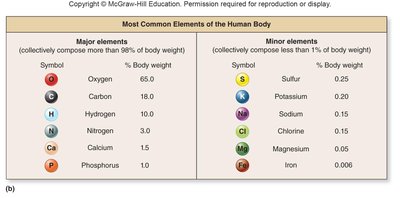
Matter is anything that has mass and occupies space, existing in three forms: solid, liquid, and gas. Atoms are the smallest units of elements that retain their chemical properties. Elements are pure substances that cannot be broken down by ordinary chemical means. Of the 92 naturally occurring elements, about 25 are essential for life, with a few making up the majority of the human body's mass.
Major elements: Oxygen, Carbon, Hydrogen, Nitrogen, Calcium, Phosphorus
Minor elements: Sulfur, Potassium, Sodium, Chlorine, Magnesium, Iron
Components of an Atom
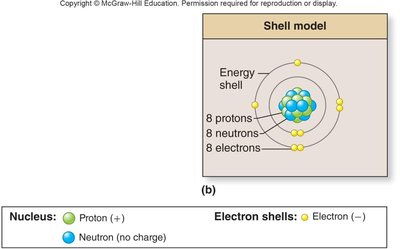
Atoms are composed of three subatomic particles:
Neutrons: Mass of 1 amu, no charge
Protons: Mass of 1 amu, positive charge (+1)
Electrons: Negligible mass, negative charge (-1), located in orbitals around the nucleus
Electrons occupy energy shells around the nucleus, with the innermost shell holding up to 2 electrons and the second shell up to 8 electrons.
The Periodic Table and Isotopes
Each element is represented by a chemical symbol, atomic number (number of protons), and average atomic mass (protons + neutrons). Isotopes are atoms of the same element with different numbers of neutrons, resulting in different atomic masses but identical chemical properties. Radioisotopes are unstable isotopes with excess neutrons.
Chemical Stability and the Octet Rule
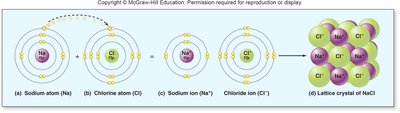
Atoms tend to gain, lose, or share electrons to achieve a full outer shell of 8 electrons (octet rule). This drive for stability leads to the formation of ions and chemical bonds.
Ions and Ionic Bonds
Ions are charged atoms formed by the loss or gain of electrons:
Cations: Positively charged (loss of electrons)
Anions: Negatively charged (gain of electrons)
Ionic bonds form between cations and anions due to electrostatic attraction, resulting in compounds like sodium chloride (NaCl).
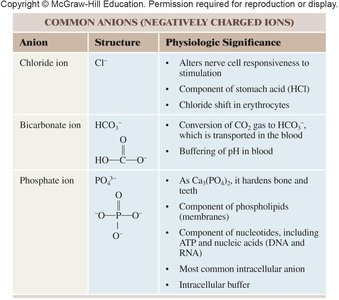
Common Anions in Physiology
Anion | Structure | Physiologic Significance |
|---|---|---|
Chloride ion | Cl- | Alters nerve cell responsiveness, component of stomach acid (HCl), chloride shift in erythrocytes |
Bicarbonate ion | HCO3- | CO2 transport, buffering of blood pH |
Phosphate ion | PO43- | Hardens bone/teeth, component of phospholipids, nucleotides, intracellular buffer |
Covalent Bonds, Molecules, and Isomers
Covalent bonds involve the sharing of electrons between atoms. Molecules are groups of atoms held together by covalent bonds, while compounds contain atoms of different elements. Isomers are molecules with the same molecular formula but different structural arrangements, leading to different properties (e.g., glucose, galactose, fructose).
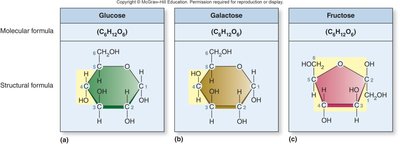
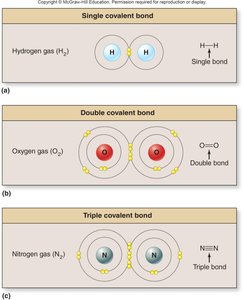
Types of Covalent Bonds
Single bond: One pair of electrons shared (e.g., H2)
Double bond: Two pairs shared (e.g., O2)
Triple bond: Three pairs shared (e.g., N2)
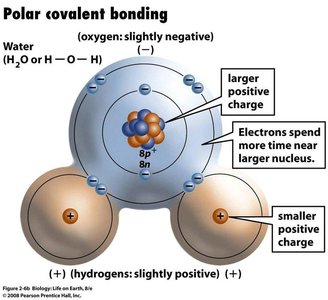
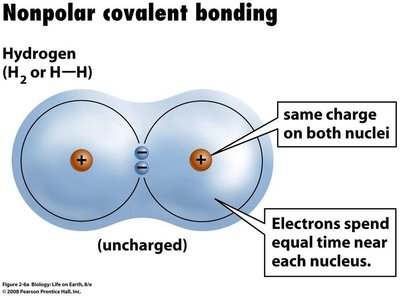
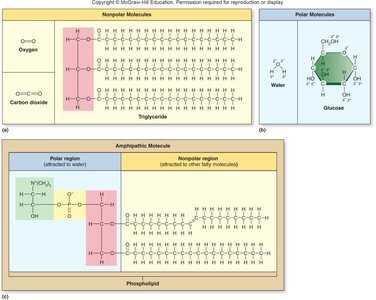
Polar and Nonpolar Covalent Bonds
Nonpolar covalent bond: Electrons shared equally (e.g., H2)
Polar covalent bond: Electrons shared unequally, creating partial charges (e.g., H2O)
Amphipathic Molecules
Amphipathic molecules contain both polar and nonpolar regions, such as phospholipids, which are essential for cell membrane structure.
Intermolecular Attractions: Hydrogen Bonds
Hydrogen bonds are weak attractions between a partially positive hydrogen atom and a partially negative atom (often oxygen or nitrogen). These bonds are crucial for the properties of water and the structure of biological molecules.
Properties and Functions of Water
Water is a polar molecule, making up about two-thirds of body weight. It can exist as a gas, liquid, or solid, and its hydrogen bonding gives rise to unique properties:
Cohesion: Attraction between water molecules
Surface tension: Inward pull at the surface of water
Adhesion: Attraction between water and other substances
High specific heat and heat of vaporization: Helps regulate body temperature
Water as the Universal Solvent
Water dissolves many substances due to its polarity:
Hydrophilic: Polar molecules and ions dissolve easily
Hydrophobic: Nonpolar molecules do not dissolve
Amphipathic: Molecules with both polar and nonpolar regions partially dissolve
Acids, Bases, and pH
Acids release H+ ions in solution (proton donors), while bases accept H+ (proton acceptors). The pH scale (0–14) measures the concentration of H+ ions:
pH 7: Neutral
pH < 7: Acidic
pH > 7: Basic (alkaline)
Buffers help maintain pH by accepting or donating H+ as needed.
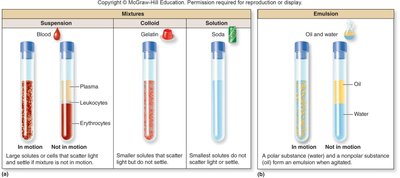
Mixtures and Emulsions
Mixtures are combinations of substances not chemically bonded:
Suspension: Large particles, settle out (e.g., blood)
Colloid: Medium particles, do not settle (e.g., gelatin)
Solution: Small particles, do not settle (e.g., soda)
Emulsion: Mixture of water and nonpolar liquid (e.g., oil and water)
Biological Macromolecules
Organic molecules contain carbon and are essential for life. The four major classes are:
Lipids
Carbohydrates
Nucleic acids
Proteins
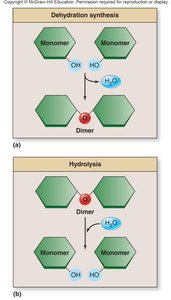
Macromolecules are often polymers, built from repeating monomers via dehydration synthesis and broken down by hydrolysis.
Lipids
Lipids are hydrophobic molecules used for energy storage, membrane structure, and signaling. Major types include:
Triglycerides: Energy storage, insulation
Phospholipids: Main component of cell membranes
Steroids: Hormones, membrane components
Eicosanoids: Local signaling molecules
Carbohydrates
Carbohydrates are composed of carbon, hydrogen, and oxygen. They serve as energy sources and structural components. Types include:
Monosaccharides: Simple sugars (e.g., glucose)
Disaccharides: Two monosaccharides (e.g., sucrose)
Polysaccharides: Many monosaccharides (e.g., glycogen)
Nucleic Acids
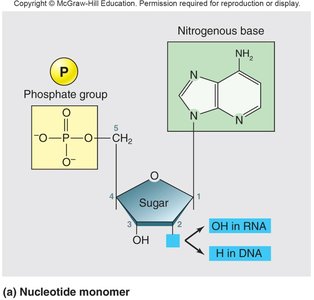
Nucleic acids store and transfer genetic information. They are polymers of nucleotide monomers, each consisting of a sugar, phosphate group, and nitrogenous base. DNA and RNA are the two main types.
Proteins
Proteins are polymers of amino acids and perform a wide range of functions, including catalysis, transport, support, movement, regulation, and storage. Protein structure is organized into four levels:
Primary: Amino acid sequence
Secondary: Alpha helices and beta sheets
Tertiary: 3D folding
Quaternary: Multiple polypeptide chains
Protein function depends on its conformation, which can be disrupted by denaturation (e.g., changes in temperature or pH).
