 뒤로
뒤로Atoms, Molecules, and Bonds: Foundations of Chemistry in Anatomy & Physiology
스터디 가이드 - 스마트 노트
 자료에 맞춘 맞춤형 노트, 핵심 정의, 예시, 맥락을 확장해 제공합니다.
Atoms, Molecules, and Bonds
Introduction to Chemistry in Anatomy & Physiology
Chemistry is fundamental to understanding physiological processes in the human body. All biological functions, from muscle contraction to nerve signaling, are based on chemical interactions. This section introduces the basic chemical principles essential for Anatomy & Physiology students.
2.1 Matter and Energy
Matter: Definition and States
Matter is anything that has mass and occupies space. It can be seen, smelled, and/or felt.
States of matter include:
Solid: Definite shape and volume.
Liquid: Changeable shape, definite volume.
Gas: Changeable shape and volume.
Energy: Forms and Properties
Energy is the capacity to do work or put matter into motion.
Energy exists in two main forms:
Kinetic energy: Energy in action.
Potential energy: Stored (inactive) energy.
Energy can be transformed from potential to kinetic energy (e.g., stored energy released as movement).
Types of Energy in Biological Systems
Chemical energy: Stored in bonds of chemical substances.
Electrical energy: Results from movement of charged particles.
Mechanical energy: Directly involved in moving matter.
Radiant (electromagnetic) energy: Travels in waves (e.g., heat, visible light, ultraviolet light, X-rays).
Energy Conversion
Energy may be converted from one form to another (e.g., electrical energy to light energy in a lamp).
Energy conversion is inefficient; some energy is always lost as heat.
2.2 Atoms and Elements
Elements: The Building Blocks of Matter
Elements are substances that cannot be broken down into simpler substances by ordinary chemical methods.
Four elements make up 96% of the human body: Oxygen (O), Carbon (C), Hydrogen (H), and Nitrogen (N).
The periodic table lists all known elements (currently 118, with 92 occurring naturally).

Major, Lesser, and Trace Elements in the Human Body
The human body is composed of major, lesser, and trace elements, each with specific biological functions.
Element | Symbol | Approx. % Body Mass | Functions |
|---|---|---|---|
Oxygen | O | 65.0 | Component of organic/inorganic molecules; needed for ATP production |
Carbon | C | 18.5 | Component of all organic molecules |
Hydrogen | H | 9.5 | Component of organic molecules; influences pH |
Nitrogen | N | 3.3 | Component of proteins and nucleic acids |
Calcium | Ca | 1.5 | Bone/teeth structure; muscle contraction; nerve impulses; blood clotting |
Phosphorus | P | 1.0 | Bones/teeth; nucleic acids; ATP; phospholipids |
Potassium | K | 0.4 | Major cation in cells; nerve impulses; muscle contraction |
Sulfur | S | 0.3 | Component of proteins |
Sodium | Na | 0.2 | Major cation in extracellular fluids; water balance; nerve impulses |
Chlorine | Cl | 0.2 | Major anion in extracellular fluids |
Magnesium | Mg | 0.1 | Bone; metabolic reactions |
Iodine | I | <0.01 | Thyroid hormone production |
Iron | Fe | <0.01 | Hemoglobin; enzymes |
Additional info: Trace elements such as zinc, copper, and selenium are required in minute amounts and are often enzyme cofactors.
Atoms: Structure and Subatomic Particles
Atoms are the smallest units of an element that retain its properties.
Composed of three subatomic particles:
Protons (p+): Positive charge, 1 atomic mass unit (amu), located in nucleus.
Neutrons (n0): No charge, 1 amu, located in nucleus.
Electrons (e-): Negative charge, negligible mass, orbit nucleus.
Particle | Charge | Mass (amu) | Located in Nucleus? |
|---|---|---|---|
Proton | +1 | 1 | Yes |
Neutron | 0 | 1 | Yes |
Electron | -1 | ~0 | No |
Atomic Models
Planetary model: Electrons depicted in fixed orbits around nucleus (outdated).
Orbital model: Electrons occupy regions of probability (electron cloud) around nucleus (current model).

Electron Distribution and Chemical Properties
Chemical behavior depends on the number of electrons in the outermost shell (valence shell).
Atoms with unpaired electrons in the valence shell are more reactive.

Identifying Elements: Atomic Number, Mass Number, and Isotopes
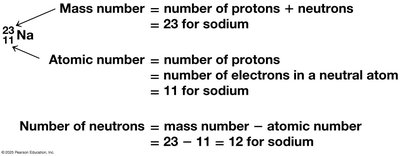
Atomic number: Number of protons in the nucleus (also equals number of electrons in a neutral atom).
Mass number: Total number of protons and neutrons in the nucleus.
Isotopes: Atoms of the same element with different numbers of neutrons (same atomic number, different mass number).

Radioisotopes and Their Uses
Radioisotopes are unstable isotopes that decay, emitting energy (radioactivity).
Used in biological research and medicine (e.g., PET scans for cancer detection).
Radioactivity can damage living tissue but is also used therapeutically to destroy cancer cells.

2.3 Combining Matter: Molecules and Compounds
Molecules and Compounds
Molecule: Two or more atoms bonded together (can be the same or different elements).
Compound: A molecule containing two or more different kinds of atoms (e.g., H2O, NaCl).
Molecules with only one type of atom are not compounds (e.g., O2).

Example: Sodium (Na, a reactive metal) and chlorine (Cl, a poisonous gas) combine to form sodium chloride (NaCl, table salt), which is safe and essential for life.
Concept Check
Review and answer questions related to atomic structure, elements, and chemical bonds to reinforce your understanding of these foundational concepts.
