 뒤로
뒤로Autonomic Nervous System: Structure, Function, and Comparison with Somatic Nervous System
스터디 가이드 - 스마트 노트
 자료에 맞춘 맞춤형 노트, 핵심 정의, 예시, 맥락을 확장해 제공합니다.
Autonomic Nervous System (ANS) Overview
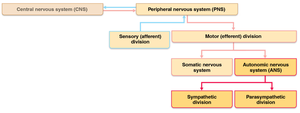
Organization of the Human Nervous System
The human nervous system is divided into the central nervous system (CNS) and the peripheral nervous system (PNS). The PNS is further subdivided into sensory (afferent) and motor (efferent) divisions. The motor division includes the somatic nervous system (SNS) and the autonomic nervous system (ANS), which itself is split into sympathetic and parasympathetic divisions.
CNS: Composed of the brain and spinal cord.
PNS: Includes all neural structures outside the CNS.
Motor Division: Controls effector organs via SNS and ANS.
Somatic vs. Autonomic Nervous System
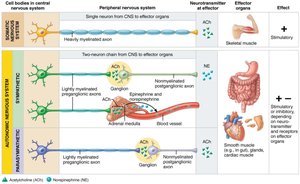
The somatic and autonomic nervous systems are both part of the motor division of the PNS, but they differ in their effectors, neural pathways, neurotransmitters, and actions.
Somatic Nervous System (SNS): Controls voluntary movements via skeletal muscle.
Autonomic Nervous System (ANS): Regulates involuntary functions in smooth muscle, cardiac muscle, and glands.
Comparison Table
Feature | SNS | ANS |
|---|---|---|
Effectors | Skeletal muscle | Smooth muscle, cardiac muscle, glands |
Neural Pathway | Single neuron chain | Two neuron chain (preganglionic & postganglionic) |
Neurotransmitters | Acetylcholine (ACh) | Acetylcholine (ACh), Norepinephrine (NE) |
Actions | Stimulatory | Stimulatory or inhibitory |
Autonomic Nervous System: Divisions and Functions
Parasympathetic Division
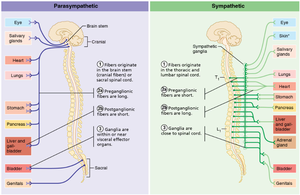
The parasympathetic division is responsible for maintenance functions, conserving energy, and promoting 'rest and digest' activities. It slows the heart rate, lowers blood pressure, and stimulates digestive processes.
Origin: Cranial nerves and sacral spinal cord (S2 & S4).
Ganglia Location: Close to or within effector organs.
Fiber Lengths: Long preganglionic, short postganglionic fibers.
Neurotransmitter: Acetylcholine (ACh).
Sympathetic Division
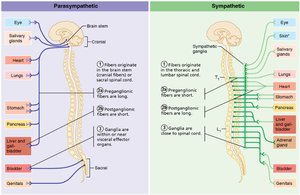
The sympathetic division prepares the body for activity, increasing heart rate, blood pressure, and dilating airways. It is associated with 'fight or flight' responses.
Origin: Thoracic and lumbar spinal cord (T1-L2).
Ganglia Location: Far from effector organs, often in paravertebral ganglia beside the spinal column.
Fiber Lengths: Short preganglionic, long postganglionic fibers.
Neurotransmitters: Acetylcholine (ACh) and Norepinephrine (NE).
Adrenal Medulla: The sympathetic system can also stimulate the adrenal medulla to release epinephrine and norepinephrine into the bloodstream.
Neural Pathways and Ganglia
Ganglia and Neuron Chains
In the ANS, neural pathways consist of two neurons: a preganglionic neuron (originating in the CNS) and a postganglionic neuron (located in a ganglion). Ganglia are clusters of neuronal cell bodies outside the CNS.
Preganglionic Neuron: Originates in CNS, synapses in ganglion.
Postganglionic Neuron: Originates in ganglion, innervates effector organ.
Ganglia: Parasympathetic ganglia are near or within effector organs; sympathetic ganglia are near the spinal cord.
Functional Roles and Neurotransmitters
Neurotransmitters in the ANS
Neurotransmitters are chemical messengers released by neurons to communicate with other cells. The main neurotransmitters in the ANS are acetylcholine (ACh) and norepinephrine (NE).
Acetylcholine (ACh): Used by all preganglionic neurons and parasympathetic postganglionic neurons.
Norepinephrine (NE): Used by most sympathetic postganglionic neurons.
Actions: Can be stimulatory or inhibitory depending on the receptor type in the effector organ.
Summary Table: Sympathetic vs. Parasympathetic
Feature | Sympathetic | Parasympathetic |
|---|---|---|
Site of Origin | T1-L2 (thoracolumbar) | Cranial, S2-S4 (craniosacral) |
Preganglionic Fiber Length | Short | Long |
Postganglionic Fiber Length | Long | Short |
Ganglia Location | Near spinal cord | Near/in effector organ |
Functional Role | Fight or flight | Rest and digest |
Key Definitions and Concepts
Ganglion: A cluster of neuronal cell bodies in the PNS.
Effector Organ: The target tissue or organ that responds to neural stimulation.
Preganglionic Neuron: The first neuron in the two-neuron chain of the ANS.
Postganglionic Neuron: The second neuron in the chain, which innervates the effector.
Example Application
During exercise, the sympathetic nervous system increases heart rate and dilates airways to supply more oxygen to muscles. After eating, the parasympathetic nervous system stimulates digestion and slows the heart rate.
Additional info:
Some content was inferred from standard Anatomy & Physiology textbooks to ensure completeness and clarity.
