 뒤로
뒤로Blood Transfusions and Human Blood Groups
스터디 가이드 - 스마트 노트
 자료에 맞춘 맞춤형 노트, 핵심 정의, 예시, 맥락을 확장해 제공합니다.
Blood Transfusions and Human Blood Groups
Blood Loss and Transfusion Needs
Blood transfusions are critical medical procedures used to restore blood volume and oxygen-carrying capacity in patients who have experienced significant blood loss. The body can compensate for only a limited amount of blood loss before severe physiological consequences occur.
15–30% blood loss: Causes pallor (paleness) and weakness due to reduced oxygen delivery to tissues.
More than 30% blood loss: Results in potentially fatal severe shock, requiring immediate intervention.
Restoring Blood Volume
When blood volume is lost, it can be restored using intravenous fluids or blood products:
Volume Replacement: Normal saline or multiple-electrolyte solutions (such as Ringer’s solution) are used to restore circulating volume.
Oxygen-Carrying Capacity: Packed red blood cells (PRBCs) are transfused to restore the blood’s ability to carry oxygen.
Blood Banks: Blood is stored and matched for compatibility before transfusion to prevent adverse reactions.
Human Blood Groups
Blood Group Antigens and Antibodies
Red blood cell (RBC) membranes contain glycoproteins that act as antigens (also called agglutinogens). These antigens are recognized as foreign by the immune system if they are not naturally present in the recipient’s body, potentially triggering an immune response.
Antigen: Any substance perceived as foreign that can generate an immune response.
Agglutinogens: Antigens on RBCs that promote agglutination (clumping) when incompatible blood types are mixed.
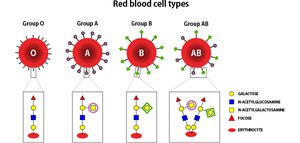
ABO Blood Groups
The ABO blood group system is based on the presence or absence of two agglutinogens (A and B) on the surface of RBCs. The four main blood types are:
Type A: Has only A agglutinogen on RBCs; plasma contains anti-B antibodies.
Type B: Has only B agglutinogen on RBCs; plasma contains anti-A antibodies.
Type AB: Has both A and B agglutinogens; plasma contains no anti-A or anti-B antibodies (universal recipient).
Type O: Has neither A nor B agglutinogens; plasma contains both anti-A and anti-B antibodies (universal donor).
Antibodies (agglutinins) against A or B antigens form in the blood at about 2 months of age and reach adult levels by 8–10 years of age.
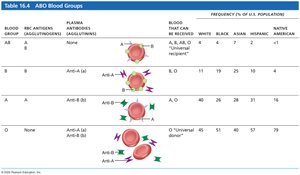
Table: ABO Blood Groups
Blood Group | RBC Antigens (Agglutinogens) | Plasma Antibodies (Agglutinins) | Blood That Can Be Received | Frequency (%) in U.S. Populations |
|---|---|---|---|---|
AB | A, B | None | AB, A, B, O (Universal recipient) | White: 4, Black: 4, Asian: 7, Hispanic: 2, Native American: 1 |
B | B | Anti-A | B, O | White: 11, Black: 19, Asian: 25, Hispanic: 10, Native American: 4 |
A | A | Anti-B | A, O | White: 41, Black: 26, Asian: 28, Hispanic: 31, Native American: 16 |
O | None | Anti-A, Anti-B | O (Universal donor) | White: 45, Black: 51, Asian: 40, Hispanic: 57, Native American: 79 |
Rh Factors
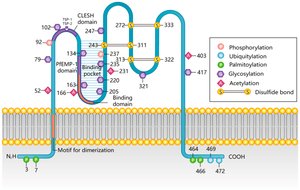
The Rh blood group system is based on the presence or absence of the Rh antigen (also called the D antigen) on RBCs. Individuals are classified as Rh-positive (Rh+) if they have the antigen, or Rh-negative (Rh−) if they do not. The Rh factor is important in transfusions and in pregnancy, as incompatibility can lead to hemolytic disease of the newborn.
Transfusion Reactions
If mismatched blood is transfused, the recipient’s plasma antibodies attack the donor’s RBCs, causing them to agglutinate (clump) and rupture. This can lead to serious complications:
Decreased oxygen-carrying capacity due to destruction of RBCs.
Decreased blood flow beyond blocked vessels caused by clumped cells.
Hemoglobin release into the bloodstream, which can accumulate in kidney tubules and cause renal failure.
Blood Typing and Cross Matching
Blood typing is performed by mixing a blood sample with antibodies against A and B antigens. If agglutination occurs, the corresponding antigen is present. Blood is typed for both ABO and Rh factors. Cross matching involves mixing the recipient’s serum with donor RBCs and vice versa to ensure compatibility before transfusion.
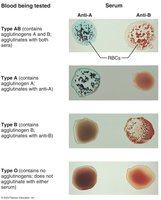
Example: If a person’s blood agglutinates with anti-A serum but not with anti-B serum, the blood type is A.
Additional info: Proper blood typing and cross matching are essential to prevent transfusion reactions and ensure patient safety during blood transfusions.
