 뒤로
뒤로Cell Biology and Membrane Transport: Structured Study Notes for Anatomy & Physiology
스터디 가이드 - 스마트 노트
 자료에 맞춘 맞춤형 노트, 핵심 정의, 예시, 맥락을 확장해 제공합니다.
Cell Biology: Chemical and Cellular Foundations
Chemical Level of Organization
The chemical level forms the basis of all biological structures and functions. Atoms are the basic units of matter, consisting of protons (positive charge), neutrons (neutral charge), and electrons (negative charge). Atoms combine to form molecules via chemical bonds:
Ionic bonds: Form between oppositely charged ions.
Covalent bonds: Form when atoms share electrons.
Types of Chemical Reactions
Cells control chemical reactions to maintain life. Metabolism is the sum of all chemical reactions in a cell/system, including:
Decomposition: Breakdown from larger to smaller molecules.
Synthesis: Production of larger molecules from smaller ones.
Redox (reduction-oxidation) reactions: Involve transfer of electrons from one molecule to another.
Energy and ATP
All living organisms require energy. Energy exists as:
Potential energy: Stored energy.
Kinetic energy: Energy of motion.
ATP (Adenosine Triphosphate) is the cell’s energy currency, used for energy-requiring cellular processes.
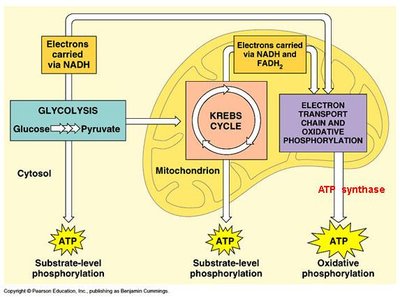
Cellular Respiration
Cellular respiration is a multistep metabolic pathway where organic molecules (e.g., glucose) are broken down by enzymes to form ATP. The net chemical reaction is:
Occurs in four stages: Glycolysis, Preparatory Reaction, Citric Acid/Krebs Cycle, Electron Transport Chain.
Organic Macromolecules
Categories and Functions
Carbohydrates: Used primarily for energy; range from monosaccharides to polysaccharides.
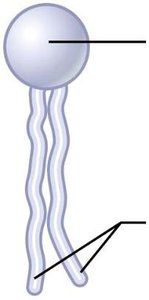
Lipids: Functions include energy storage, membrane structure, and signaling. Examples: phospholipids, triglycerides, steroids.
Proteins: Formed from amino acids; classified as structural or functional; structure dictates function.
Nucleic Acids: Includes DNA and RNA; built from nucleotides (sugar, phosphate, nitrogenous base).
Cell Anatomy and Plasma Membrane
Introduction to Cells
The cell is the basic functional unit of the body. Most cells have three common components: plasma membrane, cytoplasm (with organelles), and nucleus.
Plasma Membrane Structure and Function
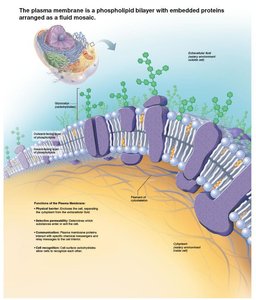
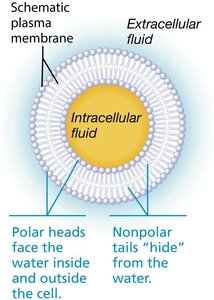
The plasma membrane (PM) acts as a physical barrier, provides selective permeability, establishes electrochemical gradients, and enables communication. It consists of lipids, proteins, and carbohydrates.
Membrane Transport
Passive vs. Active Transport
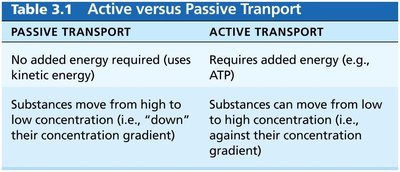
Membrane transport is essential for cellular homeostasis. Passive transport does not require energy, while active transport requires ATP.
Passive Transport | Active Transport |
|---|---|
No added energy required (uses kinetic energy) | Requires added energy (e.g., ATP) |
Substances move from high to low concentration (down their concentration gradient) | Substances can move from low to high concentration (against their concentration gradient) |
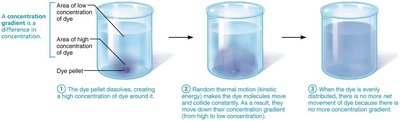
Passive Processes: Diffusion
Diffusion is the movement of molecules from high to low concentration due to random thermal motion.
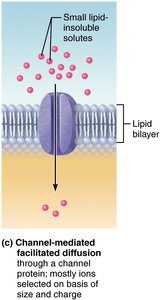
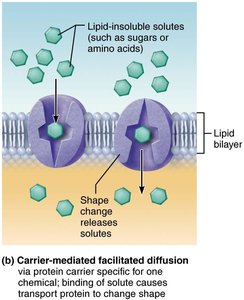
Facilitated Diffusion
Facilitated diffusion involves movement of ions or polar molecules down their concentration gradient with the assistance of channel or carrier proteins.
Osmosis
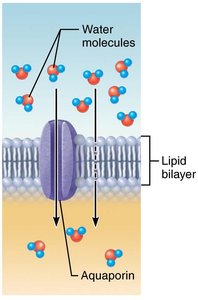
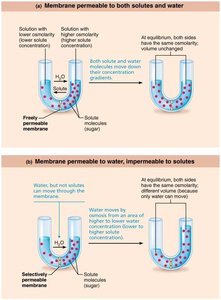
Osmosis is the movement of water through aquaporins in a selectively permeable membrane, in response to concentration changes.
Tonicity
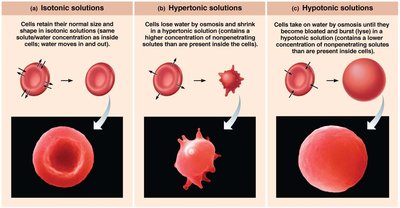
Tonicity describes the capability of a solution to modify the volume of a cell by altering its water content. Cellular responses:
Isotonic solution: No net change in cell volume.
Hypotonic solution: Cell swells as water enters.
Hypertonic solution: Cell shrinks as water leaves.
Summary of Passive Membrane Transport
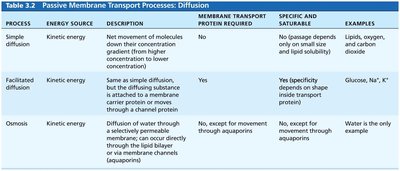
Process | Energy Source | Description | Membrane Transport Protein Required | Specific and Saturable | Examples |
|---|---|---|---|---|---|
Simple diffusion | Kinetic energy | Movement of molecules down concentration gradient | No | No | Lipids, oxygen, carbon dioxide |
Facilitated diffusion | Kinetic energy | Movement via carrier or channel protein | Yes | Yes | Glucose, Na+, K+ |
Osmosis | Kinetic energy | Movement of water through aquaporins | No (except aquaporins) | No (except aquaporins) | Water |
Active Processes
Active processes require energy/ATP and involve movement of solutes against their concentration gradient or movement of large substances. Examples include primary active transport and vesicular transport.
Primary Active Transport
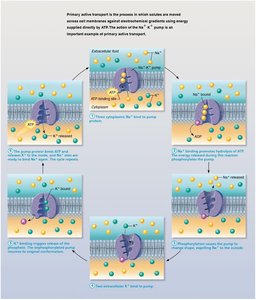
Uses protein pumps and energy from ATP to move solutes against their concentration gradient. Example: Sodium-potassium pumps.
Primary vs. Secondary Active Transport
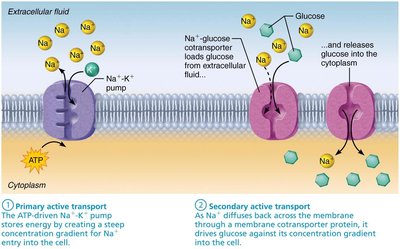
Primary active transport directly uses ATP, while secondary active transport uses energy stored in gradients created by primary transport.
Vesicular Transport
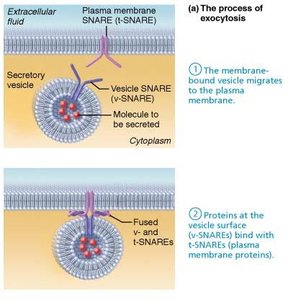
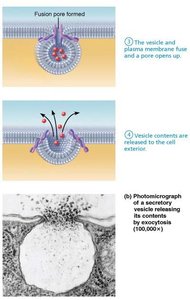
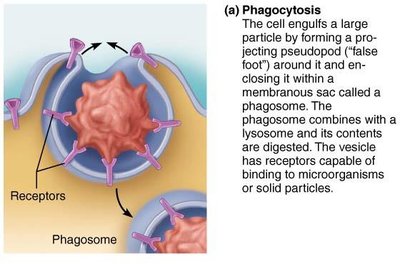
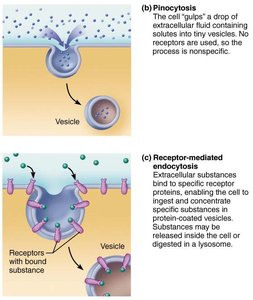
Bulk transport moves large materials in membrane-bound sacs (vesicles). Exocytosis moves materials out of the cell; endocytosis moves materials into the cell (phagocytosis for solids, pinocytosis for liquids).
Resting Membrane Potential
Establishment and Maintenance
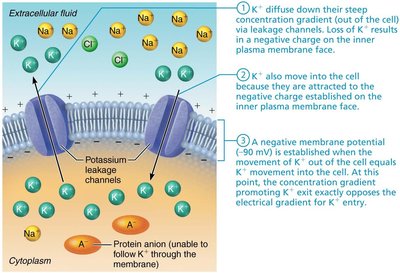
Cells have an electrical charge difference across the plasma membrane, known as resting membrane potential (RMP). RMP is established by differences in ion concentrations and voltage across the membrane.
Cytoplasmic Organelles
Membrane-bound and Non-membrane-bound Organelles
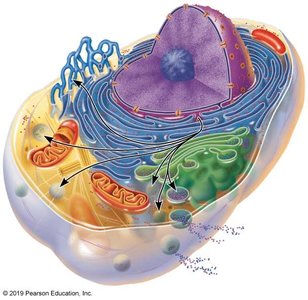
Organelles perform specialized functions within the cell:
Rough ER: Protein production and folding.
Smooth ER: Lipid synthesis and metabolism.
Golgi apparatus: Sorts, modifies, and packages proteins.
Lysosomes: Breakdown of wastes.
Mitochondria: Aerobic cellular respiration.
Ribosomes: Protein production (translation).
Cytoskeleton: Cell structure and movement.
Proteasomes: Degrade unneeded or damaged proteins.
Centrioles: Role in cell division.
External Cell Structures
Surface Extensions
Cilia: Hair-like projections that move substances along the cell surface.
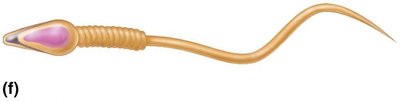
Flagella: Whip-like tail that propels the cell forward (e.g., sperm).
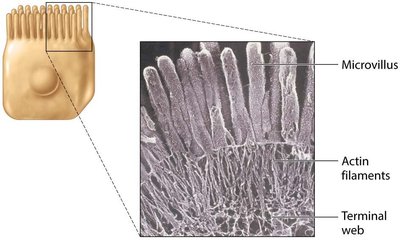
Microvilli: Densely packed extensions that increase surface area for absorption.
The Nucleus and DNA
Nucleus Structure and Function
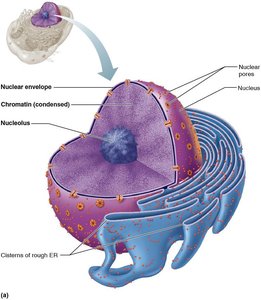
The nucleus is the largest structure in a cell, enclosed by a double phospholipid membrane (nuclear envelope), and contains the nucleolus (site of ribosome production) and genetic material.
DNA Organization
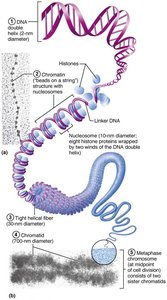
DNA is double-stranded and composed of nucleotides. It exists as chromatin in non-dividing cells and chromosomes in dividing cells. DNA is organized into genes, which provide instructions for protein synthesis.
Protein Synthesis
Transcription and Translation
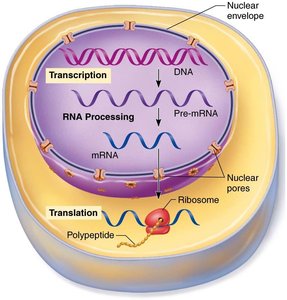
Protein synthesis is directed by DNA and carried out by ribosomes in the cytoplasm. It involves two major phases:
Transcription: Occurs in the nucleus; DNA is "unzipped" and a copy of a gene (mRNA) is produced by RNA polymerase.
Translation: mRNA enters the cytoplasm and binds to a ribosome; tRNA adds appropriate amino acids to assemble the protein.
The Cell Cycle
Phases and Importance
The cell cycle is the time from the formation of a cell until it divides. Somatic cells undergo several steps to produce two genetically identical daughter cells. Two major phases:
Interphase: Lasts ~23 hours; cell prepares for division (G1, S, G2 phases).
Mitotic phase: Lasts ~1 hour; includes mitosis (nuclear division) and cytokinesis (cytoplasmic division).
Mitosis
Mitosis occurs in somatic cells and includes four sub-phases:
Prophase: Chromatin condenses into chromosomes; nucleolus breaks down; spindle fibers grow.
Metaphase: Chromosomes align in the center; spindle fibers attach at centromeres.
Anaphase: Spindle fibers move sister chromatids toward poles.
Telophase: Chromosomes arrive at poles, uncoil, new nucleolus forms, mitotic spindles break down, new nuclear envelopes form.
Cytokinesis
Cytokinesis is the division of cytoplasm resulting in two newly formed cells, often overlapping with anaphase and telophase.
Summary: Cell Cycle
Additional info:
These notes expand on brief points with academic context, definitions, and examples for self-contained study.
Tables and images are included only when directly relevant to the explanation.
