 뒤로
뒤로Cells and Biomolecules: Foundations of Anatomy & Physiology
스터디 가이드 - 스마트 노트
 자료에 맞춘 맞춤형 노트, 핵심 정의, 예시, 맥락을 확장해 제공합니다.
Cells: The Living Units
Overview of the Cell
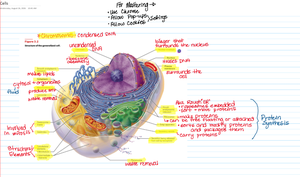
The cell is the basic structural and functional unit of all living organisms. Each cell contains specialized structures called organelles that perform distinct functions necessary for life.
Nucleus: Contains genetic material (DNA) and controls cellular activities.
Mitochondria: Site of ATP (energy) production; known as the "powerhouse" of the cell.
Ribosomes: Responsible for protein synthesis.
Endoplasmic Reticulum (ER): Rough ER is studded with ribosomes and synthesizes proteins; Smooth ER synthesizes lipids and detoxifies chemicals.
Golgi Apparatus: Modifies, sorts, and packages proteins and lipids for secretion or use within the cell.
Lysosomes: Contain digestive enzymes to break down waste and cellular debris.
Cytoskeleton: Provides structural support and facilitates cell movement.
Plasma Membrane: Structure and Function
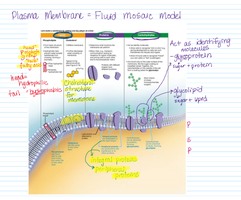
The plasma membrane, described by the Fluid Mosaic Model, is a selectively permeable barrier that surrounds the cell, controlling the movement of substances in and out.
Phospholipid Bilayer: Composed of hydrophilic (water-attracting) heads and hydrophobic (water-repelling) tails.
Proteins: Integral and peripheral proteins serve as channels, carriers, receptors, and enzymes.
Carbohydrates: Attached to proteins (glycoproteins) or lipids (glycolipids) for cell recognition.
Cholesterol: Stabilizes membrane fluidity.
Membrane Transport Mechanisms
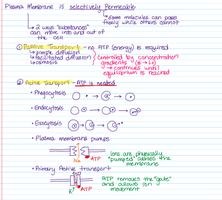
The plasma membrane is selectively permeable, allowing some molecules to pass while restricting others. Transport can be passive or active:
Passive Transport: No energy required. Includes diffusion, facilitated diffusion, and osmosis.
Active Transport: Requires ATP. Includes primary and secondary active transport, endocytosis, and exocytosis.
Primary Active Transport: Direct use of ATP (e.g., Na+/K+ pump).
Secondary Active Transport: Uses energy from ion gradients created by primary active transport.
Cell Junctions
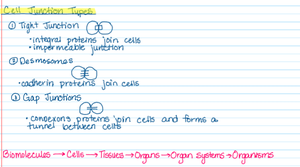
Cells are connected by specialized junctions that facilitate communication and maintain tissue integrity.
Tight Junctions: Integral proteins join cells to form impermeable barriers.
Desmosomes: Cadherin proteins anchor cells together, providing mechanical strength.
Gap Junctions: Connexon proteins form channels allowing direct communication between cells.
Chemistry Comes Alive: Biomolecules
Basic Biochemistry
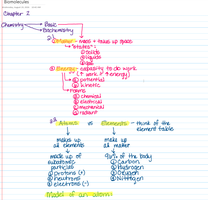
Biochemistry is the study of the chemical composition and reactions of living matter. Understanding atoms, elements, and energy is foundational to the study of biomolecules.
Matter: Anything that has mass and occupies space. Exists as solids, liquids, or gases.
Energy: The capacity to do work. Forms include kinetic, potential, chemical, electrical, and radiant energy.
Atoms: Smallest units of elements, composed of protons, neutrons, and electrons.
Elements: Pure substances consisting of one type of atom. Four elements (C, H, O, N) make up most of the human body.
Atomic Structure and Chemical Bonds
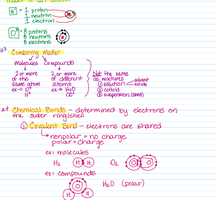
Atoms combine to form molecules and compounds through chemical bonds, which are determined by the electrons in the outer shell.
Covalent Bonds: Electrons are shared between atoms. Can be nonpolar (equal sharing) or polar (unequal sharing).
Ionic Bonds: Electrons are transferred from one atom to another, creating charged ions.
Hydrogen Bonds: Weak attractions between polar molecules, important in water and biological molecules.
Inorganic Compounds
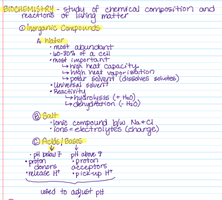
Inorganic compounds are essential for life and include water, salts, and acids/bases.
Water: Most abundant and important inorganic compound; excellent solvent, high heat capacity, and involved in chemical reactions (hydrolysis and dehydration).
Salts: Ionic compounds that dissociate in water to form electrolytes.
Acids and Bases: Acids release H+; bases accept H+. pH measures hydrogen ion concentration.
Organic Compounds
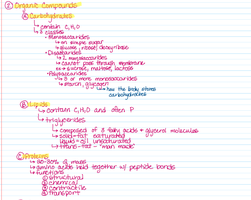
Organic compounds contain carbon and are the building blocks of life. The four major classes are carbohydrates, lipids, proteins, and nucleic acids.
Carbohydrates: Contain C, H, O. Include monosaccharides (glucose), disaccharides (sucrose), and polysaccharides (glycogen, starch).
Lipids: Contain C, H, O (and sometimes P). Include triglycerides (fats and oils), phospholipids, and steroids.
Proteins: Composed of amino acids linked by peptide bonds. Serve structural, enzymatic, and transport functions.
Summary Table: Major Biomolecules
The following table summarizes the main classes of biomolecules, their elements, and functions:
Biomolecule | Elements | Examples | Main Functions |
|---|---|---|---|
Carbohydrates | C, H, O | Glucose, Glycogen | Energy source, structural support |
Lipids | C, H, O (P) | Triglycerides, Phospholipids | Energy storage, membrane structure |
Proteins | C, H, O, N (S) | Enzymes, Hemoglobin | Structure, catalysis, transport |
Nucleic Acids | C, H, O, N, P | DNA, RNA | Genetic information, protein synthesis |
Additional info: Nucleic acids (DNA and RNA) are not detailed in the provided notes but are essential for genetic information storage and transfer.
