 뒤로
뒤로Chapter 2: Basic Chemistry for Anatomy & Physiology
스터디 가이드 - 스마트 노트
 자료에 맞춘 맞춤형 노트, 핵심 정의, 예시, 맥락을 확장해 제공합니다.
Introduction to Chemistry in Anatomy & Physiology
Chemistry is fundamental to understanding physiology because all body processes depend on chemical interactions. This chapter introduces the basic concepts of chemistry as they relate to the human body, including the structure of matter, atomic structure, chemical bonds, molecules, and the importance of acids, bases, and pH in biological systems.
Composition of Matter
Elements and Atoms
All matter is composed of elements, which are substances that cannot be broken down into simpler substances by ordinary chemical means. There are about 92 naturally occurring elements, with oxygen, carbon, hydrogen, and nitrogen being the most abundant in living organisms. Elements are made up of atoms, the smallest units that retain the properties of an element.
Matter: Anything that takes up space and has mass.
Element: A pure substance consisting of one type of atom.
Atom: The smallest unit of an element, varying in size and chemical behavior.
Atomic Structure
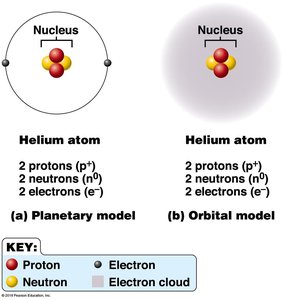
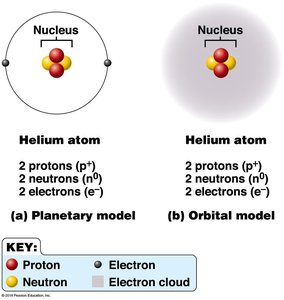
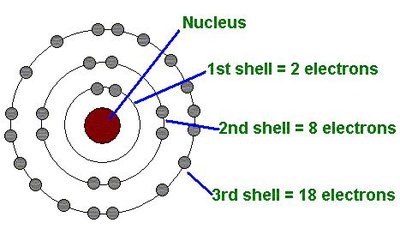
An atom consists of a central nucleus containing protons and neutrons, with electrons orbiting the nucleus in energy shells. The number of protons determines the atomic number, while the sum of protons and neutrons gives the atomic mass.
Proton (p+): Positively charged particle in the nucleus.
Neutron (n0): Neutral particle in the nucleus, similar in mass to a proton.
Electron (e-): Negatively charged particle, much smaller than protons or neutrons, found in shells around the nucleus.
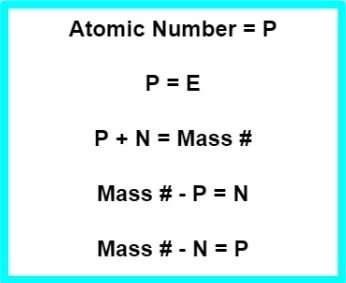
Atomic Number: Number of protons in the nucleus.
Atomic Mass: Number of protons plus neutrons.
Neutral Atom: Has equal numbers of protons and electrons.
Electron Shells
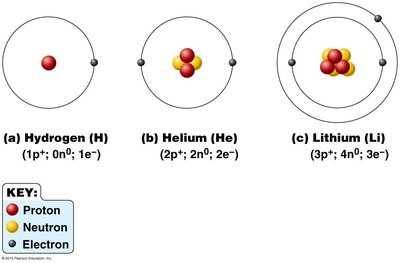
Electrons occupy energy levels or shells around the nucleus. The arrangement of electrons determines how atoms interact and bond with each other.
The first shell holds up to 2 electrons.
The second shell holds up to 8 electrons.
The third shell can hold up to 18 electrons.
Chemical Bonds and Chemical Reactions
Formation of Chemical Bonds
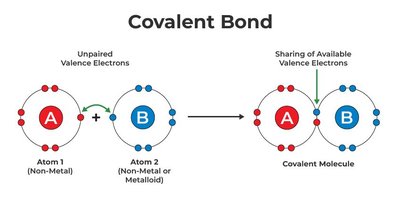
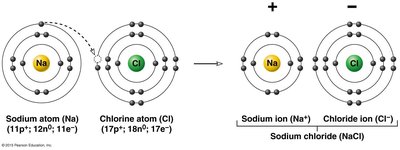
Atoms form bonds by gaining, losing, or sharing electrons to achieve stable outer shells. Atoms with incomplete outer shells are reactive and seek stability through bonding.
Ionic Bonds: Formed when atoms transfer electrons, resulting in oppositely charged ions that attract each other.
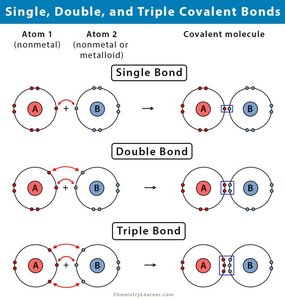
Covalent Bonds: Formed when atoms share electrons to fill their outer shells. Single, double, or triple covalent bonds involve sharing one, two, or three pairs of electrons, respectively.
Molecules and Compounds
A molecule is formed when two or more atoms combine. If the atoms are of different elements, the molecule is also called a compound. Compounds have a definite ratio and type of atoms.
Molecule: Two or more atoms bonded together.
Compound: A molecule containing atoms of different elements in a fixed ratio.
Chemical Formulas
Chemical formulas represent the types and numbers of atoms in a molecule. Structural formulas show how atoms are arranged and bonded within the molecule.
Molecular Formula: Indicates the number and type of atoms (e.g., H2O).
Structural Formula: Illustrates the arrangement of atoms and bonds.
Chemical Reactions
Chemical reactions involve the making or breaking of bonds between atoms, ions, or molecules. Reactants are substances changed by the reaction, and products are substances formed.
Synthesis Reaction: Two or more atoms/molecules combine to form a larger molecule.
Decomposition Reaction: Larger molecules are broken into smaller ones.
Exchange Reaction: Parts of molecules trade places.
Reversible Reaction: Can proceed in both directions, indicated by two arrows ().
Catalyst: Substance that speeds up the rate of a chemical reaction without being consumed.
Acids, Bases, and pH
Electrolytes, Acids, and Bases
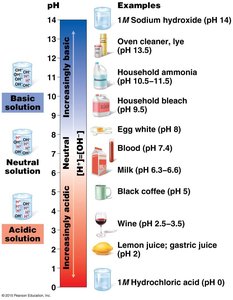
Substances that release ions in water are called electrolytes. Acids release hydrogen ions (H+), while bases release ions that combine with hydrogen ions (often OH-).
Electrolyte: Substance that dissociates into ions in water.
Acid: Releases H+ ions in solution.
Base: Releases ions that combine with H+ (often OH-).
pH Scale
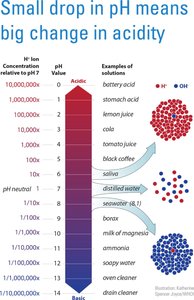
The pH scale measures the concentration of hydrogen ions in a solution. It ranges from 0 (most acidic) to 14 (most basic), with 7 being neutral. Each unit change represents a tenfold difference in H+ concentration.
pH 7: Neutral (equal H+ and OH-).
pH < 7: Acidic (more H+).
pH > 7: Basic (more OH-).
Importance of pH in Physiology
The concentration of hydrogen and hydroxyl ions in body fluids is tightly regulated because even small changes in pH can significantly affect cellular processes and enzyme activity.
Summary Table: Key Atomic Relationships
Concept | Formula |
|---|---|
Atomic Number | Number of Protons (P) |
Number of Electrons (neutral atom) | P = E |
Mass Number | P + N |
Number of Neutrons | Mass # - P = N |
Number of Protons | Mass # - N = P |
Example: Carbon-12 has 6 protons, 6 neutrons, and 6 electrons (in a neutral atom). Its atomic number is 6, and its mass number is 12.
Additional info: Understanding basic chemistry is essential for grasping more advanced topics in anatomy and physiology, such as metabolism, cellular respiration, and the function of enzymes and hormones.
