 뒤로
뒤로Chapter 2: Chemistry Comes Alive – Foundations for Anatomy & Physiology
스터디 가이드 - 스마트 노트
 자료에 맞춘 맞춤형 노트, 핵심 정의, 예시, 맥락을 확장해 제공합니다.
Matter and Energy
Definition and States of Matter
Matter is defined as anything that has mass and occupies space. It exists in three primary states: solid, liquid, and gas.
Solids: Have a definite shape and volume.
Liquids: Have a definite volume but conform to the shape of their container.
Gases: Have neither a definite shape nor volume.
Energy: Forms and Importance
Energy is the capacity to do work or put matter into motion. Unlike matter, energy does not have mass or occupy space. Life depends on the ability to transform energy from one form to another.
Kinetic Energy: Energy in action or motion.
Potential Energy: Stored (inactive) energy that can be released to do work.
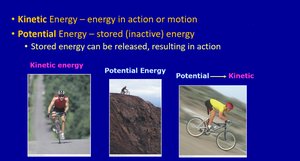
Example: A cyclist at the top of a hill has potential energy, which is converted to kinetic energy as they descend.
Chemical Energy: Stored in the bonds of chemical substances.
Electrical Energy: Results from the movement of charged particles (e.g., nerve impulses).
Mechanical Energy: Directly involved in moving matter.
Radiant/Electromagnetic Energy: Travels in waves (e.g., light, heat, X-rays).
Energy conversions are inefficient; some energy is always lost as heat, which helps maintain body temperature.
Properties of an Element
Elements and Their Biological Importance
Elements are substances that cannot be broken down into simpler substances by ordinary chemical methods. All matter is composed of elements, and the periodic table lists all known elements.
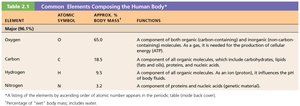
Four elements make up 96% of body weight: Carbon, Oxygen, Hydrogen, and Nitrogen.
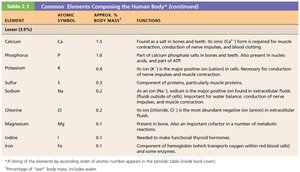
Nine elements make up 3.9% of body weight: Calcium, Phosphorus, Potassium, Sulfur, Sodium, Chlorine, Magnesium, Iodine, Iron.
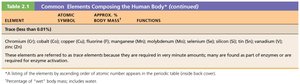
Eleven elements make up less than 0.01% (trace elements).
Element | Symbol | Approx. % Body Mass | Function |
|---|---|---|---|
Oxygen | O | 65.0 | Component of organic/inorganic molecules; needed for cellular energy (ATP) production. |
Carbon | C | 18.5 | Component of all organic molecules (carbohydrates, lipids, proteins, nucleic acids). |
Hydrogen | H | 9.5 | Component of organic molecules; as an ion, influences pH. |
Nitrogen | N | 3.2 | Component of proteins and nucleic acids. |
Element | Symbol | Approx. % Body Mass | Function |
|---|---|---|---|
Calcium | Ca | 1.5 | Found in bones/teeth; needed for muscle contraction, nerve impulses, blood clotting. |
Phosphorus | P | 1.0 | Part of bones/teeth, nucleic acids, ATP. |
Potassium | K | 0.4 | Major positive ion in cells; nerve impulse transmission, muscle contraction. |
Sulfur | S | 0.3 | Component of proteins (muscle proteins). |
Sodium | Na | 0.2 | Major positive ion in extracellular fluids; water balance, nerve impulses, muscle contraction. |
Chlorine | Cl | 0.2 | Most abundant negative ion in extracellular fluids. |
Magnesium | Mg | 0.1 | Present in bones; cofactor for enzymes. |
Iodine | I | 0.1 | Needed for thyroid hormones. |
Iron | Fe | 0.1 | Component of hemoglobin (oxygen transport in blood). |
Element | Function |
|---|---|
Trace elements (e.g., Cr, Cu, F, Mn, Mo, Se, Si, Sn, V, Zn) | Required in minute amounts; often part of enzymes or necessary for enzyme activation. |
Structure of Atoms
Subatomic Particles and Atomic Models
Atoms are the smallest units of matter that retain the properties of an element. They are composed of three subatomic particles:
Protons (p+): Positive charge, 1 atomic mass unit (amu), located in the nucleus.
Neutrons (n0): No charge, 1 amu, located in the nucleus.
Electrons (e-): Negative charge, almost no mass, located in orbitals outside the nucleus.
Atoms are electrically neutral because the number of protons equals the number of electrons.
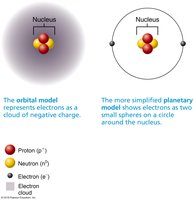
The orbital model represents electrons as a cloud of negative charge, while the planetary model shows electrons in fixed orbits.
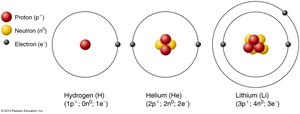
Atomic Number, Mass Number, Isotopes, and Atomic Weight
Atomic Number: Number of protons in the nucleus (also equals number of electrons in a neutral atom).
Mass Number: Total number of protons and neutrons in the nucleus.
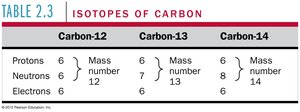
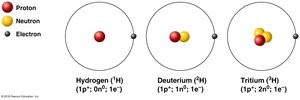
Isotopes: Atoms of the same element with different numbers of neutrons (same atomic number, different mass number).
Atomic Weight: Average of the mass numbers of all isotope forms of an atom.
Carbon-12 | Carbon-13 | Carbon-14 | |
|---|---|---|---|
Protons | 6 | 6 | 6 |
Neutrons | 6 | 7 | 8 |
Electrons | 6 | 6 | 6 |
Mass Number | 12 | 13 | 14 |
Radioisotopes
Definition and Applications
Radioisotopes are unstable isotopes that decompose to more stable forms, emitting energy (radioactivity) in the process. They are used in biological research and medical diagnosis, such as PET scans for detecting Alzheimer's disease and cancer.
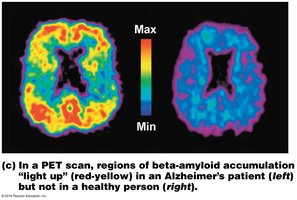
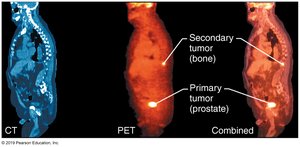
Radioactivity can damage living tissue but is also used therapeutically (e.g., treating cancer). However, exposure to certain radioactive substances (e.g., radon) increases cancer risk.
Molecules, Compounds, and Mixtures
Definitions
Molecule: Two or more atoms bonded together (e.g., O2).
Compound: A molecule containing two or more different kinds of atoms (e.g., H2O, CO2).
Most matter exists as mixtures, which are physical combinations of two or more substances. Types of mixtures include solutions, colloids, and suspensions.
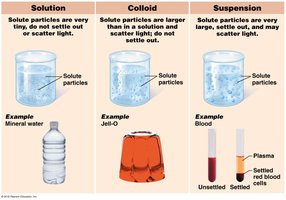
Solutions: Homogeneous mixtures; solute particles are very small and do not settle out (e.g., saline solution).
Colloids: Heterogeneous mixtures; larger particles that do not settle out (e.g., Jell-O, cytosol).
Suspensions: Heterogeneous mixtures with large, visible solutes that settle out (e.g., blood).
Mixtures vs. Compounds:
Mixtures do not involve chemical bonding; compounds do.
Mixtures can be separated by physical means; compounds require chemical means.
Mixtures can be heterogeneous or homogeneous; compounds are always homogeneous.
Chemical Bonds
Electron Shells and the Octet Rule
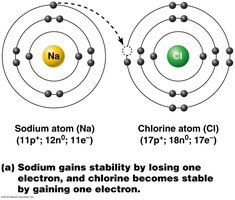
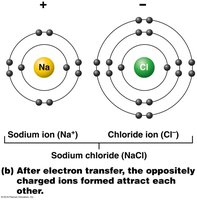
Electrons occupy energy levels called electron shells. The outermost shell is the valence shell, which determines chemical reactivity. Atoms are most stable when their valence shell is full (usually 8 electrons – the "octet rule").
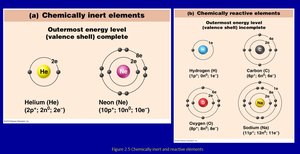
Types of Chemical Bonds
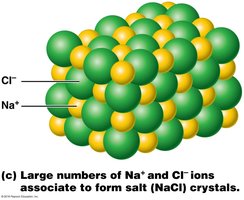
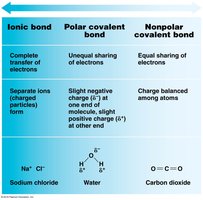
Ionic Bonds: Formed by the transfer of electrons from one atom to another, resulting in ions (cations and anions) that attract each other.
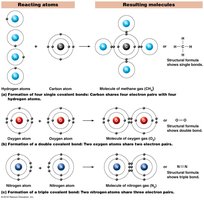
Covalent Bonds: Formed by the sharing of electrons between atoms. Can be single, double, or triple bonds.
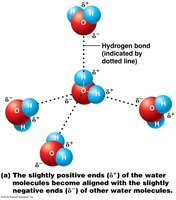
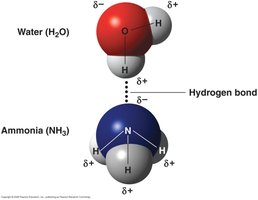
Hydrogen Bonds: Weak attractions between a hydrogen atom (already covalently bonded to another atom) and an electronegative atom (e.g., O or N).
Polar and Nonpolar Covalent Bonds
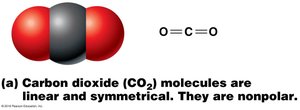
Nonpolar Covalent Bonds: Electrons are shared equally (e.g., O2, CO2).
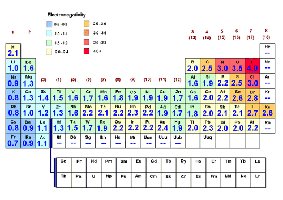
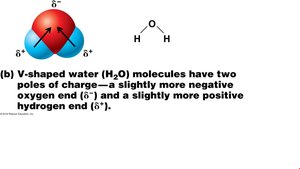
Polar Covalent Bonds: Electrons are shared unequally, creating partial charges (e.g., H2O).
Hydrogen Bonds and Their Biological Importance
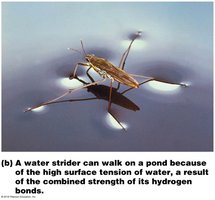
Hydrogen bonds are responsible for many properties of water, including surface tension, and play a critical role in stabilizing the structures of proteins and DNA.
Chemical Reactions
Types of Chemical Reactions
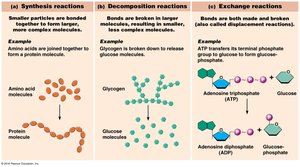
Synthesis (Combination) Reactions: Atoms or molecules combine to form larger, more complex molecules. Example: Protein synthesis.
Decomposition Reactions: Molecules are broken down into smaller molecules or atoms. Example: Glycogen breakdown.
Exchange (Displacement) Reactions: Involve both synthesis and decomposition; bonds are made and broken. Example: ATP transfers phosphate to glucose.
Oxidation-Reduction (Redox) Reactions: Involve the transfer of electrons between molecules. Oxidized substances lose electrons; reduced substances gain electrons. Example: Cellular respiration:
$\mathrm{C_6H_{12}O_6 + 6O_2 \rightarrow 6CO_2 + 6H_2O + ATP}$
Energy Flow in Chemical Reactions
Exergonic Reactions: Release energy; products have less potential energy than reactants. Example: Burning wood, cellular respiration.
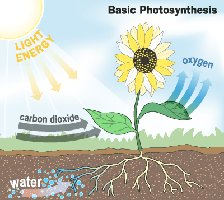
Endergonic Reactions: Absorb energy; products have more potential energy than reactants. Example: Photosynthesis, protein synthesis.

Reversibility and Rate of Chemical Reactions
All chemical reactions are theoretically reversible, but many biological reactions are not due to high energy requirements or removal of products.
The rate of chemical reactions is affected by temperature, concentration, particle size, and the presence of catalysts (e.g., enzymes).
Additional info: Enzymes are biological catalysts that speed up reactions without being consumed in the process. They are essential for maintaining life by regulating metabolic pathways.
