 뒤로
뒤로Chapter 2: Chemistry Comes Alive – Foundations for Anatomy & Physiology
스터디 가이드 - 스마트 노트
 자료에 맞춘 맞춤형 노트, 핵심 정의, 예시, 맥락을 확장해 제공합니다.
Part 1—Basic Chemistry
2.1 Matter and Energy
Understanding matter and energy is essential for grasping the chemical basis of life processes in anatomy and physiology.
Matter: Anything that occupies space and has mass. Exists in three states: solid, liquid, and gas.
Energy: The capacity to do work or put matter into motion. Exists as kinetic (energy in action) or potential (stored energy).
Forms of Energy: Chemical, electrical, mechanical, and radiant (electromagnetic).
Energy Conversion: Energy can be converted from one form to another, but some is always lost as heat, making the process inefficient.
2.2 Atoms and Elements
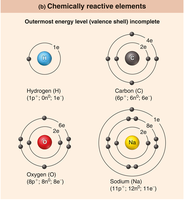
All matter is composed of elements, which are substances that cannot be broken down by ordinary chemical means. The human body is primarily made of four elements: carbon, oxygen, hydrogen, and nitrogen.
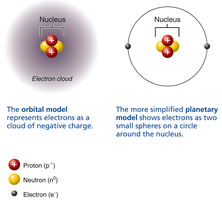
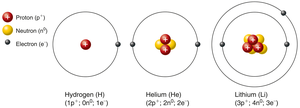
Atoms: The smallest units of elements, composed of protons, neutrons, and electrons.
Atomic Structure: Protons and neutrons are located in the nucleus; electrons orbit the nucleus in electron shells.
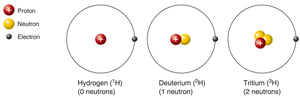
Atomic Number: Number of protons in the nucleus.
Mass Number: Total number of protons and neutrons.
Isotopes: Atoms of the same element with different numbers of neutrons.
Atomic Weight: Average of mass numbers of all isotopes of an element.
2.3 Combining Matter: Molecules, Compounds, and Mixtures
Atoms combine to form molecules and compounds, which are essential for biological structure and function.
Molecule: Two or more atoms bonded together.
Compound: A molecule containing two or more different kinds of atoms.
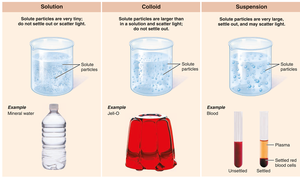
Mixtures: Physical combinations of two or more substances. Types include solutions, colloids, and suspensions.
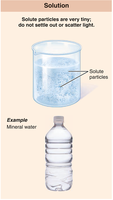
Solutions
Homogeneous mixtures; solute particles are tiny and do not settle out or scatter light.
Example: Mineral water.
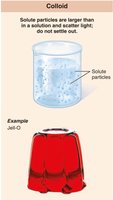
Colloids
Heterogeneous mixtures; solute particles are larger than in solutions and scatter light but do not settle out.
Example: Jell-O.
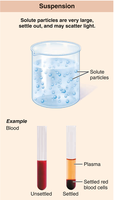
Suspensions
Heterogeneous mixtures with large, visible solutes that settle out.
Example: Blood (plasma and cells separate upon standing).
Mixtures vs. Compounds
Mixtures do not involve chemical bonding; compounds do.
Mixtures can be separated physically; compounds require chemical means.
Mixtures can be heterogeneous or homogeneous; compounds are always homogeneous.
2.4 Chemical Bonds
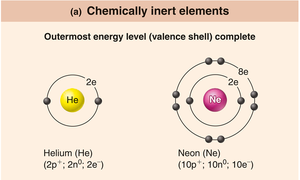
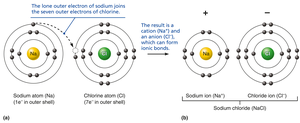
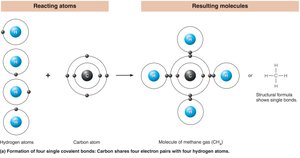
Chemical bonds are energy relationships between electrons of reacting atoms. The type of bond formed depends on the arrangement of electrons in the outermost shell (valence shell).
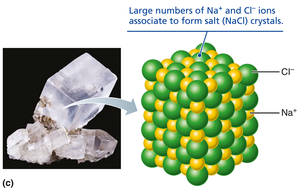
Ionic Bonds: Involve transfer of electrons from one atom to another, forming ions (cations and anions).
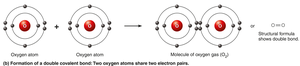
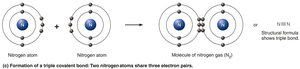
Covalent Bonds: Involve sharing of electrons between atoms. Can be single, double, or triple bonds.
Polar Covalent Bonds: Unequal sharing of electrons, resulting in partial charges (dipoles).
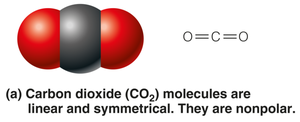
Nonpolar Covalent Bonds: Equal sharing of electrons; no charge separation.
Hydrogen Bonds: Weak attractions between a hydrogen atom and an electronegative atom (e.g., between water molecules).
2.5 Chemical Reactions
Chemical reactions involve the making or breaking of bonds between atoms. They are fundamental to all physiological processes.
Synthesis (Combination) Reactions: Atoms or molecules combine to form a larger, more complex molecule. Important in anabolic processes.
Decomposition Reactions: A molecule is broken down into smaller molecules or atoms. Important in catabolic processes.
Exchange (Displacement) Reactions: Involve both synthesis and decomposition; bonds are made and broken.
Redox (Oxidation-Reduction) Reactions: Involve transfer of electrons between atoms; essential for energy production in cells.
Exergonic Reactions: Release energy (catabolic, oxidative).
Endergonic Reactions: Absorb energy (anabolic).
Catalysts: Substances that increase the rate of a reaction without being consumed (e.g., enzymes in the body).
Part 2—Biochemistry
2.6 Inorganic Compounds
Inorganic compounds are essential for life and include water, salts, acids, and bases.
Water: Most abundant inorganic compound in the body; vital for temperature regulation, solvent properties, reactivity, and cushioning.
Salts: Ionic compounds that dissociate in water to form electrolytes, which are crucial for nerve impulse transmission and muscle contraction.
Acids and Bases: Both are electrolytes. Acids release hydrogen ions (proton donors), while bases accept hydrogen ions (proton acceptors).
pH Scale: Measures hydrogen ion concentration; ranges from 0 (acidic) to 14 (basic), with 7 being neutral.
Buffers: Compounds that resist changes in pH by releasing or binding hydrogen ions; essential for maintaining homeostasis.
Type | Definition | Example |
|---|---|---|
Solution | Homogeneous mixture; solute particles do not settle out | Mineral water |
Colloid | Heterogeneous mixture; solute particles scatter light but do not settle out | Jell-O |
Suspension | Heterogeneous mixture; solute particles are large and settle out | Blood |
Key Equations:
pH Calculation:
Neutralization Reaction:
Additional info: The chemical principles outlined here are foundational for understanding physiological processes such as nerve conduction, muscle contraction, and cellular metabolism, all of which depend on the properties of atoms, molecules, and chemical reactions.
