 뒤로
뒤로Chapter 2: Chemistry Comes Alive – Guided Study for Anatomy & Physiology
스터디 가이드 - 스마트 노트
 자료에 맞춘 맞춤형 노트, 핵심 정의, 예시, 맥락을 확장해 제공합니다.
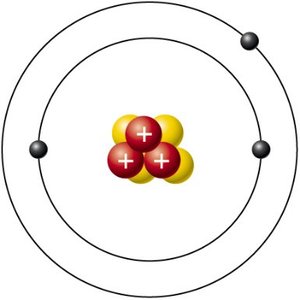
Q6. The atom shown below has _______ electrons, _________ protons, and ________ neutrons.
Background
Topic: Atomic Structure
This question tests your understanding of the basic structure of an atom, including the identification and counting of subatomic particles: electrons, protons, and neutrons.
Key Terms:
Electron: Negatively charged particle found in orbitals around the nucleus.
Proton: Positively charged particle found in the nucleus.
Neutron: Neutral particle found in the nucleus.
Step-by-Step Guidance
Examine the diagram to identify the number of electrons. Electrons are represented by the small black spheres on the rings (orbitals).
Count the number of protons in the nucleus. Protons are typically shown as red spheres with a plus sign (+).
Count the number of neutrons in the nucleus. Neutrons are usually depicted as yellow spheres without a charge.
Compare the numbers of each particle to understand the atom's identity and charge.
Try solving on your own before revealing the answer!
Final Answer:
The atom shown has 2 electrons, 2 protons, and 2 neutrons.
This is the structure of a helium atom, which is electrically neutral because the number of protons equals the number of electrons.
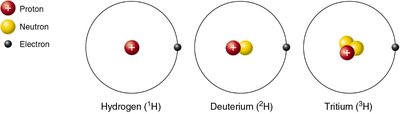
Q13. Shown below are three different structural variations of the element hydrogen. These structural variations of hydrogen are called _____________________. Which subatomic particle can vary in number among these three structural variations?
Background
Topic: Isotopes
This question is about isotopes, which are atoms of the same element with different numbers of neutrons. It also tests your ability to identify which subatomic particle changes among isotopes.
Key Terms:
Isotope: Atoms of the same element with different numbers of neutrons.
Neutron: Subatomic particle that can vary in number among isotopes.
Step-by-Step Guidance
Observe the three diagrams labeled Hydrogen, Deuterium, and Tritium.
Note that each has one proton and one electron, but the number of neutrons differs.
Recall that isotopes are defined by their neutron count, not by protons or electrons.
Identify which subatomic particle changes among these variations.
Try solving on your own before revealing the answer!
Final Answer:
These structural variations are called isotopes. The subatomic particle that varies in number is the neutron.
Hydrogen-1 has no neutrons, Deuterium has one neutron, and Tritium has two neutrons.
Q5. Explain why the overall reaction for cellular respiration (shown below) is never reversed in body cells.
Background
Topic: Cellular Respiration
This question tests your understanding of the directionality of metabolic reactions, specifically why cellular respiration is considered irreversible in living cells.
Key Terms and Formula:
Cellular Respiration: The process by which cells convert glucose and oxygen into carbon dioxide, water, and ATP.
Irreversible Reaction: A reaction that cannot proceed in the reverse direction under normal physiological conditions.
Step-by-Step Guidance
Review the chemical equation for cellular respiration.
Consider the energy changes involved: energy is released as ATP.
Think about the physiological conditions in cells and whether the reverse reaction (making glucose from CO2 and H2O) is possible.
Reflect on the role of enzymes and metabolic pathways in determining reaction directionality.

Try solving on your own before revealing the answer!
Final Answer:
The overall reaction for cellular respiration is never reversed in body cells because it is highly exergonic (releases energy), and the products (CO2 and H2O) are rapidly removed from the cell. The reverse process would require an input of energy and specialized enzymes not present in animal cells.
Q11. The bicarbonate buffer system shown below resists changes in blood pH by shifting to the right or left in response to a rise or drop in pH. Would the equilibrium shift to the right or left if blood became more acidic from the addition of a strong acid? Would this shift result in the addition or removal of H+ ions from the blood?
Background
Topic: Acid-Base Balance and Buffer Systems
This question tests your understanding of how the bicarbonate buffer system maintains blood pH by shifting equilibrium in response to changes in acidity.
Key Terms and Formula:
Buffer: A system that resists changes in pH by absorbing or releasing H+ ions.
Bicarbonate Buffer System:

Step-by-Step Guidance
Examine the buffer system equation and identify the direction of equilibrium shift when H+ is added (blood becomes more acidic).
Recall Le Chatelier's principle: the system will shift to counteract the change.
Determine whether the shift will result in the removal or addition of H+ ions.
Think about the physiological effect of this shift on blood pH.
Try solving on your own before revealing the answer!
Final Answer:
If blood becomes more acidic, the equilibrium shifts to the left, resulting in the removal of H+ ions from the blood. This helps restore normal pH.
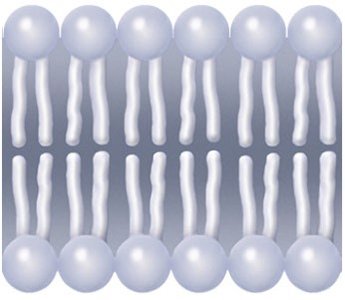
Q7. Why do phospholipids form a bilayer (shown below) when placed in a watery environment? (In your answer be sure to indicate which parts of a phospholipid are polar or nonpolar.)
Background
Topic: Cell Membrane Structure
This question tests your understanding of the amphipathic nature of phospholipids and how this property leads to the formation of a bilayer in aqueous environments.
Key Terms:
Phospholipid: A lipid molecule with a polar (hydrophilic) head and nonpolar (hydrophobic) tails.
Bilayer: A double layer structure formed by phospholipids in water.
Step-by-Step Guidance
Recall the structure of a phospholipid: a polar head and two nonpolar tails.
Consider how these molecules behave in water: polar heads interact with water, nonpolar tails avoid water.
Visualize how phospholipids arrange themselves so that heads face outward toward water and tails face inward away from water.
Think about why this arrangement is stable and forms the basis of cell membranes.
Try solving on your own before revealing the answer!
Final Answer:
Phospholipids form a bilayer because their polar heads are attracted to water, while their nonpolar tails repel water. In a watery environment, the heads face outward toward the water, and the tails face inward, away from water, creating a stable bilayer.
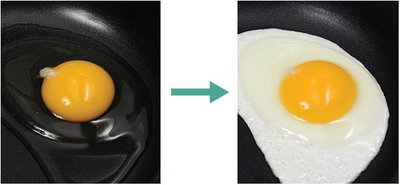
Q5. When cooking an egg (shown below) what is the term that describes what happens to the protein albumin to cause the coagulation of egg white?
Background
Topic: Protein Structure and Denaturation
This question tests your understanding of how heat affects protein structure, specifically the process that causes proteins to lose their native shape and function.
Key Terms:
Denaturation: The process by which proteins lose their three-dimensional structure due to external stress, such as heat.
Albumin: The main protein in egg white.
Step-by-Step Guidance
Consider what happens to proteins when exposed to heat: their structure changes.
Recall the term for the loss of protein structure and function due to heat or pH changes.
Think about how this process leads to the coagulation (solidification) of egg white.
Connect this process to the broader concept of protein function in the body.
Try solving on your own before revealing the answer!
Final Answer:
The term is denaturation. Heat causes the albumin protein to lose its three-dimensional structure, resulting in coagulation of the egg white.
