 뒤로
뒤로Chapter 2: Chemistry Comes Alive – Organic Compounds in Human Anatomy & Physiology
스터디 가이드 - 스마트 노트
 자료에 맞춘 맞춤형 노트, 핵심 정의, 예시, 맥락을 확장해 제공합니다.
Organic Compounds: Synthesis and Hydrolysis
Overview of Organic Molecules
Organic compounds are fundamental to life and are characterized by the presence of carbon atoms. These molecules are essential for the structure and function of cells and tissues in the human body.
Organic molecules contain carbon, except for CO and CO2, which are considered inorganic.
Carbon is electroneutral, sharing electrons and forming four covalent bonds.
Major classes: Carbohydrates, Lipids, Proteins, Nucleic acids.
Synthesis and Breakdown of Organic Molecules
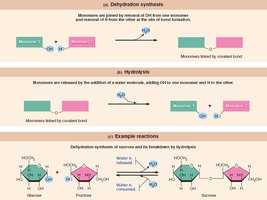
Many organic compounds are polymers, constructed from repeating units called monomers. The processes of synthesis and breakdown are crucial for metabolism and cellular function.
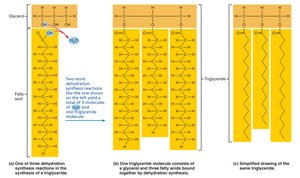
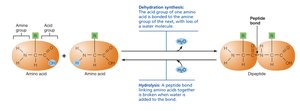
Dehydration synthesis: Monomers are joined by removal of a water molecule, forming polymers.
Hydrolysis: Polymers are broken down into monomers by the addition of water.
Carbohydrates
Structure and Classification
Carbohydrates are organic molecules composed of carbon, hydrogen, and oxygen, typically in a 2:1 ratio of hydrogen to oxygen. They serve as energy sources and structural components.
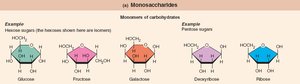
Monosaccharides: Simple sugars (3–7 carbon atoms), basic building blocks.
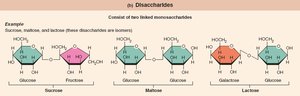
Disaccharides: Double sugars, formed by joining two monosaccharides.
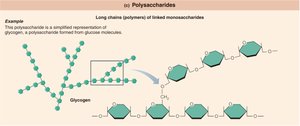
Polysaccharides: Long chains of monosaccharides, used for energy storage.
Monosaccharides
Pentose sugars: Ribose, Deoxyribose
Hexose sugars: Glucose, Fructose, Galactose
Disaccharides
Examples: Sucrose (glucose + fructose), Maltose (glucose + glucose), Lactose (glucose + galactose)
Formed by dehydration synthesis; too large to pass through cell membranes.
Polysaccharides
Examples: Starch (plants), Glycogen (animals)
Polymers of glucose; not very soluble and must be broken down for use.
Lipids
Structure and Types
Lipids are hydrophobic organic molecules containing carbon, hydrogen, and oxygen (less than carbohydrates), and sometimes phosphorus. They are essential for energy storage, membrane structure, and signaling.
Main types: Triglycerides, Phospholipids, Steroids, Eicosanoids
Triglycerides
Composed of three fatty acids bonded to a glycerol molecule.
Functions: energy storage, insulation, protection.
Saturated vs. Unsaturated Fatty Acids
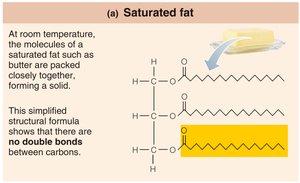
Saturated fatty acids: All carbons linked by single bonds; solid at room temperature (e.g., butter).
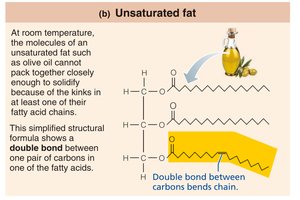
Unsaturated fatty acids: One or more double bonds; liquid at room temperature (e.g., olive oil).
Trans fats: Modified unsaturated fats, unhealthy.
Omega-3 fatty acids: Beneficial for heart health.
Phospholipids
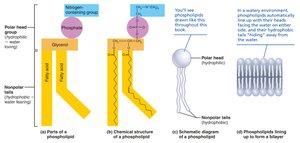
Modified triglycerides: glycerol, two fatty acids, and a phosphate group.
Head is polar and hydrophilic; tails are nonpolar and hydrophobic.
Essential for cell membrane structure.
Steroids
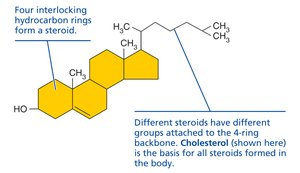
Four interlocking ring structure.
Cholesterol: Most important steroid; precursor for vitamin D, steroid hormones, bile salts.
Integral to cell membrane structure.
Eicosanoids
Derived from arachidonic acid.
Prostaglandins: Regulate blood clotting, blood pressure, inflammation, labor contractions.
NSAIDs block inflammatory actions of eicosanoids.
Proteins
Structure and Function
Proteins are polymers of amino acids and constitute 10–30% of cell mass. They are essential for structure, function, and regulation of the body's tissues and organs.
Contain C, H, O, N, and sometimes S and P.
Functions: structural support, transport, catalysis, communication, defense, movement.
Examples of Protein Functions
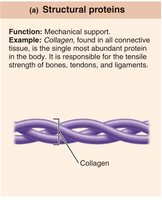
Structural proteins: Collagen provides mechanical support.
Enzyme proteins: Catalyze biochemical reactions.
Transport proteins: Hemoglobin transports oxygen.
Communication proteins: Insulin regulates blood sugar.
Contractile proteins: Actin and myosin enable movement.
Defensive proteins: Antibodies protect against disease.
Amino Acids and Peptide Bonds
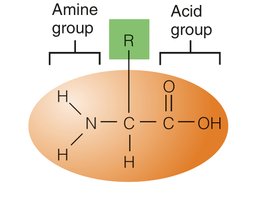
Proteins are made of 20 different amino acids, each containing an amino group, a carboxyl group, and a unique R group. Peptide bonds link amino acids together.
Polypeptides: chains of 10 or more amino acids.
Proteins: chains of 50 or more amino acids.
Amino acids can act as acids or bases.
Structural Levels of Proteins
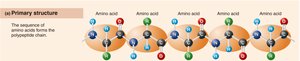
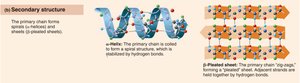
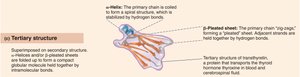
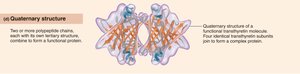
The shape and function of proteins are determined by four structural levels:
Primary structure: Linear sequence of amino acids.
Secondary structure: Alpha helix (coiled) and beta pleated sheet (folded).
Tertiary structure: 3D folding due to interactions among secondary structures.
Quaternary structure: Association of two or more polypeptide chains.
Fibrous and Globular Proteins
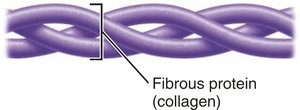
Fibrous proteins: Strandlike, water-insoluble, stable; provide mechanical support (e.g., collagen).
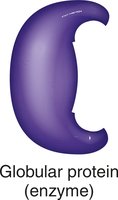
Globular proteins: Compact, spherical, water-soluble; perform functional roles (e.g., enzymes, antibodies).
Protein Denaturation
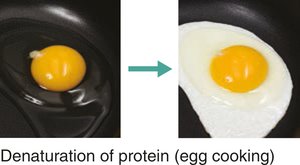
Denaturation is the loss of a protein's functional shape due to environmental changes such as pH or temperature. This process is usually reversible unless the changes are extreme.
Active sites are deactivated.
Example: Cooking an egg irreversibly denatures its proteins.
Enzymes and Enzyme Activity
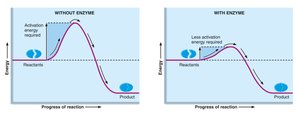
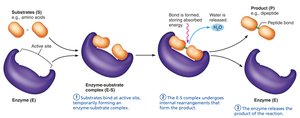
Enzymes are globular proteins that act as biological catalysts, speeding up chemical reactions by lowering activation energy.
Enzymes are specific to substrates.
Most functional enzymes are holoenzymes (apoenzyme + cofactor/coenzyme).
Names often end in -ase (e.g., hydrolase, oxidase).
Nucleic Acids
Structure and Function
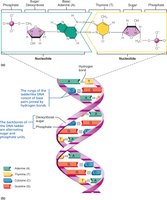
Nucleic acids are the largest molecules in the body, composed of C, H, O, N, and P. They store and transmit genetic information.
Monomers: Nucleotides (nitrogen base, pentose sugar, phosphate group).
Two major classes: DNA and RNA.
DNA
Double-stranded helix located in the nucleus.
Nucleotides: deoxyribose sugar, phosphate, and four bases (A, G, C, T).
Complementary base pairing: A-T, G-C.
RNA
Single-stranded, mostly outside the nucleus.
Ribose sugar; uracil replaces thymine.
Types: mRNA, tRNA, rRNA.
ATP (Adenosine Triphosphate)
Structure and Function
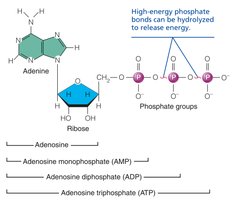
ATP is the primary energy carrier in cells, capturing chemical energy released from glucose breakdown and providing immediate, usable energy for cellular processes.
Structure: Adenine-containing RNA nucleotide with three phosphate groups.
Energy is stored in high-energy phosphate bonds.
ATP can be converted to ADP and AMP by loss of phosphate groups.
Cellular Work Driven by ATP
Transport work: ATP phosphorylates transport proteins.
Mechanical work: ATP phosphorylates contractile proteins.
Chemical work: ATP provides energy for endergonic reactions.
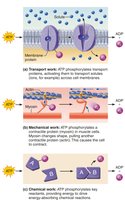
Table: Summary of Monomers and Polymers of Some Organic Molecules
Organic Molecule | Monomer | Polymer |
|---|---|---|
Carbohydrates | Monosaccharide | Polysaccharide |
Proteins | Amino acid | Polypeptide/protein |
Nucleic acids | Nucleotide | DNA/RNA |
Lipids | Fatty acid & glycerol | Not true polymers |
Additional info: Lipids do not form true polymers; their structure is based on the assembly of fatty acids and glycerol.
