 뒤로
뒤로Chapter 2: Chemistry Comes Alive – Study Notes for Anatomy & Physiology
스터디 가이드 - 스마트 노트
 자료에 맞춘 맞춤형 노트, 핵심 정의, 예시, 맥락을 확장해 제공합니다.
Chemistry and Physiological Reactions
Importance of Chemistry in Physiology
Chemistry forms the foundation of all physiological processes in the human body, including movement, digestion, heart function, and nervous system activity. Understanding basic chemistry and biochemistry is essential for interpreting how the body responds to dehydration, fluid loss, and other clinical conditions.
Basic Chemistry: Study of matter, energy, atoms, and elements.
Biochemistry: Study of chemical processes within living organisms.
2.1 Matter and Energy
Matter
Matter is anything that has mass and occupies space. It can be observed, smelled, or felt, and exists in three states:
Solid: Definite shape and volume.
Liquid: Changeable shape, definite volume.
Gas: Changeable shape and volume.
Energy
Energy is the capacity to do work or move matter. It exists in two main forms:
Kinetic Energy: Energy in action.
Potential Energy: Stored energy.
Energy can be transformed from potential to kinetic, but some energy is lost as heat during conversions.
Chemical Energy: Stored in chemical bonds.
Electrical Energy: Movement of charged particles.
Mechanical Energy: Directly moves matter.
Radiant Energy: Travels in waves (e.g., light, X-rays).
2.2 Atoms and Elements
Elements
Elements are pure substances that cannot be broken down by ordinary chemical methods. Four elements—carbon, oxygen, hydrogen, and nitrogen—make up 96% of the human body.
Atomic Symbol: One- or two-letter shorthand for each element (e.g., O for oxygen).
Structure of Atoms
Atoms are composed of three subatomic particles:
Protons: Positive charge, 1 atomic mass unit (amu).
Neutrons: No charge, 1 amu.
Electrons: Negative charge, virtually no mass.
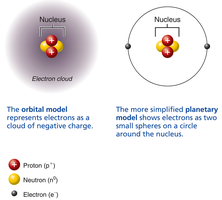
Protons and neutrons are located in the nucleus, while electrons orbit around it. Two models describe atomic structure:
Planetary Model: Electrons in fixed orbits (simplified).
Orbital Model: Electrons in probable regions (electron cloud).
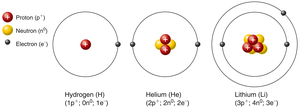
Atomic Structure of Smallest Atoms
Hydrogen, helium, and lithium differ in their numbers of protons, neutrons, and electrons.
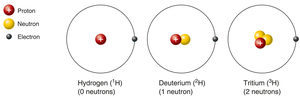
Isotopes
Isotopes are structural variations of the same element, differing in the number of neutrons. Atomic weight is the average mass of all isotope forms.
2.3 Combining Matter
Molecules and Compounds
Atoms combine to form molecules (two or more atoms bonded together) and compounds (molecules with two or more different atoms).
Mixtures
Mixtures are physical combinations of two or more components. Three basic types:
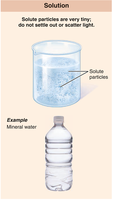
Solutions: Homogeneous mixtures; solute particles are tiny and evenly distributed.
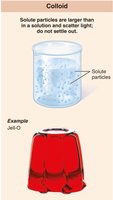
Colloids: Heterogeneous mixtures; larger particles that do not settle out.
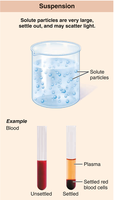
Suspensions: Heterogeneous mixtures; large particles that settle out.
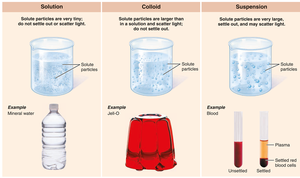
Solution Example
Colloid Example
Suspension Example
2.4 Chemical Bonds
Role of Electrons in Chemical Bonding
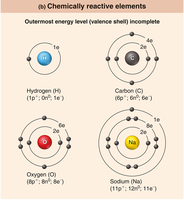
Electrons occupy energy levels called shells. The outermost shell (valence shell) determines chemical reactivity. Atoms strive for stability by achieving a full valence shell, usually eight electrons (octet rule).
Chemically Inert and Reactive Elements
Inert elements have complete valence shells and are nonreactive. Reactive elements have incomplete valence shells and tend to form bonds.
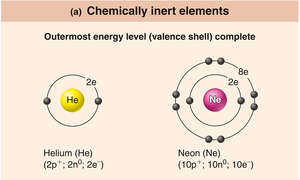
Types of Chemical Bonds
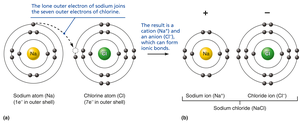
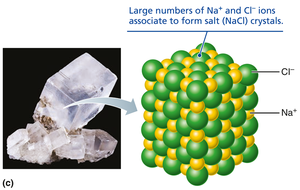
Ionic Bonds: Transfer of electrons between atoms, forming charged ions (cations and anions).
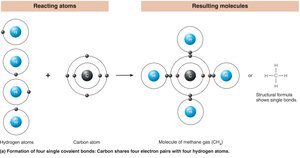
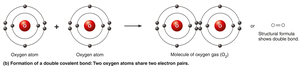
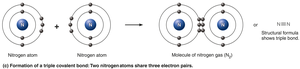
Covalent Bonds: Sharing of electrons between atoms. Can be single, double, or triple bonds.
Hydrogen Bonds: Weak attractions between electropositive hydrogen and electronegative atoms.
Formation of Ionic Bonds
Formation of Covalent Bonds
Single Bond: Sharing two electrons.
Double Bond: Sharing four electrons.
Triple Bond: Sharing six electrons.
Nonpolar and Polar Covalent Bonds
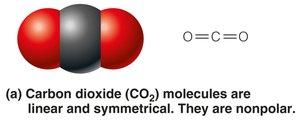
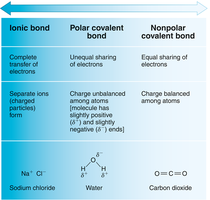
Nonpolar: Equal sharing of electrons (e.g., CO2).
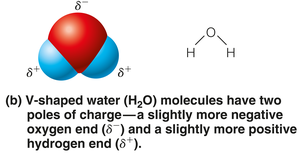
Polar: Unequal sharing, resulting in dipoles (e.g., H2O).
Bond Types Compared
Ionic, polar covalent, and nonpolar covalent bonds differ in electron sharing and charge distribution.
2.5 Chemical Reactions
Chemical Equations
Chemical reactions involve the formation, rearrangement, or breaking of chemical bonds. They are represented by chemical equations showing reactants and products.
Types of Chemical Reactions
Synthesis (Combination): Atoms or molecules combine to form larger molecules. Used in anabolic processes.
Decomposition: Molecules break down into smaller molecules or atoms. Used in catabolic processes.
Exchange (Displacement): Bonds are both made and broken; involves both synthesis and decomposition.
Redox reactions involve electron transfer: reduction (gain of electrons) and oxidation (loss of electrons).
Energy Flow in Reactions
Exergonic: Release energy; products have less potential energy than reactants.
Endergonic: Absorb energy; products have more potential energy than reactants.
Rate of Chemical Reactions
Increased temperature, concentration, and smaller particle size increase reaction rate.
Catalysts: Speed up reactions without being consumed; enzymes are biological catalysts.
2.6 Inorganic Compounds
Water
Water is the most abundant inorganic compound in the body, accounting for 60–80% of cell volume. Its properties include:
High Heat Capacity: Absorbs and releases heat with little temperature change.
High Heat of Vaporization: Requires much heat to evaporate.
Polar Solvent Properties: Dissolves ionic substances and forms hydration layers.
Reactivity: Participates in hydrolysis and dehydration synthesis.
Cushioning: Protects organs from trauma.
Salts
Salts are ionic compounds that dissociate into ions in water. They are important electrolytes for nerve and muscle function, and ionic balance is vital for homeostasis.
Acids and Bases
Acids: Proton donors; release H+ ions.
Bases: Proton acceptors; release OH- ions.
The pH scale measures hydrogen ion concentration, ranging from 0 (acidic) to 14 (basic). Neutralization occurs when acids and bases mix, forming water and salt. Buffers resist changes in pH.
2.7 Organic Compounds: Synthesis and Hydrolysis
Organic molecules contain carbon and include carbohydrates, lipids, proteins, and nucleic acids. Many are polymers made of monomers, synthesized by dehydration synthesis and broken down by hydrolysis.
2.8 Carbohydrates
Types of Carbohydrates
Monosaccharides: Simple sugars (e.g., glucose, ribose).
Disaccharides: Double sugars (e.g., sucrose, lactose).
Polysaccharides: Many sugars (e.g., starch, glycogen).
Carbohydrates are used for energy storage and structural purposes.
2.9 Lipids
Main Types of Lipids
Triglycerides: Energy storage, insulation, protection.
Phospholipids: Major component of cell membranes.
Steroids: Cholesterol, hormones, vitamin D.
Eicosanoids: Prostaglandins, involved in inflammation and blood clotting.
2.10 Proteins
Structure and Function
Proteins are polymers of amino acids, held together by peptide bonds. They serve structural, enzymatic, and contractile functions. Protein structure is determined by four levels:
Primary: Sequence of amino acids.
Secondary: Alpha helices and beta sheets.
Tertiary: 3D folding of secondary structures.
Quaternary: Interaction of multiple polypeptides.
2.11 Nucleic Acids
DNA and RNA
Nucleic acids are polymers of nucleotides, which consist of a nitrogen base, pentose sugar, and phosphate group. DNA stores genetic information; RNA is involved in protein synthesis.
2.12 ATP (Adenosine Triphosphate)
ATP is the primary energy carrier in cells. It is an adenine-containing nucleotide with three phosphate groups. Energy is released when ATP is hydrolyzed to ADP or AMP.
Summary Table: Types of Chemical Bonds
Bond Type | Electron Sharing/Transfer | Example |
|---|---|---|
Ionic | Complete transfer of electrons | Sodium chloride (NaCl) |
Polar Covalent | Unequal sharing of electrons | Water (H2O) |
Nonpolar Covalent | Equal sharing of electrons | Carbon dioxide (CO2) |
