 뒤로
뒤로Chapter 2: Chemistry Fundamentals for Anatomy & Physiology
스터디 가이드 - 스마트 노트
 자료에 맞춘 맞춤형 노트, 핵심 정의, 예시, 맥락을 확장해 제공합니다.
Chemistry Concepts in Anatomy & Physiology
Definitions of Matter, Mass, Weight, and Energy
Understanding basic chemistry is essential for studying Anatomy & Physiology, as it underpins cellular structure and function.
Matter: Anything that occupies space and has mass; its amount never changes.
Mass: The actual quantity of matter in an object; remains constant regardless of location.
Weight: The force exerted by gravity on an object; varies with gravity.
Energy: The capacity to do work or put matter into motion.
States and Forms of Energy
Energy exists in two primary states and several forms relevant to biological systems.
Kinetic Energy: Energy in motion.
Potential Energy: Stored energy, with the potential to be used.
Chemical Energy: Stored in chemical bonds; released during chemical reactions.
ATP (Adenosine Triphosphate): The primary energy carrier in cells.
Electrical Energy: Results from movement of charged particles.
Mechanical Energy: Directly involved in moving matter.
Radiant Energy: Travels in waves; includes electromagnetic energy.
Atoms and Subatomic Particles
Atoms are the fundamental units of matter, composed of subatomic particles.
Atom: Smallest unit of an element.
Proton: Positively charged, located in the nucleus.
Neutron: Neutral charge, located in the nucleus.
Electron: Negatively charged, orbits the nucleus; smallest mass (AMU of zero).
Valence electrons determine an atom's chemical reactivity.
Atomic Structure and Chemical Properties
Mass Number: Sum of protons and neutrons.
Atomic Number: Number of protons; determines element identity.
Atomic Symbol: Shorthand notation for elements.
Chemical Equations: Coefficients and Subscripts
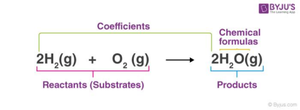
Chemical equations represent reactions, with coefficients and subscripts indicating quantities and composition.
Coefficients: Indicate the number of molecules involved.
Subscripts: Indicate the number of atoms of each element in a molecule.
Major Elements in the Human Body
Four elements make up 96% of body weight:
Carbon
Oxygen
Hydrogen
Nitrogen
Isotopes
Isotopes are atoms of the same element with different numbers of neutrons.
Mixtures vs. Compounds
Mixture: Physically combined substances (solutions, suspensions, colloids).
Compound: Chemically bonded elements.
Types of Mixtures
Solution: Homogeneous, does not settle or scatter light (e.g., salt water).
Suspension: Heterogeneous, settles over time (e.g., cytosol).
Colloid: Heterogeneous, may settle (e.g., blood).
Solvent: Substance doing the dissolving.
Solute: Substance being dissolved.
Role of Electrons in Bonding
Electron shells and the octet rule govern chemical bonding and stability.
Valence Shell: Outermost electron shell; stability achieved with 8 electrons (octet rule).
Hydrogen and Helium: Stable with 2 electrons.
Chemical Bonds
Atoms form bonds to achieve stability.
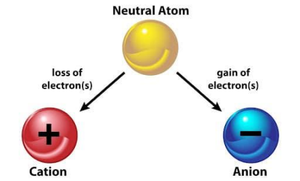
Ionic Bond: Transfer of electrons; forms cations (+) and anions (−).
Covalent Bond: Sharing of electron pairs; can be single, double, or triple bonds.
Polar Covalent: Unequal sharing of electrons.
Non-Polar Covalent: Equal sharing of electrons.
Hydrogen Bond: Weak attraction between molecules (e.g., water).
Types of Chemical Reactions
Synthesis: Formation of bonds.
Decomposition: Breaking bonds.
Exchange: Making and breaking bonds.
Redox (Oxidation-Reduction): Transfer of electrons between atoms.
Factors Influencing Chemical Reaction Rates
Temperature: Higher temperature increases rate.
Concentration: Higher concentration increases rate.
Particle Size: Smaller particles increase rate.
Catalysts: Speed up reactions; enzymes are biological catalysts.
Properties of Water
High Heat Capacity: Absorbs/releases heat without temperature change.
High Heat of Vaporization: Requires energy to evaporate (sweating).
Polar Solvent: Dissolves ionic substances.
Reactivity: Participates in hydrolysis and dehydration synthesis.
Cushioning: Protects organs.
Ions and Electrolytes
Electrolytes: Substances that dissociate into ions in solution.
Ions: Charged particles.
pH Scale and Buffers
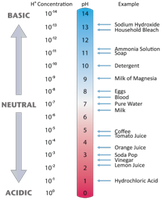
The pH scale measures acidity and alkalinity, ranging from 0 (acidic) to 14 (basic).
Neutralization Reaction: Acid and base react to form water and salt.
Buffers: Stabilize pH by releasing or absorbing ions.
Organic vs. Inorganic Compounds
Organic Compounds: Contain carbon (exceptions: CO, CO2).
Inorganic Compounds: Do not contain carbon.
Monomers and Polymers of Organic Macromolecules
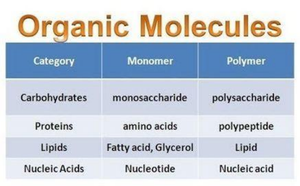
Organic macromolecules are built from monomers.
Category | Monomer | Polymer |
|---|---|---|
Carbohydrates | Monosaccharide | Polysaccharide |
Proteins | Amino acids | Polypeptide |
Lipids | Fatty acid, Glycerol | Lipid |
Nucleic Acids | Nucleotide | Nucleic acid |
Stored Carbohydrates
Animals: Glycogen
Plants: Starch
Levels of Protein Structure
Primary: Linear sequence of amino acids.
Secondary: Alpha helix or beta-pleated sheet.
Tertiary: Three-dimensional globular shape.
Quaternary: Multiple polypeptide chains.
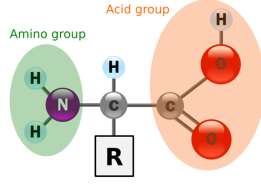
Amino Acid Structure
Amino acids are the building blocks of proteins, each containing an amino group, acid group, and an R group.
Lipids: Triglycerides, Phospholipids, and Steroids
Triglycerides: Solid (fat) if saturated; liquid (oil) if unsaturated.
Phospholipids: Major component of cell membranes.
Steroids: Include hormones and cholesterol.
Enzyme Characteristics and Action
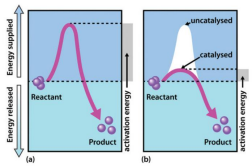
Enzymes are biological catalysts that lower activation energy, speeding up reactions.
Specificity: Enzymes act on specific substrates.
Activation Energy: Minimum energy required for a reaction.
Enzyme Action Steps: Substrate binds, products are rearranged, products are released.
DNA vs. RNA
Characteristic | DNA | RNA |
|---|---|---|
Major Cellular Site | Nucleus | Cytoplasm |
Major Function | Stores, protects, passes genetic information | Converts DNA into proteins |
Structure | Double stranded helix | Single stranded helix |
Sugar | Deoxyribose | Ribose |
Bases | Thymine | Uracil |
ATP: Cellular Energy Currency
ATP (Adenosine Triphosphate): Primary energy source for cellular processes.
AMP, ADP, ATP: Differ by number of phosphate groups (AMP = 1, ADP = 2, ATP = 3).
Uses: Transport work, mechanical work, chemical work.
Summary Table: Organic Molecules
Category | Monomer | Polymer |
|---|---|---|
Carbohydrates | Monosaccharide | Polysaccharide |
Proteins | Amino acids | Polypeptide |
Lipids | Fatty acid, Glycerol | Lipid |
Nucleic Acids | Nucleotide | Nucleic acid |
Key Equations
General chemical equation:
ATP hydrolysis:
pH calculation:
Additional info: Academic context was added to clarify definitions, expand explanations, and provide self-contained study notes for exam preparation.
