 뒤로
뒤로Chapter 2: The Chemistry of Life – Foundations for Anatomy & Physiology
스터디 가이드 - 스마트 노트
 자료에 맞춘 맞춤형 노트, 핵심 정의, 예시, 맥락을 확장해 제공합니다.
The Chemistry of Life
Introduction
Chemistry forms the foundation of human anatomy and physiology. All structures and functions of the body are based on chemical principles, from the composition of bones to the transmission of nerve impulses. Understanding the chemical level of organization is essential for comprehending higher levels of biological structure and function.
Atoms and Elements
Basic Definitions
Matter: Anything that has mass and occupies space.
Chemistry: The study of matter and its interactions.
Atom: The smallest unit of matter that retains the properties of an element.
Element: A substance composed of one type of atom; cannot be broken down by chemical means.
Atomic Structure
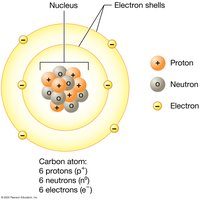
Atoms are composed of three subatomic particles:
Protons: Positively charged, located in the nucleus.
Neutrons: Uncharged, slightly larger than protons, also in the nucleus.
Electrons: Negatively charged, orbit the nucleus in electron shells.
Atoms are electrically neutral when the number of protons equals the number of electrons.
Electron shells:
1st shell: holds up to 2 electrons
2nd shell: holds up to 8 electrons
3rd shell: holds up to 18 electrons (satisfied with 8 for most biological atoms)
Elements in the Human Body
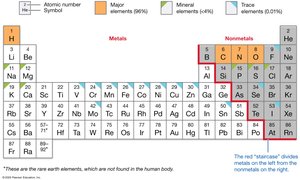
Defined by atomic number (number of protons).
Major elements (96% of body mass): Oxygen (O), Carbon (C), Hydrogen (H), Nitrogen (N).
Mineral elements (less than 4%): Sodium (Na), Potassium (K), Calcium (Ca), Chlorine (Cl), Magnesium (Mg), Phosphorus (P), Sulfur (S).
Trace elements (0.01%): Iron (Fe), Copper (Cu), Iodine (I), Zinc (Zn), and others.
Isotopes and Radioactivity
Isotope: Atoms of the same element with different numbers of neutrons (different mass numbers).
Radioisotopes: Unstable isotopes that emit radiation; used in medical imaging and cancer therapy.
Nuclear Medicine Applications
Cancer radiation therapy: Destroys cancer cells using targeted radiation.
Radiotracers: Used in diagnostic imaging to visualize organ function.
Treatment of thyroid disorders: Iodine-131 selectively destroys overactive thyroid tissue.

Matter Combined: Mixtures and Chemical Bonds
Mixtures
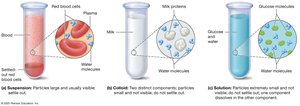
Mixture: Physical combination of two or more substances; components retain their original properties and can be separated physically.
Types of mixtures:
Suspensions: Large particles, settle out (e.g., blood).
Colloids: Small particles, do not settle, opaque (e.g., milk).
Solutions: Solute dissolves in solvent, clear (e.g., salt water).
Chemical Bonds
Chemical bond: Attractive force holding atoms together in molecules or compounds.
Valence electrons: Electrons in the outermost shell; involved in bonding.
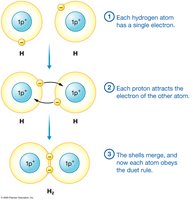
Octet Rule: Atoms are most stable with 8 electrons in their valence shell (or 2 for very small atoms—Duet Rule).
Ions and Ionic Bonds
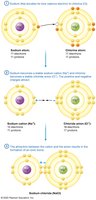
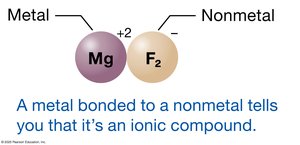
Ionic bond: Formed when electrons are transferred from a metal to a nonmetal, creating charged ions (cations and anions) that attract each other.
Cation: Positively charged ion.
Anion: Negatively charged ion.
Common in salts (e.g., NaCl).
Covalent Bonds
Covalent bond: Electrons are shared between two or more nonmetal atoms; strongest type of bond.
Single, double, or triple bonds depending on the number of shared electron pairs.
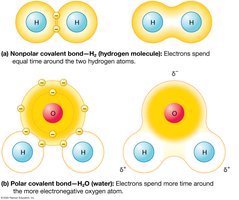
Nonpolar covalent bond: Electrons shared equally (e.g., O2, H2).
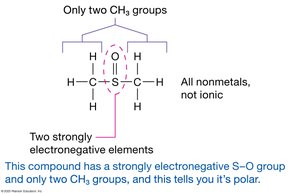
Polar covalent bond: Electrons shared unequally, creating partial charges (e.g., H2O).
Hydrogen Bonds
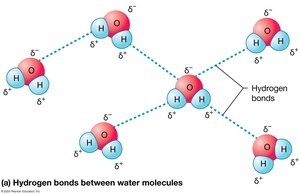
Weak attractions between partially positive hydrogen atoms and partially negative atoms in polar molecules (e.g., between water molecules).
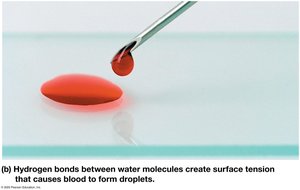
Responsible for surface tension in water and many biological properties.
Determining Bond Types
Ionic: Metal + nonmetal.
Nonpolar: Identical nonmetals, or mostly C and H.
Polar: Two nonmetals with different electronegativities.
Chemical Notation and Reactions
Chemical Equations
Chemical reaction: Bonds are formed, broken, or rearranged; electrons may be transferred.
Reactants: Starting substances (left side).
Products: Substances formed (right side).
Reversible reactions:
Irreversible reactions:
Energy in Chemical Reactions
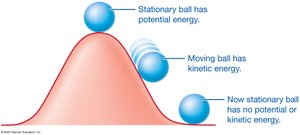
Energy: Capacity to do work; can be potential (stored) or kinetic (in motion).
Forms: Chemical, electrical, mechanical.
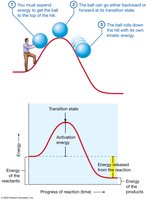
Endergonic reactions: Require energy input; products have more energy than reactants.
Exergonic reactions: Release energy; products have less energy than reactants.
Types of Chemical Reactions in the Body
Catabolic reactions: Break down large molecules; generally exergonic.
Anabolic reactions: Build new molecules; generally endergonic.
Exchange reactions: Atoms or electrons are exchanged between reactants.
Redox reactions: Involve electron transfer; oxidation (loss of electrons), reduction (gain of electrons).
Reaction Rates and Enzymes
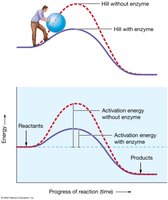
Activation energy: Minimum energy required for a reaction to occur.
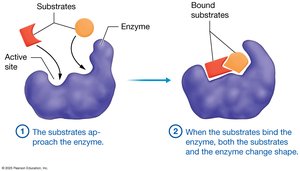
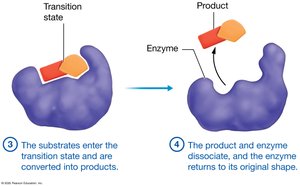
Catalyst: Substance that lowers activation energy, increasing reaction rate; biological catalysts are called enzymes.
Enzymes are highly specific, not consumed in reactions, and dramatically speed up reaction rates.
Enzyme Deficiencies
Tay-Sachs Disease: Deficiency of hexosaminidase; leads to fatal accumulation of lipids in brain cells.
SCIDS: Severe immune deficiency due to enzyme defect.
Phenylketonuria: Deficiency of phenylalanine hydroxylase; can cause intellectual disability if untreated.
Inorganic Compounds: Water, Acids, Bases, and Salts
Water
Makes up 50–65% of body mass; vital for life.
Properties: High heat capacity, evaporative cooling, cushioning, lubrication, universal solvent.
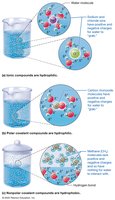
Hydrophilic: Substances that dissolve in water (polar or charged).
Hydrophobic: Substances that do not dissolve in water (nonpolar).
Acids and Bases
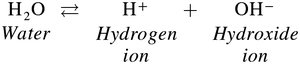
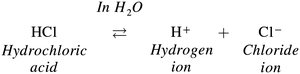
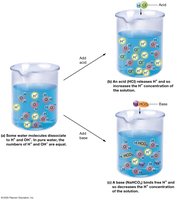
Acid: Proton (H+) donor; increases H+ in solution.
Base: Proton acceptor; decreases H+ in solution.
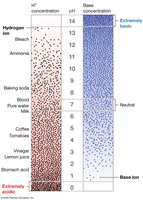
pH scale: Measures hydrogen ion concentration; 7 is neutral, below 7 is acidic, above 7 is basic.
Each pH unit represents a tenfold change in H+ concentration.
Buffers
Chemical systems that resist changes in pH.
Major buffer in blood: carbonic acid–bicarbonate system.
Acidosis: blood pH < 7.35; Alkalosis: blood pH > 7.45.

Salts and Electrolytes
Salt: Compound of a metal cation and a nonmetal anion held by ionic bonds.
Electrolytes: Ions in solution that conduct electricity; essential for nerve and muscle function.
Organic Compounds
Hydrocarbons
Organic compounds containing only carbon and hydrogen; form chains and rings; backbone of all organic molecules.
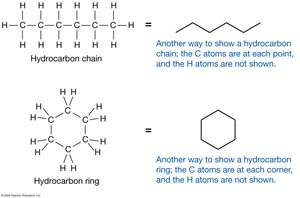
Monomers and Polymers
Four main organic compounds: carbohydrates, lipids, proteins, nucleic acids.
Monomer: Single subunit.
Polymer: Many monomers linked together.
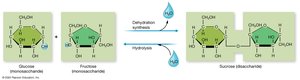
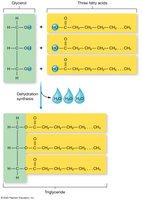
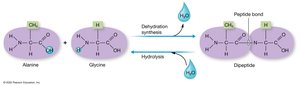
Dehydration synthesis: Joins monomers by removing water.
Hydrolysis: Breaks polymers by adding water.
Carbohydrates
Composed of C, H, O (1:2:1 ratio); polar and hydrophilic.
Functions: Fuel, structure, cell recognition.
Monosaccharides: Simple sugars (glucose, fructose, galactose, ribose, deoxyribose).
Disaccharides: Two monosaccharides (sucrose, lactose).
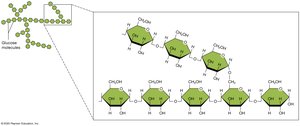
Polysaccharides: Long chains (glycogen in animals, starch in plants).
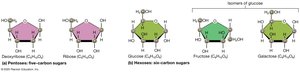
Lipids
Composed of C, H, (some O); nonpolar and hydrophobic.
Functions: Energy storage, cell membranes, hormones.
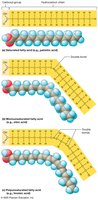
Fatty acids: Saturated (no double bonds), monounsaturated (one double bond), polyunsaturated (multiple double bonds).
Triglycerides: Three fatty acids + glycerol; main storage form.
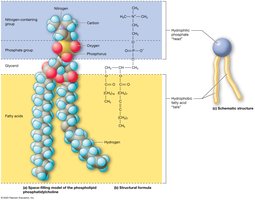
Phospholipids: Glycerol, two fatty acids, phosphate group; amphiphilic; main component of cell membranes.
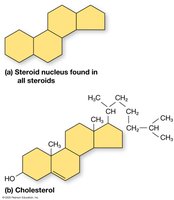
Steroids: Four-ring structure; includes cholesterol, bile acids, sex hormones.
Proteins
Composed of C, H, O, N (sometimes S); may be polar or nonpolar.
Functions: Structure, enzymes, defense, signaling, movement, fuel.
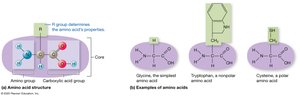
Amino acids: 21 types; central carbon, amino group, carboxyl group, R group.
Peptide bonds: Link amino acids via dehydration synthesis.
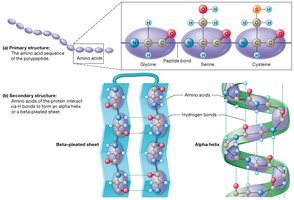
Levels of structure:
Primary: Amino acid sequence
Secondary: Alpha helix, beta-pleated sheet (hydrogen bonds)
Tertiary: 3D folding (R group interactions)
Quaternary: Multiple polypeptide chains
Denaturation: Loss of structure and function due to heat, pH, or chemicals.
Nucleotides and Nucleic Acids
Composed of C, H, O, N, P; include DNA and RNA.
Nucleotide: Nitrogenous base, five-carbon sugar, phosphate group.
ATP: Main energy carrier; formed from ADP and phosphate; hydrolysis releases energy.
DNA: Double helix; deoxyribose sugar; bases A, T, G, C; stores genetic code.
RNA: Single strand; ribose sugar; bases A, U, G, C; involved in protein synthesis.
Additional info: The chapter provides foundational chemical concepts essential for understanding all physiological processes, including cellular metabolism, signaling, and genetic inheritance.
