 뒤로
뒤로Chapter 3 Cell Structure & Function Study Guidance (Anatomy & Physiology I)
스터디 가이드 - 스마트 노트
 자료에 맞춘 맞춤형 노트, 핵심 정의, 예시, 맥락을 확장해 제공합니다.
Q1. Complete the chart on structure of the cell - summarize the structure and function for each organelle.
Background
Topic: Cell Structure & Function
This question tests your understanding of the major organelles found in eukaryotic cells, their structural features, and their specific functions. Knowing these details is foundational for understanding cell physiology and how cells maintain homeostasis.
Key Terms:
Plasma membrane
Cytosol
Mitochondria
Nucleus
Golgi apparatus
Lysosomes
Peroxisomes
Endoplasmic reticulum (smooth & rough)
Cytoskeleton
Microvilli, centrioles, cilia, flagella, ribosomes
Step-by-Step Guidance
Review the structural features of each organelle. For example, the plasma membrane is a phospholipid bilayer with embedded proteins, while mitochondria have a double membrane and internal folds called cristae.
Summarize the function of each organelle in your own words. For instance, the nucleus stores genetic material and controls cellular activities, while the Golgi apparatus modifies and packages proteins.
Compare membranous (enclosed by a membrane) and non-membranous organelles. Membranous organelles include mitochondria, nucleus, ER, Golgi, lysosomes, and peroxisomes; non-membranous include cytoskeleton, ribosomes, centrioles, etc.
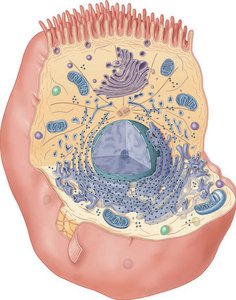
Use the cell diagram to visually identify each organelle and relate its structure to its function. For example, the extensive network of the ER is related to its role in protein and lipid synthesis.
Organize your chart so that each organelle has a brief structural description and a concise functional summary. Avoid generic phrases (e.g., "powerhouse of the cell" for mitochondria) and aim for specific, accurate explanations.
Try solving on your own before revealing the answer!
Final Answer:
Plasma membrane: Phospholipid bilayer with embedded proteins; regulates entry/exit of substances, cell communication.
Cytosol: Fluid portion of cytoplasm; site of many metabolic reactions.
Mitochondria: Double membrane, cristae; site of aerobic respiration and ATP production.
Nucleus: Double membrane (nuclear envelope), contains DNA; controls cell activities, stores genetic information.
Golgi apparatus: Stacks of flattened membranes; modifies, sorts, and packages proteins/lipids for secretion or use in cell.
Lysosomes: Membrane-bound vesicles with digestive enzymes; breakdown of waste, cellular debris, and foreign material.
Peroxisomes: Membrane-bound vesicles; detoxify harmful substances, break down fatty acids.
Endoplasmic reticulum: Rough ER (with ribosomes) synthesizes proteins; smooth ER synthesizes lipids and detoxifies.
Cytoskeleton: Network of protein filaments (microtubules, microfilaments, intermediate filaments); provides structural support, cell movement.
Microvilli: Extensions of plasma membrane; increase surface area for absorption.
Centrioles: Cylindrical structures; organize microtubules during cell division.
Cilia: Hair-like projections; move substances across cell surface.
Flagella: Long, whip-like structure; enables cell movement (e.g., sperm).
Ribosomes: Non-membranous, made of RNA and protein; site of protein synthesis.
Each organelle's structure is closely related to its function, and understanding these relationships is key to mastering cell biology.
