 뒤로
뒤로Lecture PP-Chapter 3: Cells and Tissues – Essentials of Human Anatomy & Physiology
스터디 가이드 - 스마트 노트
 자료에 맞춘 맞춤형 노트, 핵심 정의, 예시, 맥락을 확장해 제공합니다.
Cells and Tissues
Introduction to Cells
Cells are the fundamental structural and functional units of all living organisms. The human body contains approximately 50 to 100 trillion cells, each specialized for particular functions. Understanding cell structure and function is essential for comprehending human anatomy and physiology.
Cell Theory:
A cell is the basic structural and functional unit of living organisms.
The activity of an organism depends on the collective activities of its cells.
The principle of complementarity states that cell structure determines function.
Continuity of life has a cellular basis.
Cell Composition: Most cells are composed of carbon, hydrogen, oxygen, and nitrogen, and are about 60% water.
Anatomy of a Generalized Cell
Main Regions of a Cell
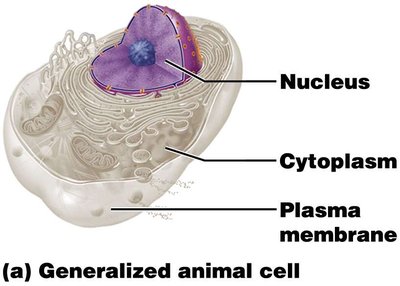
All cells share three main regions:
Plasma membrane
Nucleus
Cytoplasm
The Plasma Membrane
Structure and Function
The plasma membrane is a transparent barrier that contains and protects cell contents, separating them from the external environment. It is described by the fluid mosaic model, which highlights its dynamic and complex structure.
Fluid Mosaic Model:
Composed of a bilayer of phospholipids arranged tail-to-tail.
Contains cholesterol and proteins scattered among the phospholipids.
Sugar groups may be attached, forming glycolipids and glycoproteins.
Phospholipid Arrangement:
Hydrophilic (water-loving) heads face the inner and outer surfaces.
Hydrophobic (water-fearing) tails form the membrane's interior, making it relatively impermeable to water-soluble molecules.
Proteins: Serve as enzymes, receptors, and transport channels or carriers.
Sugars: Glycoproteins and the glycocalyx (sugar-rich area) play roles in cell recognition and adhesion.
Cell Junctions
Cells are bound together by various junctions, which are essential for tissue integrity and communication.
Tight Junctions: Impermeable, bind cells into leakproof sheets.
Desmosomes: Anchoring junctions that prevent cells from being pulled apart.
Gap Junctions: Allow communication between cells via connexons (protein channel
The Nucleus
Structure and Function
The nucleus is the control center of the cell, containing DNA necessary for protein synthesis and cell reproduction. It consists of three main regions:
Nuclear Envelope: Double membrane with pores for material exchange; encloses nucleoplasm.
Nucleolus: Site of ribosome assembly; ribosomes exit to the cytoplasm for protein synthesis.
Chromatin: DNA wound around histones; condenses into chromosomes during cell division.
The Cytoplasm
Components of the Cytoplasm
The cytoplasm is the cellular material outside the nucleus and inside the plasma membrane. It is the site of most cellular activities and includes:
Cytosol: Fluid suspending other elements, containing nutrients and electrolytes.
Inclusions: Chemical substances such as stored nutrients or cell products.
Organelles: Specialized structures performing specific functions, many of which are membrane-bound.
Major Organelles and Their Functions
Mitochondria: "Powerhouses" of the cell; site of ATP production via aerobic respiration.
Endoplasmic Reticulum (ER):
Rough ER: Studded with ribosomes; synthesizes and transports proteins.
Smooth ER: Lacks ribosomes; involved in lipid metabolism and detoxification.
Golgi Apparatus: Modifies, sorts, and packages proteins and lipids for secretion or internal use.
Lysosomes: Contain digestive enzymes; break down waste and cellular debris.
Peroxisomes: Detoxify harmful substances and break down free radicals.
Cytoskeleton: Network of protein filaments (microfilaments, intermediate filaments, microtubules) providing structural support and facilitating movement.
Centrioles: Organize microtubules and direct formation of the mitotic spindle during cell division.
Cell Extensions
Specialized Surface Structures
Cilia: Move materials across the cell surface (e.g., in the respiratory tract).
Flagella: Propel the cell; only human example is sperm.
Microvilli: Increase surface area for absorption (e.g., in the small intestine).
Cell Diversity
Specialized Cell Types
The human body contains over 200 different cell types, each adapted for specific functions:
Fibroblasts: Connect body parts by secreting fibers.
Erythrocytes (Red Blood Cells): Carry oxygen in the bloodstream.
Epithelial Cells: Cover and line body organs; resist tearing.
Muscle Cells: Contract to move body parts.
Fat Cells: Store nutrients as lipid droplets.
White Blood Cells: Fight disease by digesting microorganisms.
Nerve Cells (Neurons): Gather information and control body functions.
Oocytes and Sperm: Cells of reproduction; oocyte is the largest cell, sperm is motile.
Cell Physiology
Basic Cell Functions
Metabolize
Digest food
Dispose of wastes
Reproduce
Grow
Move
Respond to stimuli
Membrane Transport
Types of Transport
The plasma membrane is selectively permeable, allowing some substances to pass while excluding others. Transport occurs via passive or active processes.
Passive Processes: Do not require cellular energy (ATP).
Diffusion: Movement from high to low concentration (down a gradient).
Simple Diffusion: Unassisted movement of lipid-soluble or small molecules.
Osmosis: Diffusion of water through aquaporins.
Facilitated Diffusion: Uses protein carriers or channels for substances that are lipid-insoluble or too large.
Filtration: Water and solutes forced through a membrane by hydrostatic pressure (important in kidneys).
Active Processes: Require ATP.
Active Transport: Solute pumps move substances against concentration gradients (e.g., sodium-potassium pump).
Vesicular Transport: Bulk movement via vesicles (exocytosis and endocytosis).
Phagocytosis: "Cell eating" of large particles.
Pinocytosis: "Cell drinking" of extracellular fluid.
Receptor-Mediated Endocytosis: Selective uptake of specific molecules.
Cell Division
Cell Life Cycle
Interphase: Cell grows and carries out normal functions; DNA is replicated toward the end.
Cell Division: Includes mitosis (nuclear division) and cytokinesis (cytoplasmic division).
Mitosis Stages:
Prophase: Chromatin condenses into chromosomes; spindle forms.
Metaphase: Chromosomes align at the cell's equator.
Anaphase: Chromatids separate and move to opposite poles.
Telophase: Chromosomes uncoil; nuclear envelope reforms.
Cytokinesis: Division of cytoplasm, resulting in two daughter cells.
Protein Synthesis
Genetic Control of Protein Production
DNA: Blueprint for protein synthesis; genes code for specific proteins.
RNA: Messenger and decoder for DNA instructions; three types:
mRNA (Messenger RNA): Carries instructions from DNA to ribosomes.
tRNA (Transfer RNA): Brings amino acids to ribosomes.
rRNA (Ribosomal RNA): Forms part of the ribosome structure.
Transcription: DNA sequence is copied to mRNA in the nucleus.
Translation: mRNA is decoded in the cytoplasm to build a protein from amino acids.
Example: If the DNA sequence is AAT-CGT-TCG, the mRNA codons are UUA-GCA-AGC.
Table: Parts of the Cell – Structure and Function
Part | Structure | Function |
|---|---|---|
Plasma Membrane | Phospholipid bilayer with proteins and cholesterol | Encloses cell, regulates entry/exit |
Nucleus | Double membrane, contains nucleolus and chromatin | Control center, stores genetic material |
Cytoplasm | Cytosol, inclusions, organelles | Site of most cellular activities |
Mitochondria | Double membrane, cristae | ATP production |
Rough ER | Membranous, studded with ribosomes | Protein synthesis and transport |
Smooth ER | Membranous, no ribosomes | Lipid metabolism, detoxification |
Golgi Apparatus | Stack of flattened membranes | Modifies, sorts, packages proteins/lipids |
Lysosomes | Membranous sacs with enzymes | Digestion of waste and debris |
Peroxisomes | Membranous sacs with oxidase enzymes | Detoxification, breakdown of free radicals |
Cytoskeleton | Microfilaments, intermediate filaments, microtubules | Structural support, movement |
Centrioles | Rod-shaped, microtubule triplets | Organize spindle during cell division |
Additional info: This summary covers the essential concepts of cell structure, function, and physiology as outlined in Chapter 3 of "Essentials of Human Anatomy & Physiology." It is suitable for college-level Anatomy & Physiology students preparing for exams or seeking a concise review.
