 뒤로
뒤로Chemistry Comes Alive: Foundations of Anatomy & Physology
스터디 가이드 - 스마트 노트
 자료에 맞춘 맞춤형 노트, 핵심 정의, 예시, 맥락을 확장해 제공합니다.
Introduction to Chemistry in Anatomy & Physiology
Understanding chemistry is essential for studying anatomy and physiology, as it underlies all cellular and physiological processes. This section explores the foundational concepts of matter, energy, and the chemical principles that govern biological systems.
Basic Chemistry
2.1 Matter and States of Matter
Key Concepts:
Definition of Matter: Matter is any substance that has mass and occupies space. It can be seen, smelled, or felt.
States of Matter:
Solid: Definite shape and volume.
Liquid: Changeable shape, but definite volume.
Gas: Changeable shape and volume.
Weight: The measure of mass plus the effect of gravity.
2.1 Energy and Its Forms
Key Concepts:
Energy: The capacity to do work or cause change. The greater the work, the more energy consumed.
Types of Energy:
Kinetic Energy: Energy in motion.
Potential Energy: Stored energy, ready to be converted into kinetic energy.
Forms of Energy:
Chemical: Stored in the bonds of molecules.
Electrical: Movement of charged particles.
Mechanical: Directly involved in moving matter.
Radiant (or electromagnetic): Travels in waves (e.g., light, UV, X-rays).
Energy Conversion: Energy can be converted from one form to another, but some is lost as heat during conversion.
Atoms, Elements, and the Periodic Table
2.2 Elements and Atoms
Key Concepts:
Elements: Pure substances that cannot be broken down by ordinary chemical means. The human body is composed of four main elements: carbon, oxygen, hydrogen, and nitrogen (making up 96% of the body), with additional elements present in trace amounts.
Atoms: The smallest units of elements, composed of protons (positive), electrons (negative), and f (neutral).
2.3 Chemical Bonds and Reactions
Key Concepts:
Free Radicals: Highly reactive atoms with unpaired electrons.
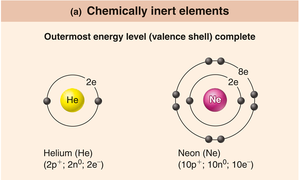
Valence Shell: The outermost shell of electrons, which determines reactivity.
Atoms achieve stability by gaining, losing, or sharing electrons to achieve a stable configuration (usually 8 electrons in the outer shell).
2.3 Combining Matter: Molecules, Compounds, and Reactions
Key Concepts:
Elements combine to form:
Ves: Two or more atoms joined together.
Compounds: Molecules with two or more different atoms.
Mixtures: Physical combinations of two or more components. Types include:
Solutions: Solute particles are very small and do not settle out or scatter.
Colloids: Particles are larger than in solutions, but do not settle out.
Suspensions: Particles are large, settle out, and may be separated by filtration.
Atomic Structure and Chemical Elements
2.4 Elements: Chemically Inert and Reactive
Key Concepts:
Inert Elements: Have complete outer shells (e.g., helium and chlorine), making them stable and unreactive.
Reactive Elements: Have incomplete outer shells (e.g., hydrogen, carbon, oxygen, chlorine), making them likely to react to achieve stability.
Types of Chemical Bonds
2.4 Ionic Bonds
Key Concepts:
Definition: Ionic bonds are formed when electrons are transferred from one atom to another, creating charged particles called ions.
Types of ions:
Anions: Gained electrons (negative charge).
Cations: Lost electrons (positive charge).
Example: Formation of NaCl (salt) by the transfer of electrons from Na to Cl (see illustration below).
2.4 Covalent Bonds
Key Concepts:
Definition: Covalent bonds are formed when two or more atoms share electrons.
Types:
Single bond: Sharing one pair of electrons.
Double bond: Sharing two pairs of electrons.
Triple bond: Sharing three pairs of electrons.
Types of covalent bonds:
Non-dipolar: Equal sharing of electrons (e.g., CO2).
Polar: Unequal sharing of electrons (e.g., H2).
2.4 Molecular Structure: Nonpolar and Polar Molecules
Key Concepts:
Nonpolar: Molecules like CO2 are linear and symmetrical, making them nonpolar.
Polar: Molecules like H2 are shaped so that one end is slightly more negative and the other more positive, making them polar.
2.4 Bond Types: Comparison Table
Comparison of Bond Types:
Bond Type | Bond Formation | Example |
|---|---|---|
Ionic | Complete transfer of electrons | Sodium chloride (NaCl) |
Polar Covalent | Unequal sharing of electrons | Water (H2) |
Nonpolar Covalent | Equal sharing of electrons | Carbon dioxide (CO2) |
Types of Chemical Reactions
2.5 Types of Chemical Reactions
Key Concepts:
Synthesis (Anabolism): Combining smaller molecules to form larger, more complex molecules. Example: Amino acids joining to form proteins.
Rion (Catabolism): Breaking down larger molecules into smaller ones. Example: Breaking down glycogen into glucose.
Biochemistry: The Chemistry of Life
2.6 Inorganic Compounds: Water, Salts, and Electrolytes
Key Concepts:
Water: The most abundant inorganic compound in the body, with important properties:
High heat capacity and heat of vaporization
Polar solvent (dissolves salts and other molecules)
Reactivity (involved in reactions like hydrolysis and dehydration)
Protective cushioning (e.g., in the brain)
Salts:
Salts are electrolytes that dissociate into ions in solution.
Important for maintaining cellular and systemic homeostasis (e.g., Na, Cl, Ca, F).
2.6 Acids, Bases, and the pH Scale
Key Concepts:
Acids: Proton donors (release H–).
Ves: Proton acceptors (accept H– and release OH–). Rts: A pH of pH of pH of <
