뒤로
뒤로Chemistry Comes Alive: Foundations of Biochemistry for Anatomy & Physiology
스터디 가이드 - 스마트 노트
 자료에 맞춘 맞춤형 노트, 핵심 정의, 예시, 맥락을 확장해 제공합니다.
Chemistry Comes Alive
Introduction to Biochemistry
Biochemistry is the study of chemical substances and vital processes occurring in living organisms. It examines the chemical makeup of organisms and the reactions required for life. Understanding biochemistry is essential for grasping the molecular basis of anatomy and physiology.
Organic compounds: Always contain carbon, often large, covalently bonded molecules (e.g., carbohydrates, lipids, proteins, nucleic acids).
Inorganic compounds: Usually do not contain carbon (exceptions: CO2, CO, carbides), often small, mostly ionic bonds (e.g., water, salts, acids, bases).
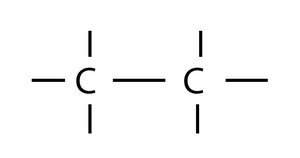
Example: Organic compounds demonstrate carbon-carbon (C–C) bonds, while inorganic compounds containing carbon lack these bonds.
Chemical Reactions
Reversibility and Reaction Rate
Chemical reactions in biological systems are often reversible, meaning products can revert to reactants. The direction and rate of these reactions are influenced by several factors.
Reversible reactions: All chemical reactions are theoretically reversible, but the predominant direction depends on conditions.
Chemical equilibrium: Achieved when the rate of the forward reaction equals the rate of the reverse reaction.
Factors increasing reaction rates:
Increased temperature
Smaller particle size
Higher reactant concentration
Catalysts (including biological catalysts such as enzymes)
Catalysts: Substances that increase reaction rates without being consumed in the reaction.
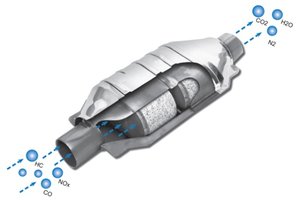
Example: Catalytic converters in cars use catalysts to speed up the conversion of harmful gases into less toxic substances.
Inorganic Compounds
Water Properties
Water is the most abundant inorganic compound in living systems and is vital for life due to its unique properties.
High heat capacity: Absorbs/releases large amounts of heat with little temperature change.
High heat of vaporization: Requires significant energy to change from liquid to gas.
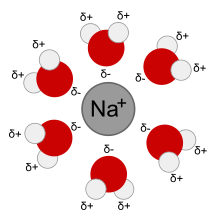
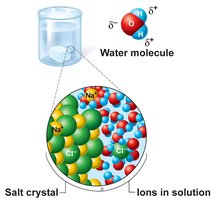
Polar solvent: Dissolves ionic substances, forms hydration layers around ions and proteins, and is the body's main transport medium.
Reactivity: Participates in hydrolysis and dehydration synthesis reactions.
Cushioning: Provides shock resistance around organs.
Salts
Salts are ionic compounds that dissociate into ions in water. These ions are electrolytes, essential for conducting electrical currents in the body.
Common salts: NaCl (sodium chloride), CaCO3 (calcium carbonate), KCl (potassium chloride).
Electrolytes: All ions from salts can conduct electricity.
Acids and Bases
Acids and bases are ionic compounds that affect the hydrogen ion concentration in solutions.
Acids: Proton (H+) donors; release H+ in solution (e.g., HCl → H+ + Cl–).
Bases: Proton acceptors; release OH– in solution (e.g., NaOH → Na+ + OH–).
Strong acids/bases: Completely dissociate in water.
Weak acids/bases: Partially dissociate in water.
Acid-Base Concentration (pH)
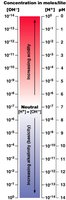
The pH scale measures the relative concentration of hydrogen ions in a solution, ranging from 0 (most acidic) to 14 (most basic).
Acidic solutions: pH 0–6.99 (higher [H+])
Neutral solutions: pH 7.00 ([H+] = [OH–])
Alkaline solutions: pH 7.01–14 (lower [H+])
Neutralization: Mixing equal amounts of acid and base yields water and a salt.
Body acid/base balance: Highly regulated, involving buffer systems.
Buffers
Buffers are solutions that resist changes in pH when small amounts of acid or base are added. They are crucial for maintaining stable pH in body fluids.
Dual action mechanism:
When pH rises, buffers release H+ (act as acids).
When pH falls, buffers bind H+ (act as bases).
Example: The carbonic acid-bicarbonate buffer system maintains blood pH.
Equation:
When blood pH is too high, carbonic acid dissociates to release H+, lowering pH. When blood pH is too low, bicarbonate binds H+, raising pH.
Organic Compounds
General Properties
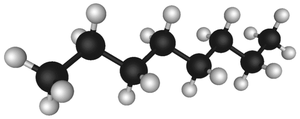
Organic compounds are defined by the presence of carbon atoms, which can form four covalent bonds, allowing for a diversity of structures and functions.
Monomers: Single organic molecules (e.g., methane, CH4).
Polymers: Long chains of monomers (e.g., starch).
Major categories: Carbohydrates, lipids, proteins, nucleic acids.
Carbohydrates
Carbohydrates are molecules composed of carbon, hydrogen, and oxygen. Their primary function is to provide cellular fuel (ATP).
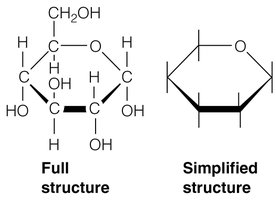
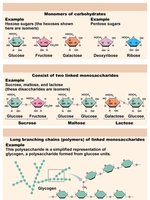
Monosaccharides: Simple sugars (single-chain or ring structures).
Disaccharides: Two monosaccharides joined by dehydration synthesis.
Polysaccharides: Long chains of monosaccharides, often branched.
Carbohydrate Reactions
Carbohydrates undergo two main types of reactions: dehydration synthesis and hydrolysis.
Dehydration synthesis: Joins two monomers by removing water, forming a glycosidic bond.
Hydrolysis: Breaks a glycosidic bond by adding water, splitting the molecule into two monomers.
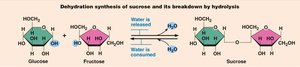


Carbohydrate Structures
Carbohydrates can be classified based on the number of sugar units present.
Monosaccharides: 5 or 6-carbon molecules (e.g., glucose, fructose).
Disaccharides: Two monosaccharides linked together (e.g., sucrose, lactose).
Polysaccharides: Branched or unbranched chains of monosaccharides (e.g., glycogen, starch).
Lipids
Lipids are a diverse group of water-insoluble molecules that dissolve in nonpolar solvents. They contain carbon, hydrogen, and oxygen, but with less oxygen than carbohydrates.
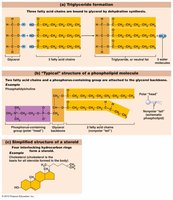
Triglycerides (neutral fats): Three fatty acids bound to glycerol.
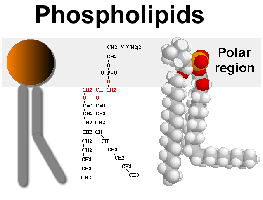
Phospholipids: Glycerol molecule with a phosphorus-containing group and two fatty acid chains; major component of cell membranes.
Steroids: Flat molecules with four interlocking hydrocarbon rings (e.g., cholesterol, steroid hormones).
Eicosanoids: Lipids derived from arachidonic acid, involved in signaling.
Lipid Structures
Lipids have characteristic structures that determine their function in biological systems.
Triglyceride: Glycerol + 3 fatty acids.
Phospholipid: Phosphorus group + glycerol + 2 fatty acids.
Cholesterol: Four interlocking carbon rings; base molecule for steroid hormones.