 뒤로
뒤로Chemistry Fundamentals for Anatomy & Physiology
스터디 가이드 - 스마트 노트
 자료에 맞춘 맞춤형 노트, 핵심 정의, 예시, 맥락을 확장해 제공합니다.
Chemistry Basics
Matter and Energy
Understanding the basic concepts of matter and energy is essential for studying Anatomy & Physiology, as all living organisms are composed of matter and require energy to function.
Matter: Anything that occupies space and has mass.
Energy: The capacity to do work. It exists in various forms:
Kinetic energy: Energy of motion.
Potential energy: Stored energy due to position.
Chemical energy: Energy stored in chemical bonds, such as ATP.
Law of Conservation of Energy: Energy cannot be created or destroyed, only converted from one form to another.
The Atom and Elements
Atomic Structure
Atoms are the fundamental units of elements, which make up all matter. The structure of an atom determines its chemical properties and behavior.
Element: A substance that cannot be broken down into simpler substances by chemical means.
Atom: The smallest unit of an element that retains its properties.
Atomic structure:
Nucleus: Contains protons (positive) and neutrons (neutral).
Electrons: Negatively charged particles orbiting the nucleus.
Atoms are electrically neutral when the number of protons equals the number of electrons.
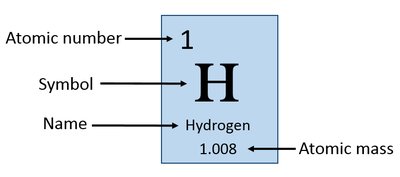
Atomic symbol: Shorthand notation for elements (e.g., H for Hydrogen).
Atomic number: Number of protons in the nucleus.
Mass number: Sum of protons and neutrons.
Isotopes: Atoms of the same element with different numbers of neutrons.
Atomic mass: Average mass of all isotopes of an element.
Molecules, Compounds, and Mixtures
Molecules and Compounds
Molecules and compounds are formed by the chemical bonding of atoms. Their properties are fundamental to biological processes.
Molecule: Two or more atoms held together by chemical bonds (e.g., H2, O2).
Compound: Two or more different atoms held together by chemical bonds (e.g., H2O).
Mixtures
Mixtures are physical combinations of substances. They are classified based on the size and behavior of their particles.
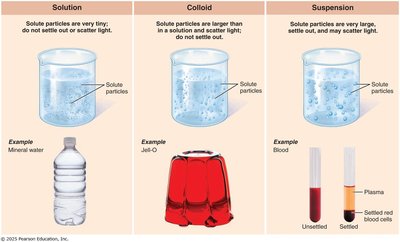
Solution: Homogeneous mixture; solute particles are very small and do not settle out or scatter light (e.g., mineral water).
Colloid: Heterogeneous mixture; solute particles are larger, do not settle out, and may scatter light (e.g., Jell-O).
Suspension: Heterogeneous mixture; solute particles are very large, settle out, and may scatter light (e.g., blood).
Chemical Bonds
Types of Chemical Bonds
Chemical bonds are the forces that hold atoms together in molecules and compounds. The type of bond affects the properties of the substance.
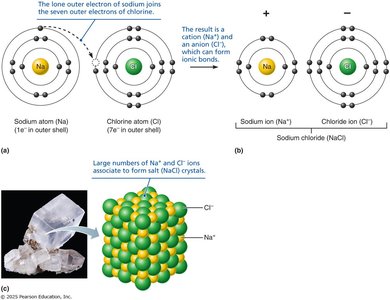
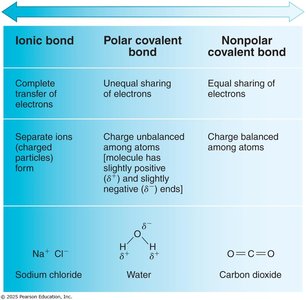
Ionic Bonds: Formed by the complete transfer of electrons from one atom to another, resulting in charged ions (cations and anions). Example: Sodium chloride (NaCl).
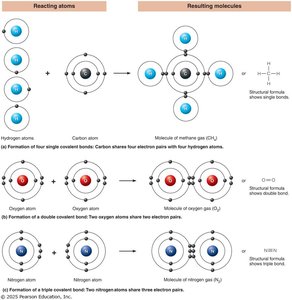
Covalent Bonds: Formed by the sharing of electrons between atoms.
Nonpolar covalent: Electrons are shared equally.
Polar covalent: Electrons are shared unequally, creating partial charges (dipoles).
Polarity and Electronegativity
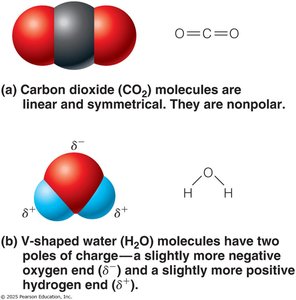
Polarity arises from differences in electronegativity between atoms, affecting molecular interactions and solubility.
Electronegativity: The ability of an atom to attract electrons.
Dipole: Partial positive and negative charges within a molecule due to unequal sharing of electrons.
Polar molecules: Have distinct poles of charge (e.g., water).
Nonpolar molecules: Have balanced charge distribution (e.g., carbon dioxide).
Hydrogen Bonding
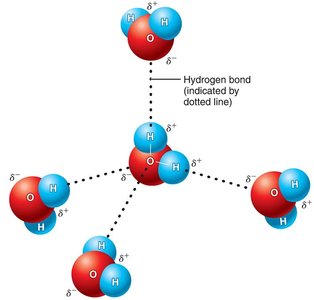
Hydrogen bonds are weak attractions between partially charged regions of molecules, important for the structure of water and biological macromolecules.
Hydrogen bond: Forms when a hydrogen atom covalently bound to an electronegative atom (N or O) interacts with another electronegative atom.
These bonds are weak but crucial for stabilizing structures like DNA and proteins.
Chemical Reactions
Types of Chemical Reactions
Chemical reactions involve the making and breaking of chemical bonds, resulting in new substances.
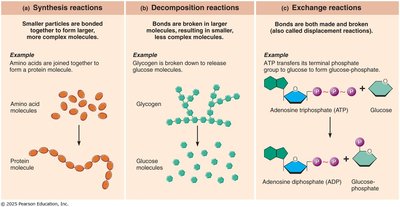
Synthesis (Combination) Reaction: Atoms or molecules combine to form larger, more complex molecules. Anabolic in nature.
Decomposition Reaction: A molecule is broken down into smaller molecules or atoms. Catabolic in nature.
Exchange Reaction: Bonds are both made and broken; atoms are exchanged between molecules.
Redox Reactions
Oxidation-reduction (redox) reactions involve the transfer of electrons between reactants, playing a vital role in metabolism.
Oxidized: Reactant loses electrons.
Reduced: Reactant gains electrons.
LEO goes GER: Lose Electrons = Oxidized; Gain Electrons = Reduced.
Energy Flow in Chemical Reactions
Energy changes accompany chemical reactions, influencing their spontaneity and biological significance.
Exergonic reactions: Release energy; typically catabolic.
Endergonic reactions: Require energy input; typically anabolic.
Chemical equilibrium: Forward and reverse reaction rates are equal.
Catalysts: Substances that increase reaction rates without being consumed.
Biochemistry: Organic and Inorganic Compounds
Water, Salts, Acids, and Bases
Water and inorganic compounds are essential for cellular function and homeostasis.
Water: Makes up 60-80% of cellular volume; has high heat capacity, high heat of vaporization, polarity, and acts as a universal solvent.
Salt: Ionic compound that dissociates in water, forming electrolytes.
Acid: Releases H+ ions in solution; proton donor.
Base: Accepts H+ ions; proton acceptor; produces OH- ions in solution.
pH and Buffer Systems
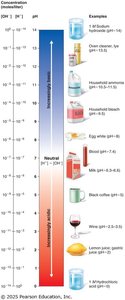
The pH scale measures the concentration of hydrogen ions in solution, which is critical for maintaining physiological balance.
pH:
pH 7 is neutral; below 7 is acidic; above 7 is basic.
Neutralization: Acids and bases react to form water and a salt.
Buffer: Resists changes in pH; often a weak acid and its conjugate base.
Macromolecules
Polymers and Monomers
Macromolecules are large, complex molecules essential for life. They are formed from smaller units called monomers.
Polymer: Chainlike molecule made of repeating monomers.
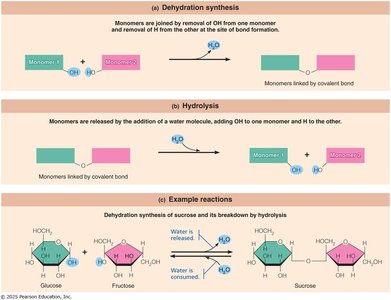
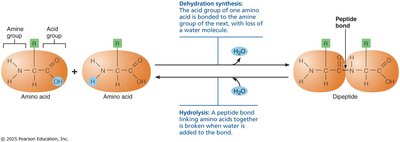
Dehydration synthesis: Formation of polymers by joining monomers and releasing water.
Hydrolysis: Breakdown of polymers into monomers using water.
Carbohydrates
Carbohydrates are organic molecules that serve as energy sources and structural components.
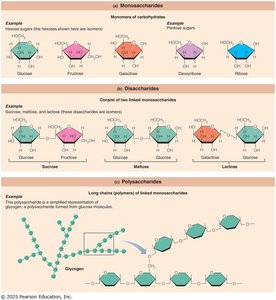
Monosaccharides: Simple sugars (e.g., glucose, fructose).
Disaccharides: Two monosaccharides linked (e.g., sucrose, lactose).
Polysaccharides: Long chains of monosaccharides (e.g., glycogen).
Lipids
Lipids are hydrophobic molecules important for energy storage, membrane structure, and signaling.
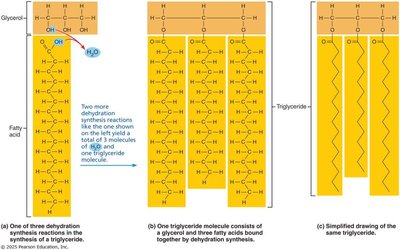
Triglycerides: Composed of glycerol and three fatty acids.
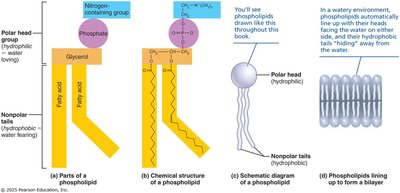
Phospholipids: Major component of cell membranes; have hydrophilic heads and hydrophobic tails.
Proteins
Proteins are polymers of amino acids that perform a wide range of functions in the body.
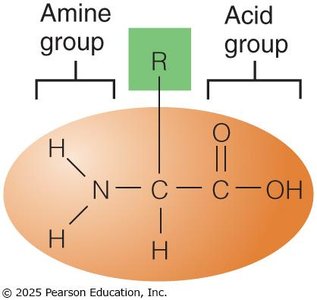
Amino acid: Building block of proteins; contains an amine group, acid group, and variable R group.
Peptide bond: Covalent bond joining amino acids via dehydration synthesis.
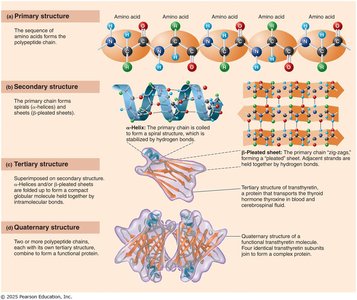
Protein structure:
Primary: Sequence of amino acids.
Secondary: Alpha helix or beta sheet formed by hydrogen bonding.
Tertiary: Three-dimensional folding due to interactions among R groups.
Quaternary: Association of multiple polypeptide chains.
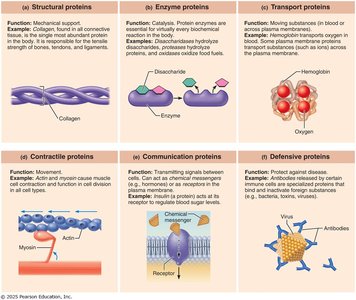
Protein functions: Structural, enzymatic, transport, contractile, communication, and defensive roles.
Enzymes
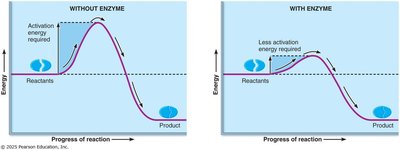
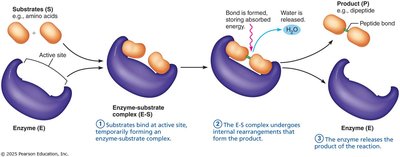
Enzymes are proteins that act as biological catalysts, speeding up chemical reactions by lowering activation energy.
Enzyme-substrate complex: Temporary association between enzyme and substrate.
Activation energy: Energy required to start a reaction; enzymes lower this barrier.
Nucleic Acids: DNA and RNA
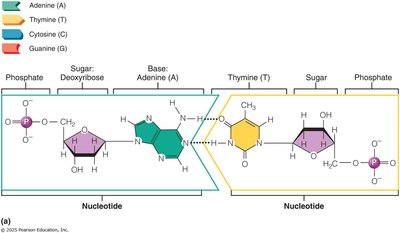
Nucleic acids store and transmit genetic information. DNA and RNA are polymers of nucleotides.
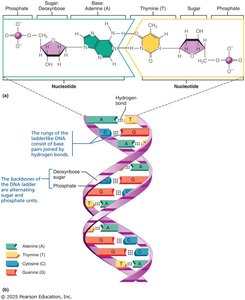
DNA: Double helix structure; contains adenine, thymine, cytosine, and guanine.
RNA: Single-stranded; contains adenine, uracil, cytosine, and guanine.
Nucleotide: Composed of a phosphate group, sugar, and nitrogenous base.
ATP: The Energy Currency of Cells
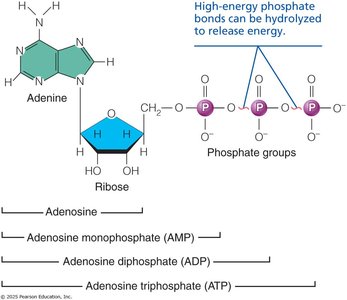
ATP (adenosine triphosphate) is the primary molecule for storing and transferring energy in cells.
Structure: Adenine, ribose, and three phosphate groups.
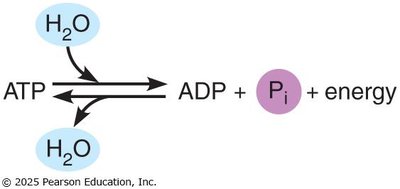
ATP hydrolysis: Releases energy by breaking a phosphate bond:
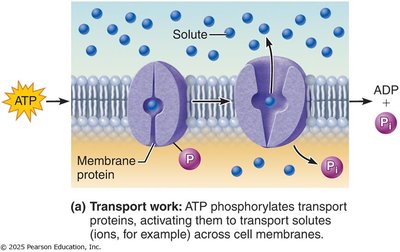
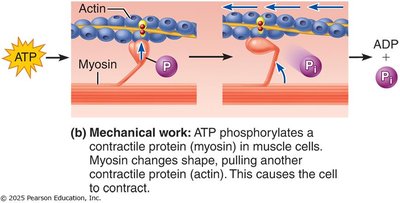
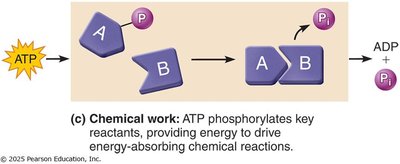
Cellular work: ATP powers transport, mechanical, and chemical work in cells.
Cell Basics
Cell Theory
The cell is the fundamental unit of life. All living organisms are composed of cells, and new cells arise from existing cells.
Cell: Smallest unit of life.
All organisms are made of one or more cells.
Cells arise only from pre-existing cells.
Cellular Structure
Basic Parts of the Cell
Cells share common structural features that enable their functions.
Plasma membrane: Selectively permeable boundary separating the cell from its environment.
Cytoplasm: Intracellular fluid containing organelles.
Nucleus: Contains genetic material and controls cellular activity.
Extracellular Materials
Extracellular materials support cell function and communication.
Extracellular fluid (ECF): Includes interstitial fluid, blood plasma, and cerebrospinal fluid.
Cellular secretions: Aid in digestion and lubrication.
Extracellular matrix (ECM): Jellylike substance composed of proteins and polysaccharides.
The Plasma Membrane
Structure and Function
The plasma membrane is a dynamic structure that regulates the movement of substances into and out of the cell.
Fluid Mosaic Model: Describes the membrane as a lipid bilayer with embedded proteins.
Phospholipid bilayer: Provides structural integrity and selective permeability.
Cholesterol: Maintains membrane fluidity.
Proteins:
Integral proteins: Span the membrane.
Peripheral proteins: Attached to the membrane surface.
Membrane Transport
Substances cross the plasma membrane via passive or active transport mechanisms.
Passive transport: No energy required; includes diffusion, facilitated diffusion, and osmosis.
Active transport: Requires energy (ATP); includes primary and secondary active transport.
Selective permeability: Only certain substances can cross the membrane.
Membrane Potential
The plasma membrane maintains a voltage difference between the inside and outside of the cell, crucial for nerve and muscle function.
Resting membrane potential: Typically -50 to -90 mV.
Exists only at the membrane.
Vesicular Transport
Cells use vesicles to move substances across membranes and within the cell.
Endocytosis: Bringing substances into the cell.
Exocytosis: Ejecting substances from the cell.
Transcytosis: Moving substances across the cell.
Vesicular trafficking: Moving substances within the cell.
The Cytoplasm and Organelles
Cytoplasm
The cytoplasm is the site of most cellular activities, containing cytosol and organelles.
Cytosol: Viscous fluid suspending cellular components.
Organelles
Organelles perform specialized functions within the cell.
Peroxisomes: Contain enzymes that neutralize free radicals.
Endomembrane system: Includes ER, Golgi apparatus, lysosomes, and nuclear envelope.
The Cytoskeleton
Structure and Function
The cytoskeleton provides structural support, facilitates movement, and organizes cellular contents.
Microfilaments
Intermediate filaments
Microtubules
The Nucleus
Structure and Function
The nucleus is the control center of the cell, containing genetic material and regulating cellular activities.
Nuclear membrane: Double membrane with nuclear pores.
Nucleoli: Site of ribosome synthesis.
Chromatin: DNA wound around histone proteins.
Chromosomes: Condensed chromatin during cell division.
The Cell Cycle
Interphase and Cell Division
The cell cycle includes periods of growth and division, ensuring proper replication and distribution of genetic material.
Interphase: G1, S, G2 phases.
Mitosis: Division of the nucleus; four phases (prophase, metaphase, anaphase, telophase).
Cytokinesis: Division of the cytoplasm.
The Central Dogma of Biology
Transcription and Translation
Genetic information flows from DNA to RNA to protein, governing cellular structure and function.
Transcription: DNA is transcribed into RNA by RNA polymerase.
Translation: mRNA is translated into protein by ribosomes.
Gene: Segment of DNA encoding a polypeptide.
Genetic code: Triplet codons specify amino acids.
tRNA: Transfers amino acids to ribosome.
rRNA: Forms ribosomal subunits.
Additional info: These notes provide foundational chemistry and cell biology concepts essential for understanding Anatomy & Physiology, covering topics from atomic structure to cellular processes.
