 뒤로
뒤로Comprehensive Study Guide for Chapter 3: Cells – Anatomy & Physiology
스터디 가이드 - 스마트 노트
 자료에 맞춘 맞춤형 노트, 핵심 정의, 예시, 맥락을 확장해 제공합니다.
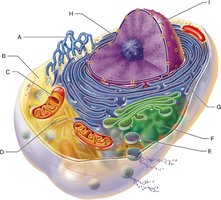
Q1. Identify each of the structures indicated (A–I) for the generalized cell.
Background
Topic: Cell Structure and Organelles
This question tests your knowledge of the major organelles and regions of a typical eukaryotic cell, including their structure and function.
Key Terms:
Organelles: Specialized structures within cells that perform distinct processes.
Cytoplasm: The material within a cell, excluding the nucleus.
Nucleus: The organelle that contains genetic material and controls cellular activities.
Step-by-Step Guidance
Examine the diagram and locate each labeled structure (A–I).
Recall the appearance and typical location of each organelle in a cell (e.g., mitochondria are bean-shaped, rough ER has ribosomes attached).
Match each label to its corresponding organelle or cell region based on its structure and function.
Review the functions of each organelle: for example, mitochondria produce ATP, Golgi apparatus packages proteins, and the nucleus stores DNA.
Use your textbook or notes to confirm the identity and function of each labeled part before completing the answer.
Try solving on your own before revealing the answer!
Final Answer:
A) Smooth Endoplasmic Reticulum
B) Cytoplasm
C) Mitochondrion
D) Centrioles
E) Secretory Vesicle
F) Golgi Apparatus
G) Rough Endoplasmic Reticulum
H) Nucleolus
I) Nucleus
This diagram helps visualize the spatial arrangement and function of each organelle in a typical human cell.
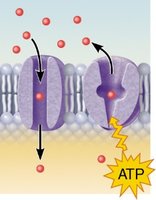
Q2. What function of a membrane protein is illustrated below?
Background
Topic: Membrane Proteins and Transport
This question tests your understanding of the role of membrane proteins in transporting substances across the plasma membrane.
Key Terms:
Transport proteins: Proteins that facilitate the movement of substances across the cell membrane.
ATP: Adenosine triphosphate, the energy currency of the cell.
Active transport: Movement of substances against their concentration gradient using energy.
Step-by-Step Guidance
Observe the diagram showing membrane proteins and the movement of particles across the membrane.
Notice that one protein allows particles to pass through without energy input, while the other uses ATP to move particles.
Recall the difference between passive and active transport: passive transport does not require energy, while active transport does.
Identify which function is being illustrated: is it simple diffusion, facilitated diffusion, or active transport?
Try solving on your own before revealing the answer!
Final Answer:
The function illustrated is transport, specifically showing both passive (channel-mediated) and active (ATP-driven) transport across the membrane.
The left protein demonstrates channel-mediated facilitated diffusion, while the right protein shows active transport using ATP.
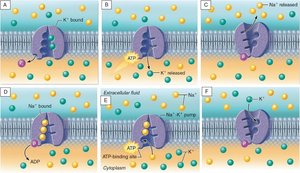
Q3. Write the letters for each step of the sodium-potassium pump in order from start to finish.
Background
Topic: Active Transport – Sodium-Potassium Pump
This question tests your understanding of the sequence of events in the sodium-potassium pump, a primary active transport mechanism in cells.
Key Terms and Process:
Sodium-potassium pump: A membrane protein that moves Na+ out and K+ into the cell using ATP.
ATP hydrolysis: The breakdown of ATP to provide energy for transport.
Phosphorylation: Addition of a phosphate group to the pump protein, causing a shape change.
Step-by-Step Guidance
Review the diagram showing the six steps labeled A–F.
Recall the sequence: sodium ions bind, ATP is hydrolyzed, the pump changes shape, sodium is released, potassium binds, and potassium is released.
Arrange the steps in logical order, starting with sodium binding and ending with potassium release.
Check your textbook or notes for the exact sequence if needed.
Try solving on your own before revealing the answer!
Final Answer:
1) E (start)
2) D
3) C
4) F
5) A
6) B (finish)
This sequence shows how the sodium-potassium pump uses ATP to move sodium and potassium ions across the membrane, maintaining cellular ion gradients.
