 뒤로
뒤로Endocrine System: Structure, Function, and Regulation
스터디 가이드 - 스마트 노트
 자료에 맞춘 맞춤형 노트, 핵심 정의, 예시, 맥락을 확장해 제공합니다.
Endocrine System Overview
Definition and Function
The endocrine system is a major regulatory system in the human body, responsible for maintaining homeostasis through the secretion of hormones. These hormones are transported via the bloodstream to target organs, influencing metabolic activities, growth, development, and other physiological processes.
Endocrinology: The study of hormones and endocrine organs.
Works in concert with the nervous system to coordinate and integrate activity of body cells.
Uses negative feedback mechanisms to maintain homeostasis.
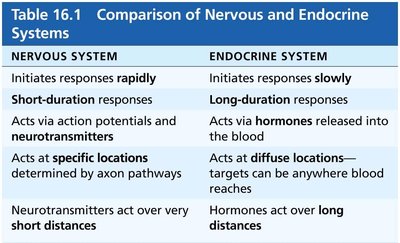
Comparison of Nervous and Endocrine Systems
The nervous and endocrine systems are the two primary control systems in the body, each with distinct characteristics.
Nervous System | Endocrine System |
|---|---|
Initiates responses rapidly | Initiates responses slowly |
Short-duration responses | Long-duration responses |
Acts via action potentials and neurotransmitters | Acts via hormones released into the blood |
Acts at specific locations | Acts at diffuse locations—targets can be anywhere blood reaches |
Neurotransmitters act over very short distances | Hormones act over long distances |
Hormonal Regulation of Blood Glucose
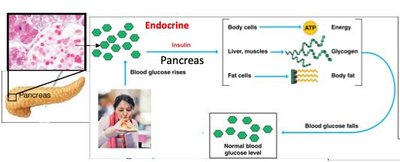
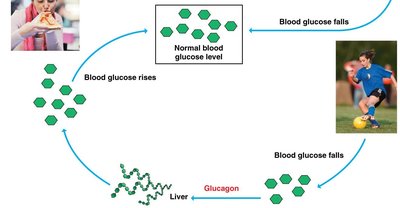
Insulin and Glucagon: Negative Feedback Mechanisms
The pancreas plays a central role in regulating blood glucose levels through the secretion of two hormones: insulin and glucagon. These hormones act in opposition to maintain glucose homeostasis.
Insulin: Secreted by beta cells in response to rising blood glucose levels (hyperglycemia). Promotes uptake of glucose by body cells, conversion of glucose to glycogen in liver and muscles, and storage of glucose as fat in adipose tissue. Result: blood glucose levels decrease to normal.
Glucagon: Secreted by alpha cells in response to falling blood glucose levels (hypoglycemia). Stimulates breakdown of glycogen in the liver and release of glucose into the blood. Result: blood glucose levels increase to normal.
Pancreatic Structure and Function
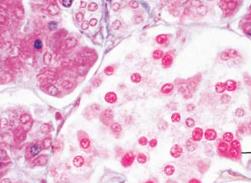
The pancreas contains both exocrine and endocrine cells. The endocrine portion consists of the islets of Langerhans, which house alpha and beta cells responsible for glucagon and insulin secretion, respectively.
Endocrine vs. Exocrine Glands
Definitions and Examples
Glands in the body are classified as either endocrine or exocrine based on their mode of secretion.
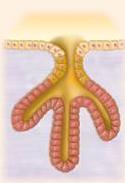
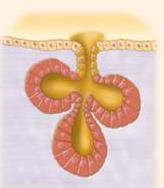
Exocrine glands: Produce nonhormonal substances (e.g., sweat, saliva) and have ducts to carry secretion to membrane surface.
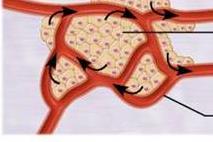
Endocrine glands: Lack ducts, release hormones directly into the surrounding tissue fluid, and have rich vascular and lymphatic drainage.
Major Endocrine Organs and Their Locations
Overview of Endocrine Organs
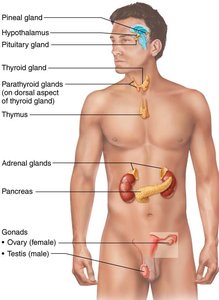
The major endocrine glands include the pituitary, thyroid, parathyroid, adrenal, and pineal glands. The hypothalamus is considered a neuroendocrine organ. Some organs, such as the pancreas, gonads, and placenta, have both endocrine and exocrine functions.
Types of Chemical Messengers
Endocrine, Paracrine, and Autocrine Signaling
Chemical messengers in the body can act over varying distances:
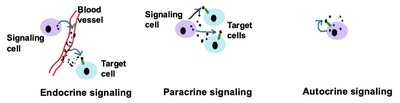
Endocrine signaling: Hormones travel through blood or lymph to distant target cells.
Paracrine signaling: Locally acting chemicals affect other cells of the same tissue.
Autocrine signaling: Chemicals exert effects on the same cells that secrete them.
Characteristics and Mechanisms of Hormone Action
Target Cell Specificity
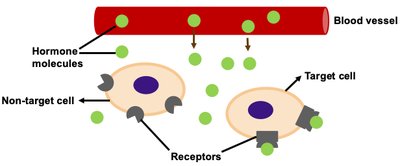
Hormones circulate systemically but only affect cells with specific receptors, known as target cells. Hormone action may alter membrane permeability, stimulate protein synthesis, activate or deactivate enzymes, induce secretory activity, or stimulate mitosis.
Classes of Hormones
Amino acid–based hormones: Includes derivatives, peptides, and proteins (e.g., insulin, glucagon, epinephrine).
Steroid hormones: Synthesized from cholesterol (e.g., gonadal and adrenocortical hormones).
Eicosanoids: Sometimes considered hormones, but mostly classified as paracrine factors.
Mechanisms of Hormone Action
Hormones act in one of two ways, depending on their chemical nature:
Water-soluble hormones (all amino acid–based except thyroid hormone): Act on plasma membrane receptors via G protein and second messengers; cannot enter cell.
Lipid-soluble hormones (steroid and thyroid hormones): Act on intracellular receptors that directly activate genes; can enter cell.
Second Messenger Systems
Water-soluble hormones use second messenger systems, such as cyclic AMP (cAMP) and PIP2-calcium.
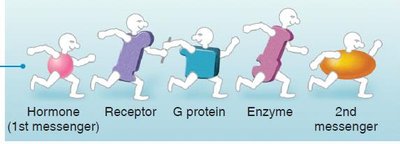
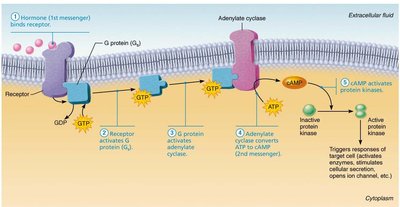
Hormone binds to receptor → activates G protein → activates adenylate cyclase → converts ATP to cAMP → cAMP activates protein kinases → cellular response.
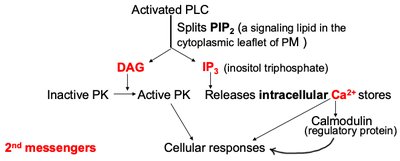
Hormone-activated G protein activates phospholipase C → splits PIP2 into DAG and IP3 → IP3 releases Ca2+ from intracellular stores → Ca2+ binds to calmodulin → cellular response.
Direct Gene Activation
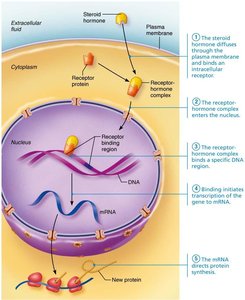
Lipid-soluble hormones diffuse into target cells, bind to intracellular receptors, and initiate DNA transcription to produce mRNA, which is then translated into specific proteins.
Regulation of Hormone Release
Endocrine Gland Stimuli
Hormone release is triggered by three types of stimuli:
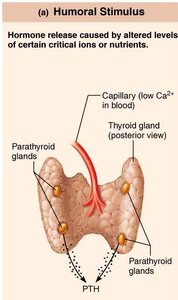
Humoral stimuli: Changing blood levels of ions and nutrients directly stimulate secretion (e.g., low Ca2+ stimulates parathyroid hormone release).
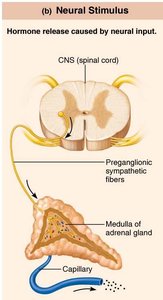
Neural stimuli: Nerve fibers stimulate hormone release (e.g., sympathetic fibers stimulate adrenal medulla).
Hormonal stimuli: Hormones stimulate other endocrine organs to release their hormones (e.g., hypothalamic-pituitary-target gland axis).
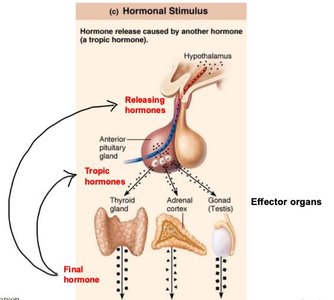
Nervous System Modulation
The nervous system can override normal endocrine controls, especially during stress, to adjust hormone levels as needed.
Factors Influencing Target Cell Activation
Determinants of Activation
Blood levels of hormone
Relative number of receptors on/in target cell (up-regulation and down-regulation)
Affinity (strength) of binding between receptor and hormone
Summary Table: Pituitary Hormones
The pituitary gland secretes several hormones, each with specific regulation, target organs, and effects. See the following summary tables for details.
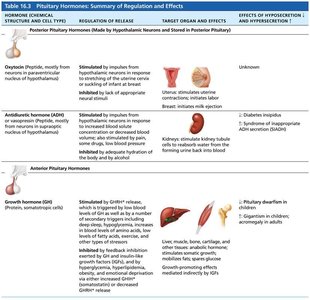
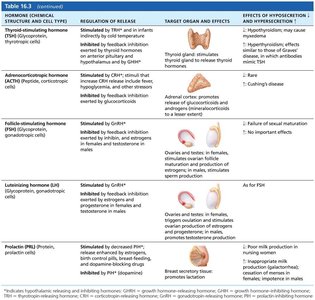 *Additional info: The notes above expand on the original content by providing definitions, mechanisms, and examples for each major topic, ensuring completeness and academic quality for exam preparation.*
