 뒤로
뒤로Genetics and Mendelian Inheritance: Foundations for Anatomy & Physiology Students
스터디 가이드 - 스마트 노트
 자료에 맞춘 맞춤형 노트, 핵심 정의, 예시, 맥락을 확장해 제공합니다.
Overview of Genetics
The Molecular Expression of Genes
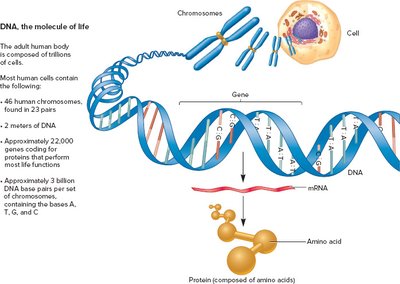
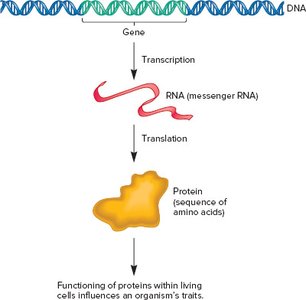
Genetics is the study of heredity and variation, providing a framework for understanding biological complexity from molecules to populations. Genes are segments of DNA that encode functional products, typically polypeptides, which fold into proteins. These proteins determine cell structure and function, ultimately influencing an organism's traits.
Key Biochemicals: Cells are composed of nucleic acids (DNA, RNA), proteins, carbohydrates, and lipids.
Proteome: The complete set of proteins made by a cell at any time.
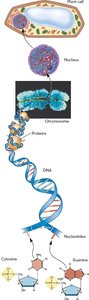
DNA: Stores information for protein synthesis; composed of nucleotides (A, T, G, C).
Gene Expression: Involves transcription (DNA to mRNA) and translation (mRNA to polypeptide).
Central Dogma: DNA → RNA → Protein
Equation:
The Relationship Between Genes and Traits
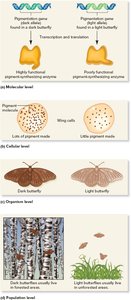
Traits are observable characteristics of organisms, governed by gene expression at multiple levels: molecular, cellular, organismal, and population. Genetic variation arises from differences in DNA sequences, chromosome structure, or chromosome number, and is influenced by environmental factors.
Morphological Traits: Affect appearance (e.g., flower color).
Physiological Traits: Affect function (e.g., metabolism).
Behavioral Traits: Affect responses to environment (e.g., mating calls).
Alleles: Alternative versions of a gene.
Genetic Variation: Differences in inherited traits among individuals.
Environment: Can modify trait expression (e.g., PKU and diet).
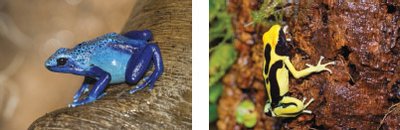
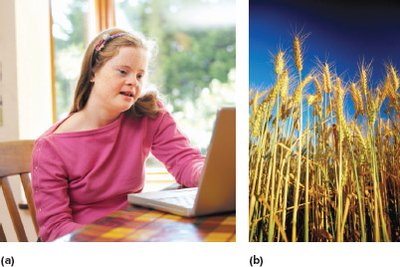
Inheritance and Evolution
Genes are transmitted from parents to offspring, often in pairs (diploid organisms). Gametes are haploid, containing one set of chromosomes. Evolution is the change in genetic composition of populations over generations, driven by natural selection.
Diploid: Two sets of chromosomes (somatic cells).
Haploid: One set of chromosomes (gametes).
Natural Selection: Favors traits that enhance reproductive success.
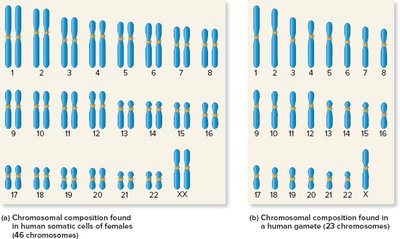
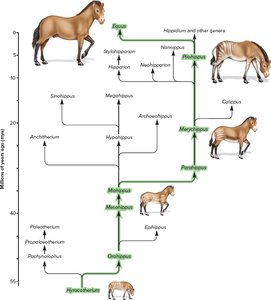
Fields of Genetics
Transmission, Molecular, and Population Genetics
Genetics is divided into three main fields:
Transmission Genetics: Studies inheritance patterns from parent to offspring.
Molecular Genetics: Focuses on the biochemical nature of genes and their expression.
Population Genetics: Examines genetic variation and its role in evolution.
Model organisms are used to study genetic principles applicable to many species.
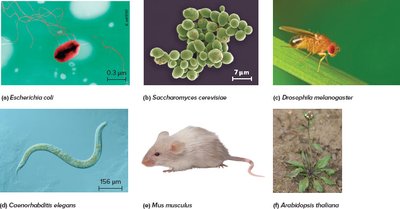
The Science of Genetics
Experimental Approaches
Genetics is an experimental science, using hypothesis testing (scientific method) and discovery-based science. Problem-solving strategies include defining terms, making drawings, predicting outcomes, comparing and contrasting, relating structure and function, describing steps, proposing hypotheses, designing experiments, analyzing data, and making calculations.
Mendelian Inheritance
Mendel’s Study of Pea Plants
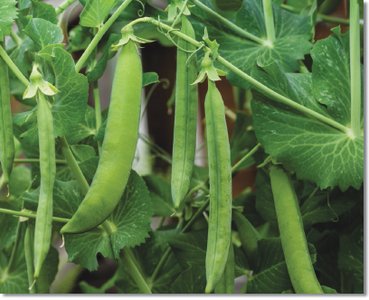
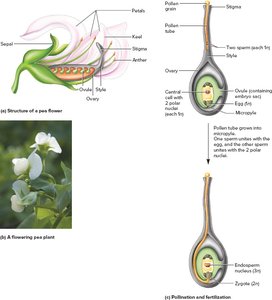
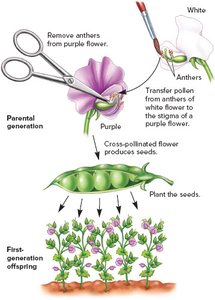
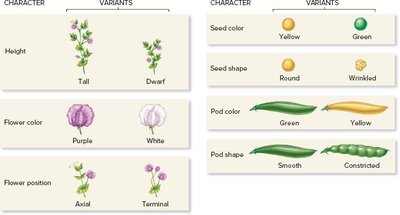
Gregor Mendel used pea plants to study inheritance, choosing traits that bred true and were easily distinguishable. He performed self-fertilization and cross-fertilization experiments to analyze trait transmission.
Characters: General features (e.g., height, flower color).
Traits/Variants: Specific forms (e.g., tall vs. dwarf).
True-Breeding: Trait remains constant across generations.
Law of Segregation
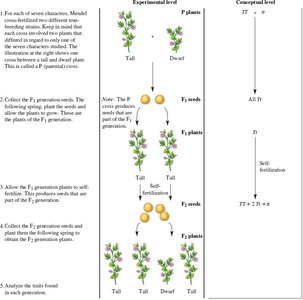
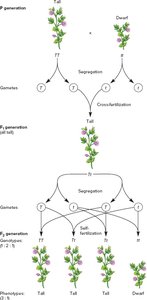
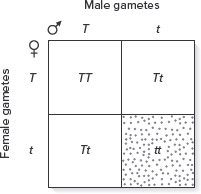
Mendel’s single-factor crosses led to the law of segregation: the two copies of a gene segregate during gamete formation, so each gamete receives only one allele. This explains the 3:1 ratio of dominant to recessive traits in the F2 generation.
Genotype: Genetic composition (e.g., TT, Tt, tt).
Phenotype: Observable trait (e.g., tall, dwarf).
Homozygous: Two identical alleles.
Heterozygous: Two different alleles.

Punnett Squares
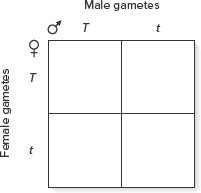
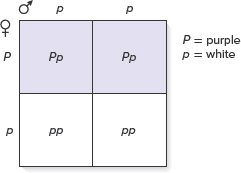
Punnett squares are used to predict the outcome of genetic crosses and self-fertilization experiments.
Law of Independent Assortment
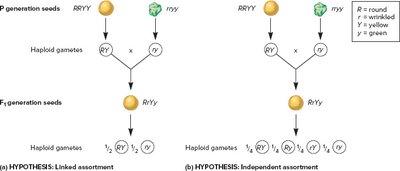
Mendel’s two-factor crosses led to the law of independent assortment: alleles of different genes assort independently during gamete formation, resulting in genetic recombination and diversity.
Genetic Recombination: New combinations of alleles in offspring.
Multiplication and Forked-Line Methods: Used for predicting outcomes in crosses involving multiple genes.
Studying Inheritance Patterns in Humans
Pedigree analysis is used to study inheritance patterns in humans, distinguishing between dominant and recessive traits.
Probability and Statistics in Genetics
Probability calculations (product rule, binomial expansion, multinomial expansion) are used to predict genetic outcomes. The chi square test evaluates the validity of genetic hypotheses by comparing observed and expected data.
Product Rule: Probability of independent outcomes is the product of their individual probabilities.
Binomial Expansion: Used for unordered combinations of outcomes.
Chi Square Test:
Example: Probability that two unaffected parents (heterozygotes) have two unaffected children:
Summary Table: Mendelian Genetics Concepts
Concept | Definition | Example |
|---|---|---|
Gene | Unit of heredity; segment of DNA | Gene for flower color |
Allele | Alternative form of a gene | Purple vs. white allele |
Genotype | Genetic composition | TT, Tt, tt |
Phenotype | Observable trait | Tall, dwarf |
Homozygous | Two identical alleles | TT or tt |
Heterozygous | Two different alleles | Tt |
Law of Segregation | Alleles separate during gamete formation | 3:1 ratio in F2 |
Law of Independent Assortment | Alleles of different genes assort independently | 9:3:3:1 ratio in F2 |
