 뒤로
뒤로Introduction to Anatomy & Physiology: Structure, Function, and Homeostasis
스터디 가이드 - 스마트 노트
 자료에 맞춘 맞춤형 노트, 핵심 정의, 예시, 맥락을 확장해 제공합니다.
Ch.1: An Introduction to Anatomy and Physiology
Anatomy and Physiology: Definitions and Scope
Anatomy and physiology are foundational sciences in understanding the human body. Anatomy is the study of internal and external structures and their relationships, while physiology focuses on how the human body works. Mastery of medical terminology is essential for both fields.
Anatomy: The oldest medical science, dating back to 1600 B.C.
Physiology: Explores the functions and mechanisms of the body.
Medical Terminology Examples:
thrombo: clot (e.g., thrombocyte)
-opia: eye (e.g., myopia)
a-: without (e.g., avascular)

Branches of Anatomy and Physiology
Anatomy is divided into gross (macroscopic) and microscopic anatomy. Physiology is categorized by the level of biological organization studied.
Gross Anatomy: Examines large, visible structures.
Microscopic Anatomy: Examines cells and molecules.
Cytology: Study of cells and their structures.
Histology: Study of tissues and their structures.
Physiology Subfields:
Cell Physiology: Processes within and between cells.
Organ Physiology: Functions of specific organs.
Systemic Physiology: Functions of organ systems.
Pathological Physiology: Effects of diseases.
Levels of Organization in the Human Body
Chemical, Cellular, Tissue, Organ, and System Levels
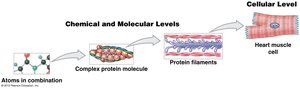
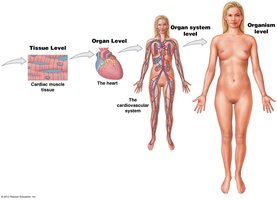
The human body is organized hierarchically, from atoms to the complete organism. Each level builds upon the previous, allowing for complex structure and function.
Chemical/Molecular Level: Atoms combine to form molecules.
Cellular Level: Molecules form organelles, which make up cells.
Tissue Level: Groups of similar cells working together.
Organ Level: Groups of different tissues working together.
Organ System Level: Groups of organs working together; humans have 11 organ systems.
Organism Level: The complete living individual.
Overview of Organ Systems
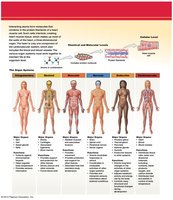
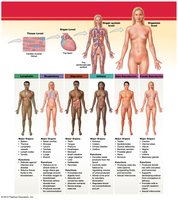
Each organ system has specific functions essential for maintaining life. The lymphatic system, for example, includes the spleen and tonsils and is responsible for defending against infection.
Lymphatic System: Includes spleen and tonsils; main function is defense against infection.
Humans have 11 organ systems, each with unique roles.
Concepts of Anatomy & Physiology: Homeostasis
Homeostatic Mechanisms and Feedback Loops
Homeostasis is the process by which the internal environment of the organism is actively maintained relatively constant. This is achieved through negative and positive feedback systems involving cells, tissues, and organs.
Homeostatic Mechanisms: Create optimum cellular environments for enzyme function.
Lock and Key Complex: Protein-ligand binding, a mechanistic reasoning example.
Dynamic Internal Environment: The internal environment is constantly changing, not static.
Physiological Variables Regulated by Homeostasis
Several physiological variables are regulated to maintain homeostasis, including blood gases, electrolytes, glucose, temperature, and blood pressure.
Arterial PO2 and PCO2
[Plasma K+], [Plasma Ca2+], [Plasma H+] (pH)
[Plasma glucose]
Body temperature
Blood pressure, volume, osmolarity, coagulation
Criteria for Homeostatically Regulated Variables
Variables regulated by homeostasis are typically found in the blood, contribute to life maintenance, have sensors, set-points, and are controlled by feedback systems.
Associated with or found in the blood
Contribute to maintaining life
Have a sensor and a set-point
Regulated by negative or positive feedback systems
Components of Homeostatic Regulation
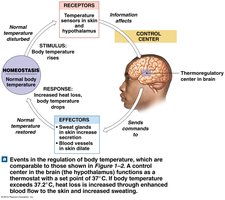
Homeostasis is regulated via negative and positive feedback loops. The major components of a feedback loop are:
Receptor: Sensor that receives stimulus
Control Center: Processes information and sends instructions
Effector: Carries out instructions
Negative Feedback Loop
Most homeostatic systems operate via negative feedback loops, where the response of the effector negates the stimulus. An example is thermoregulation.
Response opposes the initial change
Maintains stability of physiological variables
Positive Feedback Loop
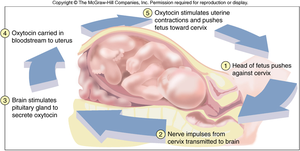
Positive feedback is rare and occurs when the effector amplifies the stimulus. It is used in situations requiring rapid completion, such as childbirth.
Response amplifies the initial change
Restores homeostasis quickly in dangerous or stressful processes
Example: Childbirth
Misconceptions about Homeostasis
Several misconceptions exist regarding homeostasis:
The internal environment is static (Correction: It is dynamic).
All negative feedback systems are homeostatic (Correction: Not all are homeostatic).
The set-point is a specific number (Correction: It is a range).
Homeostasis is maintained only by the nervous system (Correction: It can be maintained by nervous, endocrine, or both).
The set-point never changes (Correction: It can vary, e.g., diurnal variation, ovulation, fever).
Mechanisms of Homeostatic Regulation
Homeostasis can be regulated intrinsically (autoregulation) or extrinsically (nervous and endocrine systems).
Autoregulation (Intrinsic): Automatic response in cell, tissue, or organ to environmental change.
Extrinsic Regulation: Responses controlled by nervous and endocrine systems.
Roles of Organ Systems in Homeostatic Regulation
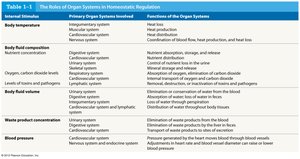
Organ systems play distinct roles in maintaining homeostasis, such as regulating body temperature, fluid balance, and waste product concentration.
Internal Stimulus | Primary Organ Systems Involved | Functions of the Organ Systems |
|---|---|---|
Body temperature | Integumentary, muscular, cardiovascular, nervous | Heat loss, heat production, heat distribution |
Body fluid composition | Digestive, cardiovascular, urinary | Nutrient absorption, distribution, and release |
Body fluid volume | Urinary, cardiovascular, digestive | Regulation of volume and distribution of fluids |
Waste product concentration | Urinary, digestive | Elimination of waste products |
Blood pressure | Cardiovascular, endocrine | Regulation of blood flow and pressure |
Reflection and Critical Thinking
Blood calcium regulation is an example of homeostatic control, involving stimulus, sensor, input, integration, output, target, and response. The hormone calcitonin is released in response to increased blood calcium, helping maintain homeostasis.
Stimulus: Increased blood calcium
Sensor: Thyroid gland
Response: Release of calcitonin to lower blood calcium
Summary of Key Equations
Homeostatic regulation often involves mathematical relationships, such as:
Blood glucose set-point:
Calcium set-point:
Additional info: Academic context was added to clarify the hierarchical levels of organization, feedback mechanisms, and the role of organ systems in homeostasis.
