 뒤로
뒤로Membrane Dynamics: Transport Mechanisms and Homeostasis
스터디 가이드 - 스마트 노트
 자료에 맞춘 맞춤형 노트, 핵심 정의, 예시, 맥락을 확장해 제공합니다.
Membrane Dynamics
Introduction to Membrane Dynamics
Membrane dynamics refers to the movement of water, ions, and molecules across cell membranes, which is essential for maintaining homeostasis in the body. The cell membrane is selectively permeable, allowing certain substances to pass while restricting others. Understanding these processes is crucial for comprehending physiological functions such as nutrient uptake, waste removal, and signal transduction.
Body Fluid Compartments and Disequilibrium
Intracellular and Extracellular Fluid
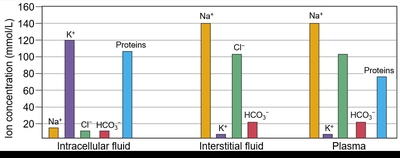
The body is divided into two main fluid compartments: intracellular fluid (ICF) and extracellular fluid (ECF). Water moves freely between these compartments, resulting in osmotic equilibrium. However, solutes are often in chemical disequilibrium (different concentrations across compartments) and electrical disequilibrium (different charge distributions).
ICF: Higher concentration of K+ and proteins
ECF: Higher concentration of Na+, Cl-, and HCO3-
Osmosis, Osmolarity, and Osmotic Pressure
Osmosis and Osmolarity
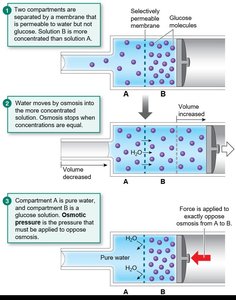
Osmosis is the movement of water across a selectively permeable membrane from an area of low solute concentration to high solute concentration. Osmolarity is the total concentration of solute particles in a solution, measured in osmoles per liter (Osm/L). It is important to distinguish between mole (amount of substance) and osmole (number of particles in solution).
Glucose does not dissociate: 0.1 mole = 0.1 osmole
NaCl dissociates: 0.1 mole = 0.2 osmole (Na+ + Cl-)
Milliosmole (mOsm): 1/1000 of an osmole, commonly used in physiology
Osmotic Pressure
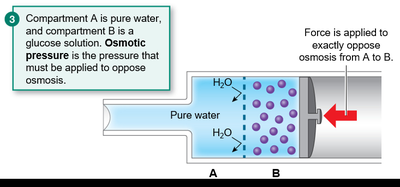
Osmotic pressure is the pressure required to stop the net movement of water by osmosis. It reflects the total solute concentration and the ability of a solution to "pull" water. Water moves from areas of high water concentration (low solute) to low water concentration (high solute).
Tonicity and Cell Volume Changes
Tonicity
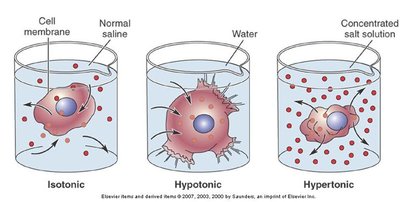
Tonicity describes how a solution affects cell volume, depending on the concentration of non-permeating solutes relative to the cell's interior.
Isotonic: Equal concentration of non-permeating solutes inside and outside the cell; no net water movement.
Hypotonic: Lower solute concentration outside the cell; water enters the cell, causing it to swell.
Hypertonic: Higher solute concentration outside the cell; water leaves the cell, causing it to shrink.
Membrane Permeability
Selectively Permeable Membranes
Cell membranes are selectively permeable. Nonpolar molecules (e.g., O2, CO2, fatty acids) cross easily, while ions and polar molecules (e.g., glucose, proteins, Na+) require transport proteins.
Driving Forces for Membrane Transport
Chemical, Electrical, and Electrochemical Driving Forces
Substances move across membranes due to three main driving forces:
Chemical driving force: Due to concentration gradients; molecules move from high to low concentration.
Electrical driving force: Due to membrane potential (Vm); charged particles move according to electrical gradients.
Electrochemical driving force: The combination of chemical and electrical forces determines the net movement of ions.
Types of Membrane Transport
Passive vs. Active Transport
Passive transport moves substances down their concentration or electrochemical gradients without energy input. Active transport moves substances against their gradients and requires energy, usually from ATP.
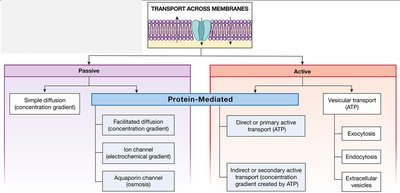
Map of Membrane Transport Mechanisms
Passive Transport (no energy required):
Simple diffusion
Facilitated diffusion (via carrier proteins)
Ion channels (electrochemical gradient)
Aquaporin channels (osmosis)
Active Transport (energy required):
Primary active transport (direct use of ATP)
Secondary active transport (indirect use of ATP via ion gradients)
Vesicular transport (endocytosis, exocytosis)
Properties of Diffusion
Seven Properties of Diffusion
Diffusion is passive (no energy required).
Molecules move from high to low concentration; the rate depends on the gradient's magnitude.
Net movement continues until equilibrium is reached.
Diffusion is rapid over short distances, slower over long distances.
Rate increases with temperature.
Rate decreases with increasing molecular weight and size.
Can occur in open systems or across membranes.
Simple Diffusion and Lipophilicity
Only lipophilic (hydrophobic) molecules cross membranes by simple diffusion.
Rate depends on the molecule's ability to dissolve in the lipid bilayer and the membrane's surface area.
Protein-Mediated Transport
Membrane Proteins and Their Functions
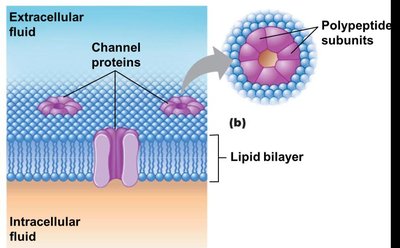
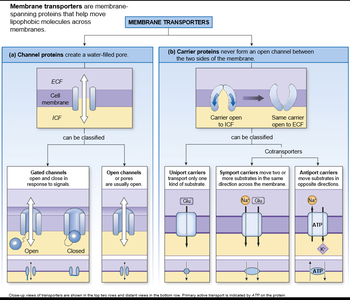
Membrane proteins facilitate the movement of substances that cannot cross the lipid bilayer directly. They serve as structural proteins, enzymes, receptors, and transport proteins (channels and carriers).
Channel Proteins
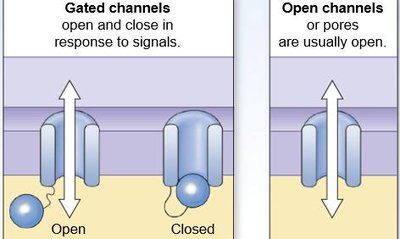
Channel proteins form open, water-filled passageways for specific ions or water (aquaporins). They can be open (leak channels) or gated (open/close in response to signals).
Carrier Proteins
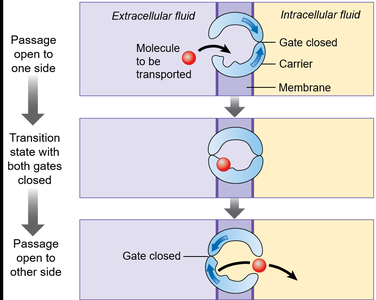
Carrier proteins bind specific molecules and undergo conformational changes to transport them across the membrane. They never form an open channel between both sides. Facilitated diffusion is a passive process using carriers.
Comparison: Channels vs. Carriers
Feature | Channel Proteins | Carrier Proteins |
|---|---|---|
Transport Rate | High (many molecules at once) | Lower (one/few at a time) |
Open to Both Sides? | Yes (when open) | No (never open to both sides simultaneously) |
Specificity | High (for ions/water) | High (for specific molecules) |
Types | Leak, gated | Uniport, symport, antiport |
Factors Affecting Transport Rates
Passive Transport
Magnitude of concentration gradient
Membrane permeability
Surface area of the membrane
Temperature (additional info: higher temperature increases rate)
Active Transport
Rate of transport by individual pumps
Number of pumps in the membrane
Active Transport Mechanisms
Primary Active Transport
Uses energy directly from ATP hydrolysis to move substances against their concentration gradients. Example: Sodium/Potassium (Na+/K+) pump.
Secondary Active Transport
Uses the energy stored in ion gradients (created by primary active transport) to drive the movement of other substances against their gradients. Example: Sodium-glucose cotransport.
Vesicular Transport
Endocytosis and Exocytosis
Endocytosis: The cell engulfs material into vesicles. Types include pinocytosis (nonspecific), receptor-mediated endocytosis (specific), and phagocytosis (requires actin).
Exocytosis: The cell expels large molecules by fusing vesicles with the plasma membrane.
Epithelial Transport
Solute and Water Transport Across Epithelia
Epithelial cells transport solutes and water across two membranes (apical and basolateral). The Na+/K+ pump creates gradients that drive secondary active transport and water movement by osmosis.
Summary Table: Types of Membrane Transport
Type | Energy Requirement | Direction | Example |
|---|---|---|---|
Simple Diffusion | No | Down gradient | O2, CO2 |
Facilitated Diffusion | No | Down gradient | Glucose via GLUT transporter |
Primary Active Transport | Yes (ATP) | Against gradient | Na+/K+ pump |
Secondary Active Transport | Indirect (ion gradient) | Against gradient | Sodium-glucose cotransport |
Vesicular Transport | Yes (ATP) | Bulk movement | Endocytosis, exocytosis |
Key Definitions
Molarity: Moles of solute per liter of solution
Osmolarity: Number of particles per liter of solution
Osmolality: Number of particles per kilogram of solvent
Osmotic Pressure: Pressure needed to stop osmosis
Tonicity: Effect of a solution on cell volume
