 뒤로
뒤로Membrane Transport, Diffusion, and Osmosis: Study Guide for Anatomy & Physiology
스터디 가이드 - 스마트 노트
 자료에 맞춘 맞춤형 노트, 핵심 정의, 예시, 맥락을 확장해 제공합니다.
Membrane Transport
Forms of Membrane Transport
The plasma membrane regulates the movement of substances into and out of the cell through various transport mechanisms. These mechanisms are classified as passive (no energy required) or active (requiring energy).
Passive Processes: Include diffusion and osmosis, where substances move down their concentration gradients without cellular energy.
Active Processes: Require energy (usually ATP) and include carrier-mediated transport and vesicular transport.
Carrier-Mediated Transport: Can be passive (facilitated diffusion) or active (active transport).
Vesicular Transport: Includes endocytosis and exocytosis, both requiring energy.
Selective Permeability of the Plasma Membrane
The plasma membrane is selectively permeable, allowing certain substances to pass while restricting others based on:
Size
Electrical charge
Molecular shape
Lipid solubility
Carrier-Mediated and Vesicular Transport
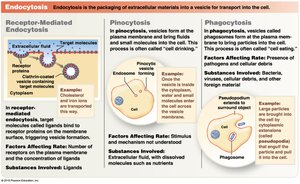
Cells use carriers and vesicles to transport substances across the membrane. Endocytosis and exocytosis are key vesicular transport processes:
Endocytosis: The cell engulfs material from the extracellular environment.
Pinocytosis: The cell 'drinks' extracellular fluid, taking in small molecules and fluids.
Phagocytosis: The cell 'eats' large particles or microorganisms using pseudopodia.
Exocytosis: The cell releases substances by fusing vesicles with the plasma membrane.
Diffusion
Definitions: Solution, Solvent, Solute, Concentration, and Concentration Gradient
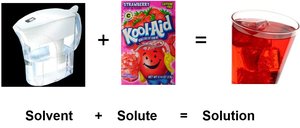
A solution is a homogeneous mixture of a solvent (the substance doing the dissolving) and a solute (the substance being dissolved). Concentration refers to the amount of solute per unit of solution. A concentration gradient exists when there is a difference in solute concentration between two regions.
Principles of Diffusion
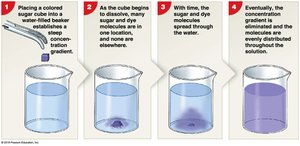
Diffusion is the net movement of molecules from an area of higher concentration to an area of lower concentration, driven by random molecular motion. The concentration gradient is the difference in concentration between two areas.
Key Factors Affecting Diffusion:
Distance the particle must move
Size of ions and molecules (smaller = faster)
Temperature (higher = faster)
Steepness of concentration gradient (steeper = faster)
Electrical forces (opposites attract, like charges repel)
Diffusion Across Plasma Membranes
Substances cross the plasma membrane by:
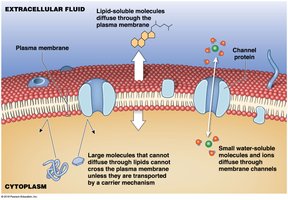
Simple Diffusion: Lipid-soluble compounds (e.g., alcohols, fatty acids, steroids) and dissolved gases (O2, CO2) move directly through the lipid bilayer.
Channel-Mediated Diffusion: Water-soluble compounds and ions move through protein channels, influenced by size, charge, and channel interactions.
Osmosis and Tonicity
Osmosis: A Special Case of Diffusion
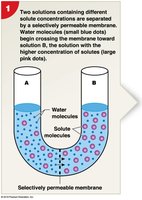
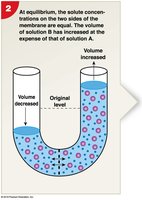
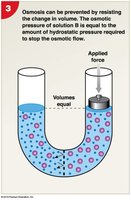
Osmosis is the diffusion of water across a selectively permeable membrane. Water moves toward the side with more solutes (lower water concentration), increasing volume on that side. The membrane must be permeable to water but selectively restrict solutes.
Osmolarity and Tonicity
Osmolarity is the total solute concentration in a solution. Tonicity describes how a solution affects cell volume, depending on solute nature:
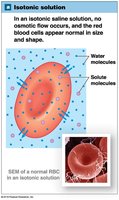
Isotonic Solution: Same solute concentration as the cell; no net water movement.
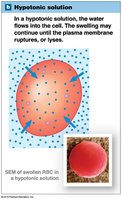
Hypotonic Solution: Lower solute concentration than the cell; water enters the cell, causing swelling and possible rupture (hemolysis).
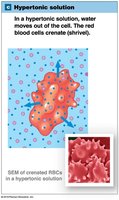
Hypertonic Solution: Higher solute concentration than the cell; water leaves the cell, causing shrinkage (crenation).
Effects of Tonicity on Cells
Cells respond to their environment based on tonicity:
Isotonic: Cell remains normal in size and shape.
Hypotonic: Cell gains water, may rupture.
Hypertonic: Cell loses water, shrinks.
Scientific Method
Steps of the Scientific Method
The scientific method is a systematic approach to investigation and discovery. It is used in both scientific research and everyday problem-solving.
Observation: Noticing and describing phenomena.
Hypothesis: Formulating a testable explanation.
Experiment: Designing and conducting tests to evaluate the hypothesis.
Results: Collecting and recording data.
Analysis: Interpreting data to draw conclusions.
Data Types:
Qualitative: Descriptive, non-numerical
Quantitative: Numerical, measurable
Additional Academic Context
Equations and Relationships
Fick's Law of Diffusion: The rate of diffusion () is proportional to the concentration gradient (), surface area (), and inversely proportional to the distance (): where is the diffusion coefficient.
Osmotic Pressure: The pressure required to prevent osmosis is given by: where is osmotic pressure, is the van't Hoff factor, is concentration, is the gas constant, and is temperature.
Example: In clinical practice, 0.9% NaCl (normal saline) is used as an isotonic solution to prevent osmotic imbalance in patients.
Example: Salt is used to preserve meat by creating a hypertonic environment, causing water to leave microbial cells and inhibiting their growth.
Example: Roadside vegetation may die due to salt runoff, which creates a hypertonic environment in the soil, leading to water loss from plant cells.
Example: The scientific method can be applied to everyday observations, such as investigating why certain plants die near salted roads.
Additional info: The notes expand on brief points to provide full academic explanations, including definitions, examples, and relevant equations for diffusion and osmosis.
