뒤로
뒤로Molecules, Chemistry, and the Cell: Essential Study Notes for Anatomy & Physiology
스터디 가이드 - 스마트 노트
 자료에 맞춘 맞춤형 노트, 핵심 정의, 예시, 맥락을 확장해 제공합니다.
Molecules of the Body
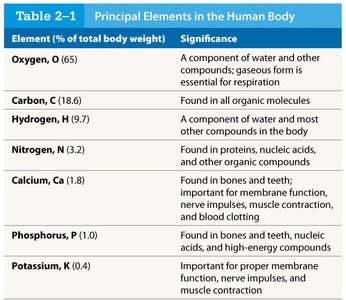
Principal Elements in the Human Body
The human body is composed of various elements, each playing a critical role in physiological processes. Understanding these elements is foundational for studying anatomy and physiology.
Element | % of Total Body Weight | Significance |
|---|---|---|
Oxygen (O) | 65 | Component of water and other compounds; essential for respiration |
Carbon (C) | 18.6 | Found in all organic molecules |
Hydrogen (H) | 9.7 | Component of water and most other compounds |
Nitrogen (N) | 3.2 | Found in proteins, nucleic acids, and other organic compounds |
Calcium (Ca) | 1.8 | Bones and teeth; membrane function, nerve impulses, muscle contraction, blood clotting |
Phosphorus (P) | 1.0 | Bones and teeth, nucleic acids, high-energy compounds |
Potassium (K) | 0.4 | Membrane function, nerve impulses, muscle contraction |
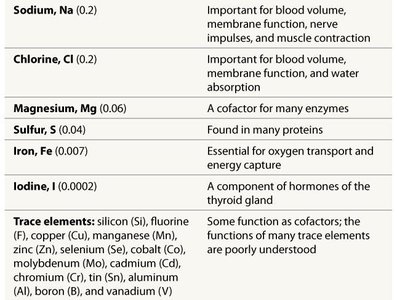
Sodium (Na) | 0.2 | Blood volume, membrane function, nerve impulses, muscle contraction |
Chlorine (Cl) | 0.2 | Membrane function, water absorption |
Magnesium (Mg) | 0.06 | Cofactor for many enzymes |
Sulfur (S) | 0.04 | Found in many proteins |
Iron (Fe) | 0.007 | Oxygen transport and energy capture |
Iodine (I) | 0.0002 | Hormones of the thyroid gland |
Trace elements | - | Some function as cofactors; many functions are poorly understood |
Organic and Inorganic Compounds
Definitions and Classifications
Compounds in the body are classified as organic or inorganic based on their chemical structure and function.
Organic Compounds: Molecules based on carbon and hydrogen. Includes carbohydrates, proteins, lipids, and nucleic acids.
Inorganic Compounds: Molecules not based on carbon and hydrogen. Includes water, carbon dioxide, oxygen, acids, bases, and salts.
Nutrients: Essential molecules obtained from food.
Metabolites: Molecules made or broken down in the body.
Properties of Water and Electrolytes
Water and Solutions
Water is the most abundant compound in the body, accounting for up to two-thirds of total body weight. It acts as a solvent, forming solutions with solutes dispersed within it.
Electrolytes in Body Fluids
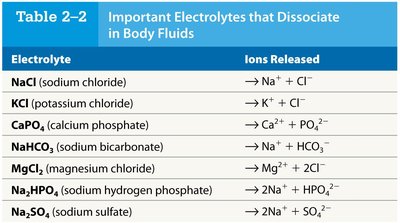
Electrolytes are inorganic ions that conduct electricity in solution. Their balance is vital for normal body function.
Electrolyte | Ions Released |
|---|---|
NaCl (sodium chloride) | Na+ + Cl- |
KCl (potassium chloride) | K+ + Cl- |
CaPO4 (calcium phosphate) | Ca2+ + PO42- |
NaHCO3 (sodium bicarbonate) | Na+ + HCO3- |
MgCl2 (magnesium chloride) | Mg2+ + 2Cl- |
Na2HPO4 (sodium hydrogen phosphate) | 2Na+ + HPO42- |
Na2SO4 (sodium sulfate) | 2Na+ + SO42- |
pH and Homeostasis
pH Scale and Body Fluids
The pH scale measures the concentration of hydrogen ions (H+) in a solution. It is inversely related to H+ concentration: more H+ means lower pH (acidic), less H+ means higher pH (basic).
Neutral pH: 7.0 (pure water)
Acidic pH: < 7.0 (high H+, low OH-)
Basic pH: > 7.0 (low H+, high OH-)
Human blood pH: 7.35–7.45
Carbohydrates
Structure and Function
Carbohydrates are organic molecules containing carbon, hydrogen, and oxygen in a 1:2:1 ratio. They are classified by the number of sugar units:
Monosaccharides: Simple sugars (glucose, fructose)
Disaccharides: Two sugars (sucrose, lactose, maltose)
Polysaccharides: Many sugars (glycogen, starch, cellulose)
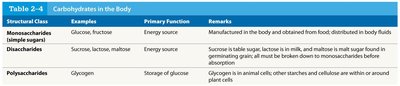
Structural Class | Examples | Primary Function | Remarks |
|---|---|---|---|
Monosaccharides | Glucose, fructose | Energy source | Manufactured in the body and obtained from food |
Disaccharides | Sucrose, lactose, maltose | Energy source | Must be broken down to monosaccharides before absorption |
Polysaccharides | Glycogen | Storage of glucose | Glycogen in animal cells; starch and cellulose in plant cells |
Lipids
Types and Functions
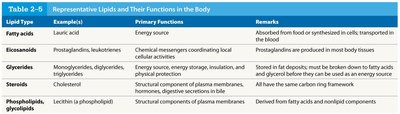
Lipids are hydrophobic molecules, mainly composed of carbon and hydrogen. They include fatty acids, glycerides, steroids, phospholipids, and glycolipids.
Fatty Acids: Long chains with a carboxyl group; can be saturated or unsaturated.
Glycerides: Fatty acids attached to glycerol; triglycerides serve as energy source, insulation, and protection.
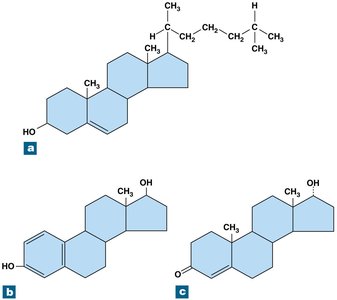
Steroids: Four rings of carbon and hydrogen; includes cholesterol, estrogens, testosterone, corticosteroids, and bile salts.
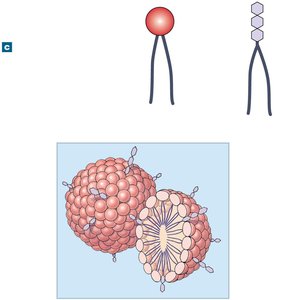
Phospholipids and Glycolipids: Structural lipids with hydrophilic heads and hydrophobic tails; key components of cell membranes.
Lipid Type | Examples | Primary Functions | Remarks |
|---|---|---|---|
Fatty acids | Lauric acid | Energy source | Absorbed from food or synthesized in cells |
Eicosanoids | Prostaglandins, leukotrienes | Chemical messengers | Produced in most body tissues |
Glycerides | Mono-, di-, triglycerides | Energy, insulation, protection | Stored in fat deposits |
Steroids | Cholesterol | Structural component, regulation | All have the same carbon ring framework |
Phospholipids/glycolipids | Lecithin | Structural components | Derived from fatty acids and nonlipid components |
Nucleic Acids
Structure and Function
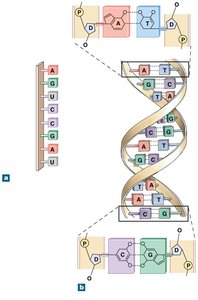
Nucleic acids are large organic molecules that store and process information at the molecular level. DNA and RNA are composed of nucleotides, each with a pentose sugar, phosphate group, and nitrogenous base.
DNA: Double-stranded, forms a double helix; stores genetic information.
RNA: Single-stranded; involved in protein synthesis.
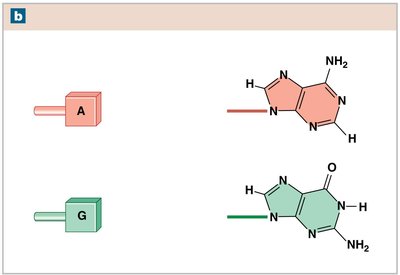
Nucleotides: Building blocks; bases include adenine (A), guanine (G), cytosine (C), thymine (T, DNA only), uracil (U, RNA only).
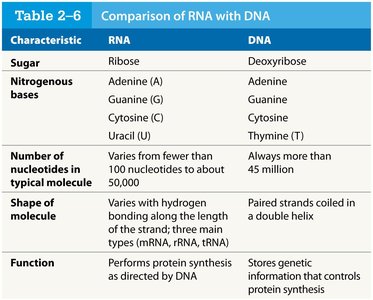
Characteristic | RNA | DNA |
|---|---|---|
Sugar | Ribose | Deoxyribose |
Nitrogenous bases | A, G, C, U | A, G, C, T |
Number of nucleotides | 100–50,000 | Always more than 45 million |
Shape | Varies; three main types | Paired strands, double helix |
Function | Protein synthesis | Stores genetic information |
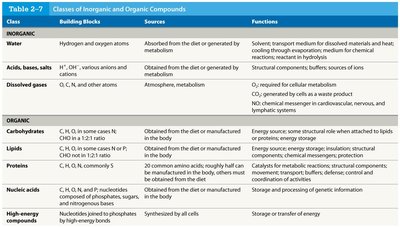
Classes of Inorganic and Organic Compounds
Overview Table
The body contains both inorganic and organic compounds, each with distinct building blocks, sources, and functions.
Class | Building Blocks | Sources | Functions |
|---|---|---|---|
Water | H, O | Diet/metabolism | Solvent, transport medium |
Acids, bases, salts | H+, OH-, ions | Diet/metabolism | Regulate pH, sources of ions |
Dissolved gases | C, N, O | Atmosphere/metabolism | Cellular metabolism |
Carbohydrates | C, H, O | Diet/manufactured | Energy, structure |
Lipids | C, H, O (sometimes P) | Diet/manufactured | Energy, structure, regulation |
Proteins | C, H, O, N | Diet/manufactured | Structure, enzymes, regulation |
Nucleic acids | C, H, O, N, P | Manufactured | Storage/processing of genetic info |
High-energy compounds | Nucleotides, phosphate groups | Synthesized | Storage/transfer of energy |
Cell Chemistry and Turnover
Turnover Times
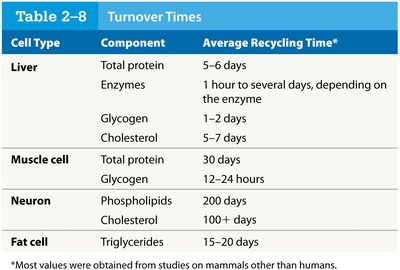
Cell components are recycled at different rates depending on cell type and function.
Cell Type | Component | Average Recycling Time |
|---|---|---|
Liver | Total protein | 5–6 days |
Liver | Enzymes | 1 hour to several days |
Liver | Glycogen | 1–2 days |
Liver | Cholesterol | 5–7 days |
Muscle cell | Total protein | 30 days |
Muscle cell | Glycogen | 12–24 hours |
Neuron | Phospholipids | 200 days |
Neuron | Cholesterol | 100+ days |
Fat cell | Triglycerides | 15–20 days |