 뒤로
뒤로Step-by-Step Guidance for Anatomy & Physiology Exam Study Topics
스터디 가이드 - 스마트 노트
 자료에 맞춘 맞춤형 노트, 핵심 정의, 예시, 맥락을 확장해 제공합니다.
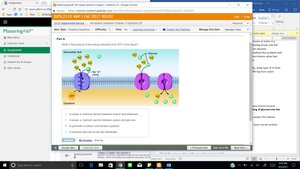
Q1. Which of the following choices would decrease the rate of glucose endocytosis based on the figure below?
Background
Topic: Cell Transport Mechanisms (Primary and Secondary Active Transport)
This question tests your understanding of how primary and secondary active transporters function, specifically in the context of glucose uptake into cells. It requires you to interpret a diagram showing the movement of ions and glucose across the cell membrane, and to predict how changes in ATP, sodium, or potassium concentrations affect glucose endocytosis.
Key Terms and Formulas:
Primary Active Transport: Uses ATP directly to move ions (e.g., Na+, K+) against their concentration gradients.
Secondary Active Transport: Uses the energy from the movement of one ion (often Na+) down its gradient, created by primary active transport, to move another molecule (e.g., glucose) against its gradient.
ATP: Adenosine triphosphate, the energy currency of the cell.
Endocytosis: The process by which cells internalize molecules from the extracellular environment.
Step-by-Step Guidance
Examine the diagram: Identify the two transporters. The left transporter is likely a Na+/K+ pump (primary active transport), and the right transporter is a Na+/glucose symporter (secondary active transport).
Recall that the Na+/K+ pump uses ATP to move Na+ out and K+ in, creating a sodium gradient across the membrane.
The Na+/glucose symporter uses the sodium gradient to bring glucose into the cell along with Na+ (secondary active transport).
Consider how changes in ATP, sodium, or potassium concentrations would affect the function of these transporters and the rate of glucose uptake.
Think about which option would disrupt the sodium gradient or the energy supply needed for these processes, thereby decreasing glucose endocytosis.
Try solving on your own before revealing the answer!
Final Answer: Decrease intracellular ATP (Choice B)
Decreasing intracellular ATP would impair the Na+/K+ pump, reducing the sodium gradient needed for secondary active transport. Without this gradient, the Na+/glucose symporter cannot efficiently bring glucose into the cell, thus decreasing the rate of glucose endocytosis.
Q2. Which system is responsible for exchanging gases between the blood and atmospheric air?
Background
Topic: Organ Systems and Their Functions
This question tests your knowledge of the major organ systems and their primary functions, specifically focusing on gas exchange.
Key Terms:
Respiratory System: Responsible for the exchange of oxygen and carbon dioxide between the blood and the air.
Cardiovascular System: Transports blood throughout the body.
Urinary System: Removes waste from the blood and regulates water balance.
Endocrine System: Regulates hormones.
Nervous System: Controls and coordinates body activities.
Step-by-Step Guidance
Review the primary function of each system listed in the answer choices.
Identify which system is directly involved in the exchange of gases (oxygen and carbon dioxide).
Recall the anatomical structures involved in gas exchange (e.g., lungs, alveoli).
Try solving on your own before revealing the answer!
Final Answer: B. Respiratory System
The respiratory system is responsible for exchanging gases between the blood and atmospheric air, primarily through the lungs.
Q3. The fingers are ______ to the elbow region.
Background
Topic: Anatomical Directional Terminology
This question tests your understanding of directional terms used in anatomy to describe the location of body parts relative to each other.
Key Terms:
Distal: Farther from the point of attachment or origin.
Proximal: Closer to the point of attachment or origin.
Lateral: Away from the midline.
Medial: Toward the midline.
Superior: Above another structure.
Step-by-Step Guidance
Identify the reference point: the elbow region.
Consider the position of the fingers relative to the elbow along the limb.
Recall the definition of "distal" and "proximal" in anatomical terminology.
Try solving on your own before revealing the answer!
Final Answer: C. Distal
The fingers are distal to the elbow region, meaning they are farther from the point of attachment (shoulder).
Q4. Which organelle in eukaryote is responsible for modifying, storing, and shipping products to different parts of the cell?
Background
Topic: Cell Organelles and Their Functions
This question tests your knowledge of the functions of various cell organelles, specifically those involved in processing and transporting cellular products.
Key Terms:
Golgi Apparatus: Modifies, sorts, and packages proteins and lipids for storage or transport.
Lysosome: Digests waste and cellular debris.
Endoplasmic Reticulum (ER): Synthesizes proteins (rough ER) and lipids (smooth ER).
Ribosomes: Site of protein synthesis.
Step-by-Step Guidance
Review the functions of each organelle listed in the answer choices.
Identify which organelle is primarily involved in modifying, storing, and shipping products.
Recall the structure and location of the Golgi apparatus in the cell.
Try solving on your own before revealing the answer!
Final Answer: D. Golgi Apparatus
The Golgi apparatus is responsible for modifying, storing, and shipping products to different parts of the cell.
Q5. The sister chromatids line up along the middle of the cell describes which stage of mitotic division?
Background
Topic: Cell Division and Mitosis
This question tests your understanding of the stages of mitosis, specifically the stage where chromosomes align at the cell's equator.
Key Terms:
Metaphase: Chromosomes align at the metaphase plate (middle of the cell).
Prophase: Chromosomes condense and spindle fibers form.
Anaphase: Sister chromatids separate.
Telophase: Nuclear envelope reforms.
Step-by-Step Guidance
Recall the sequence of mitotic stages: prophase, metaphase, anaphase, telophase.
Identify the stage where chromosomes are aligned at the cell's equator.
Review the characteristics of metaphase.
Try solving on your own before revealing the answer!
Final Answer: C. Metaphase
During metaphase, sister chromatids line up along the middle of the cell.
Q6. When a eukaryote cell is subjected to external aqueous solution with LESS solute than the cell’s cytosol, the cell is described to be in which of the following conditions?
Background
Topic: Osmosis and Tonicity
This question tests your understanding of how cells respond to different solute concentrations in their environment, specifically the concept of tonicity.
Key Terms:
Hypotonic: Solution has less solute than the cell's cytosol; water enters the cell.
Hypertonic: Solution has more solute than the cell's cytosol; water leaves the cell.
Isotonic: Solution has equal solute concentration as the cell's cytosol.
Step-by-Step Guidance
Compare the solute concentration of the external solution to the cell's cytosol.
Recall the definitions of hypotonic, hypertonic, and isotonic solutions.
Predict the direction of water movement based on the concentration gradient.
Try solving on your own before revealing the answer!
Final Answer: A. Hypotonic
When the external solution has less solute than the cell's cytosol, it is hypotonic, causing water to enter the cell.
Q7. Which of the following describes a sample tissue with a single layer of cube-shaped cells?
Background
Topic: Epithelial Tissue Types
This question tests your ability to identify epithelial tissue types based on cell shape and arrangement.
Key Terms:
Simple Cuboidal Epithelium: Single layer of cube-shaped cells.
Simple Squamous Epithelium: Single layer of flat cells.
Simple Columnar Epithelium: Single layer of tall, column-shaped cells.
Stratified: Multiple layers of cells.
Step-by-Step Guidance
Review the characteristics of each epithelial tissue type listed in the answer choices.
Identify which type consists of a single layer of cube-shaped cells.
Recall examples and locations where simple cuboidal epithelium is found (e.g., kidney tubules).
Try solving on your own before revealing the answer!
Final Answer: B. Simple Cuboidal Epithelium
Simple cuboidal epithelium describes a tissue with a single layer of cube-shaped cells.
