 뒤로
뒤로Step-by-Step Study Guidance: The Endocrine System (Anatomy & Physiology)
스터디 가이드 - 스마트 노트
 자료에 맞춘 맞춤형 노트, 핵심 정의, 예시, 맥락을 확장해 제공합니다.
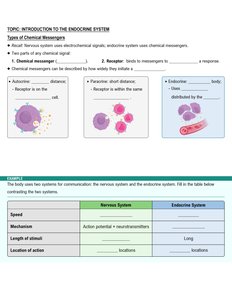
Q1. Compare the nervous system and endocrine system as methods of communication in the body. Fill in the table below with differences between the two systems.
Background
Topic: Nervous vs. Endocrine System Communication
This question tests your understanding of how the nervous and endocrine systems transmit signals, including speed, mechanism, length of stimulus, and location of action.
Key Terms:
Action potential: Electrical signal used by neurons.
Neurotransmitter: Chemical messenger released at synapses.
Hormone: Chemical messenger released by endocrine glands, travels in blood.
Step-by-Step Guidance
Review the four categories in the table: speed, mechanism, length of stimulus, and location of action.
Recall that the nervous system uses rapid electrical signals and neurotransmitters, while the endocrine system uses hormones that travel through the bloodstream.
Think about which system acts faster and which has longer-lasting effects.
Consider the location of action: nervous system signals are localized, endocrine signals are distributed throughout the body.
Try solving on your own before revealing the answer!
Final Answer:
Speed: Nervous system is fast; endocrine system is slow.
Mechanism: Nervous uses action potentials and neurotransmitters; endocrine uses hormones.
Length of stimulus: Nervous is short; endocrine is long.
Location of action: Nervous is localized; endocrine is widespread.
The nervous system is specialized for rapid, short-term responses, while the endocrine system regulates long-term processes by releasing hormones into the bloodstream.
Q2. For a nerve impulse to travel from one neuron to another, the signal must be transmitted across a synapse. The synapse uses a neurotransmitter that diffuses across the synapse and activates receptors on the postsynaptic neuron. Is this an example of endocrine, autocrine, paracrine, or intracellular signaling?
Background
Topic: Types of Chemical Signaling
This question tests your ability to distinguish between different types of cell signaling: endocrine, autocrine, paracrine, and intracellular.
Key Terms:
Endocrine: Hormones travel through blood to distant targets.
Autocrine: Cell signals itself.
Paracrine: Cell signals nearby cells.
Intracellular: Signal within the same cell.
Step-by-Step Guidance
Identify the location of the signal: Is it acting on the same cell, nearby cells, or distant cells?
Recall that neurotransmitters released at synapses act on adjacent cells (postsynaptic neuron).
Compare this to the definitions of autocrine, paracrine, and endocrine signaling.
Determine which type best describes neurotransmitter action at a synapse.
Try solving on your own before revealing the answer!
Final Answer: Paracrine
Neurotransmitters act locally on adjacent cells, which is characteristic of paracrine signaling.
Q3. Epinephrine (adrenaline) is produced by your adrenal medulla during stressful situations. The adrenal medulla releases epinephrine into the bloodstream, where it acts on distant targets such as the heart, liver, and muscles. Based on this description, what type of signaling is epinephrine involved in?
Background
Topic: Endocrine Signaling
This question tests your understanding of how hormones like epinephrine are distributed and act on distant targets.
Key Terms:
Endocrine signaling: Hormones released into blood, act on distant cells.
Paracrine signaling: Local action.
Autocrine signaling: Self-action.
Step-by-Step Guidance
Identify the source of epinephrine: adrenal medulla.
Determine how epinephrine travels: via bloodstream.
Consider the targets: distant organs (heart, liver, muscles).
Match this description to the types of signaling.
Try solving on your own before revealing the answer!
Final Answer: Endocrine signaling
Epinephrine acts on distant targets via the bloodstream, which is classic endocrine signaling.
Q4. Which statement below correctly identifies a significant difference between the endocrine and nervous systems?
Background
Topic: Comparison of Endocrine and Nervous Systems
This question tests your ability to distinguish the mechanisms and effects of the two systems.
Key Terms:
Endocrine system: Hormones, slow, long-lasting, widespread.
Nervous system: Neurotransmitters, fast, short-lasting, localized.
Step-by-Step Guidance
Review the answer choices for differences in speed, mechanism, and location of action.
Recall that the endocrine system uses hormones distributed via blood, while the nervous system uses electrical and chemical signals at synapses.
Think about which system is faster and which has more widespread effects.
Identify the statement that best highlights these differences.
Try solving on your own before revealing the answer!
Final Answer:
The endocrine system uses hormones distributed via the bloodstream for widespread, long-lasting effects, while the nervous system uses rapid, localized electrical and chemical signals.
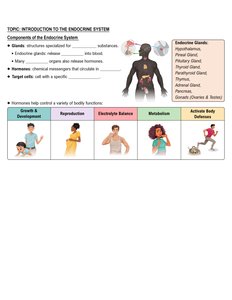
Q5. Fill in the blanks: Glands are structures specialized for ______ substances. The endocrine glands release ______ into the blood. Target cells act with a specific ______.
Background
Topic: Components of the Endocrine System
This question tests your knowledge of the basic structure and function of endocrine glands and target cells.
Key Terms:
Glands: Specialized for secretion.
Hormones: Chemical messengers released into blood.
Target cells: Cells with specific receptors for hormones.
Step-by-Step Guidance
Recall what glands do: produce and release substances.
Think about what endocrine glands release: hormones.
Consider what makes a target cell responsive: presence of a specific receptor.
Fill in the blanks with the correct terms based on your understanding.
Try solving on your own before revealing the answer!
Final Answer:
Glands are specialized for secreting substances.
Endocrine glands release hormones into the blood.
Target cells act with a specific receptor.
These are the fundamental components of the endocrine system.
