 뒤로
뒤로The Chemical Level of Organization: Foundations for Anatomy & Physiology
스터디 가이드 - 스마트 노트
 자료에 맞춘 맞춤형 노트, 핵심 정의, 예시, 맥락을 확장해 제공합니다.
Chapter 3: The Chemical Level of Organization
Introduction
The chemical level of organization forms the foundation for understanding anatomy and physiology. This chapter explores the essential elements, atomic structure, chemical bonds, reactions, and the major classes of inorganic and organic compounds vital to human life.
Elements and Atoms: The Building Blocks of Matter
Definition of Matter and Mass
Matter: Anything that occupies space and has mass.
Mass: The amount of matter in an object; remains constant regardless of location.
Weight: The force exerted by gravity on an object; can change with location.
Elements, Atoms, Molecules, and Compounds
Element: Pure substance made of one type of atom.
Atom: Smallest unit of an element retaining its properties.
Molecule: Two or more atoms chemically bonded.
Compound: Substance formed from two or more different elements joined by chemical bonds.

Major Elements in the Human Body
Oxygen, carbon, hydrogen, and nitrogen make up the majority of the human body.
Element and Symbol | Percentage in the Body |
|---|---|
Oxygen (O) | 65.0 |
Carbon (C) | 18.5 |
Hydrogen (H) | 9.5 |
Nitrogen (N) | 3.2 |
Calcium (Ca) | 1.5 |
Phosphorus (P) | 1.0 |
Potassium (K) | 0.4 |
Sulfur (S) | 0.3 |
Sodium (Na) | 0.2 |
Chlorine (Cl) | 0.2 |
Magnesium (Mg) | 0.1 |
Trace elements | less than 1.0 |

Atomic Structure and Subatomic Particles
Protons: Positively charged, found in the nucleus.
Neutrons: No charge, found in the nucleus.
Electrons: Negatively charged, orbit the nucleus.

The Periodic Table
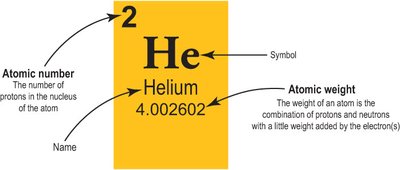
Elements are organized by atomic number, symbol, and atomic weight.

Atomic Number, Mass Number, and Isotopes
Atomic number: Number of protons in an atom.
Mass number: Sum of protons and neutrons.
Isotopes: Atoms of the same element with different numbers of neutrons.
Radioactive isotopes: Unstable, emit radiation.

Ions and Chemical Bonds
Ions
Ion: Atom with a net electrical charge due to loss or gain of electrons.
Cation: Positively charged ion (loss of electrons).
Anion: Negatively charged ion (gain of electrons).
Electron Shells and Valence Electrons
Electrons occupy shells around the nucleus; the outermost shell is the valence shell.
First shell holds up to 2 electrons, second up to 8, third up to 18, etc.
Atoms react to fill their valence shell, often by gaining, losing, or sharing electrons.
Forming Ions and Bonds
Potassium donates an electron to become a cation; fluorine gains an electron to become an anion.

Types of Chemical Bonds
Ionic bonds: Formed by transfer of electrons between atoms, resulting in oppositely charged ions (e.g., NaCl).
Covalent bonds: Formed by sharing electrons between atoms. Can be nonpolar (equal sharing) or polar (unequal sharing).
Hydrogen bonds: Weak attractions between polar molecules, important in water and biological molecules.




Chemical Reactions and Energy
Types of Chemical Reactions
Synthesis reactions: Combine smaller molecules into larger ones (anabolic, usually endergonic).
Decomposition reactions: Break down larger molecules into smaller ones (catabolic, usually exergonic).
Exchange reactions: Involve both synthesis and decomposition.
Energy in Chemical Reactions
Potential energy: Stored energy (e.g., in chemical bonds).
Kinetic energy: Energy of motion.
Chemical energy: Potential energy stored in bonds.
Exergonic reactions: Release energy.
Endergonic reactions: Absorb energy.


Enzymes and Activation Energy
Enzymes: Biological catalysts that lower activation energy and speed up reactions.
Enzymes are not changed by the reaction and can be reused.
Inorganic Compounds Essential to Human Functioning
Inorganic vs. Organic Compounds
Inorganic compounds: Do not contain both carbon and hydrogen (e.g., water, salts, acids, bases).
Organic compounds: Contain both carbon and hydrogen (e.g., carbohydrates, lipids, proteins, nucleic acids).
Water
Makes up 50–70% of the adult body.
Functions: lubrication, cushioning, temperature regulation, solvent for ions/nutrients, involved in hydrolysis and dehydration reactions.
Solutions, Solvents, and Solutes
Solution: Homogeneous mixture of solute dissolved in solvent.
Solvent: Substance that dissolves another (water is the universal solvent).
Solute: Substance dissolved in the solvent.
Acids, Bases, and pH
Acids: Release H+ ions in solution.
Bases: Release OH− ions or bind H+ in solution.
pH scale: Ranges from 0 (acidic) to 14 (alkaline); 7 is neutral.
Buffers: Prevent rapid changes in pH.
Organic Compounds Essential to Human Functioning
Major Classes of Organic Macromolecules
Carbohydrates: Main energy source; made of monosaccharides (e.g., glucose), disaccharides (e.g., sucrose), and polysaccharides (e.g., glycogen, starch, cellulose).
Lipids: Hydrophobic molecules including triglycerides (energy storage), phospholipids (membranes), steroids (hormones), and prostaglandins (signaling).
Proteins: Made of amino acids; provide structure, transport, catalyze reactions (enzymes), and regulate processes.
Nucleic acids: DNA (stores genetic code) and RNA (protein synthesis); made of nucleotides.
ATP: The Energy Currency of the Cell
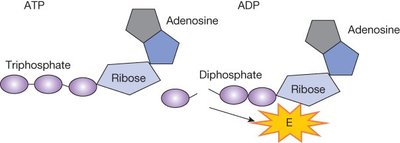
Adenosine triphosphate (ATP): Modified nucleotide; stores and releases energy for cellular processes.
Energy is released when phosphate bonds are broken:
Summary Table: Major Organic Macromolecules and Functions
Macromolecule | Function |
|---|---|
Protein | Structure, catalysis (enzymes), transport |
Carbohydrate | Energy source, structure |
Lipid | Energy storage, insulation, membrane structure |
Nucleic acid | Genetic information, protein synthesis |
