 뒤로
뒤로The Chemistry of Life: Foundations for Anatomy & Physiology
스터디 가이드 - 스마트 노트
 자료에 맞춘 맞춤형 노트, 핵심 정의, 예시, 맥락을 확장해 제공합니다.
The Chemistry of Life
Introduction to Chemistry in Anatomy & Physiology
Chemistry forms the basis for understanding the structure and function of the human body. The study of matter, atoms, and their interactions is essential for comprehending physiological processes.
Matter and Atomic Structure
Definition and States of Matter
Matter is anything that has mass and occupies space, existing as solids, liquids, or gases. Chemistry is the study of matter and its interactions. The atom is the smallest unit of matter retaining its original properties.
Subatomic Particles
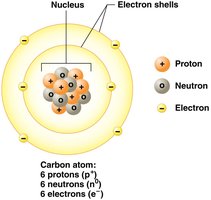
Atoms are composed of three main subatomic particles:
Protons (p+): Positively charged, found in the nucleus.
Neutrons (n0): No charge, slightly larger than protons, found in the nucleus.
Electrons (e-): Negatively charged, found in electron shells surrounding the nucleus.
Atoms are electrically neutral when the number of protons equals the number of electrons.
Electron Shells
Electrons occupy regions called electron shells around the nucleus. The first shell holds 2 electrons, the second holds 8.
Elements and Isotopes
Elements in the Human Body
An element is a substance that cannot be broken down by chemical means. The atomic number (number of protons) defines each element. The human body is primarily composed of hydrogen, oxygen, carbon, and nitrogen, along with mineral and trace elements.
Isotopes and Radioactivity
Isotopes are atoms of the same element with different numbers of neutrons, resulting in different mass numbers. Radioisotopes are unstable isotopes that release energy or radiation during radioactive decay.

Nuclear Medicine Applications
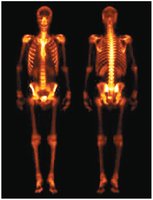
Radioisotopes are used in medical imaging and treatment, such as cancer radiation therapy and thyroid disorder treatments.
Mixtures and Solutions
Types of Mixtures
Matter can be physically combined to form mixtures. There are three main types:
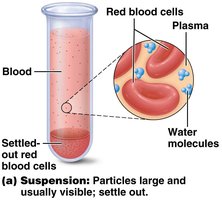
Suspensions: Large, unevenly distributed particles that settle out (e.g., blood).
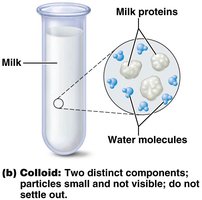
Colloids: Small, evenly distributed particles that do not settle out (e.g., milk).
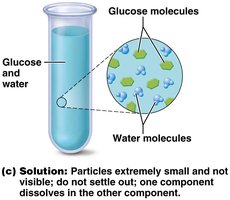
Solutions: Extremely small, evenly distributed particles; solute dissolved in solvent (e.g., glucose in water).
Chemical Bonds and Molecules
Types of Chemical Bonds
Chemical bonds are energy relationships between atoms, not physical structures. They include:
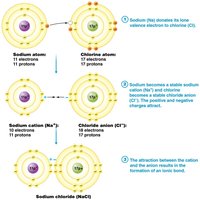
Ionic Bonds: Electrons are transferred from a metal to a nonmetal, forming cations and anions (e.g., NaCl).
Covalent Bonds: Electrons are shared between nonmetals. Can be single, double, or triple bonds.
Electron Sharing in Covalent Bonds
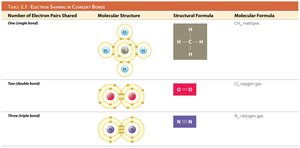
Covalent bonds can involve sharing one, two, or three pairs of electrons. The octet rule states that atoms are most stable with 8 electrons in their valence shell.
Number of Electron Pairs Shared | Molecular Structure | Structural Formula | Molecular Formula |
|---|---|---|---|
One (single bond) | H2 | H-H | H2 |
Two (double bond) | O2 | O=O | O2 |
Three (triple bond) | N2 | N≡N | N2 |
Polar and Nonpolar Covalent Bonds
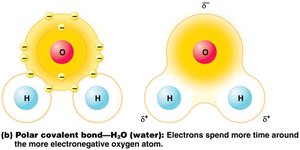
Nonpolar covalent bonds occur when atoms share electrons equally. Polar covalent bonds occur when atoms with different electronegativities share electrons unequally, creating dipoles.
Hydrogen Bonds
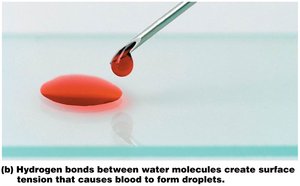
Hydrogen bonds are weak attractions between the partially positive end of one dipole and the partially negative end of another. They are responsible for water's surface tension.
Chemical Reactions and Energy
Types of Chemical Reactions
Three fundamental types of reactions maintain homeostasis:
Catabolic (Decomposition) Reactions: Break down large substances into smaller ones.
Exchange Reactions: Atoms are exchanged between reactants.
Anabolic (Synthesis) Reactions: Build larger molecules from smaller subunits.
Energy in Chemical Reactions
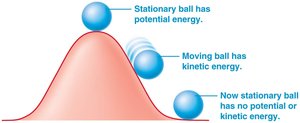
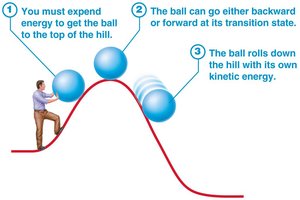
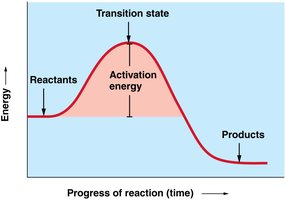
Potential energy is stored and can be released to do work. Kinetic energy is energy in motion. Chemical reactions require activation energy to proceed.
Enzymes and Reaction Rates
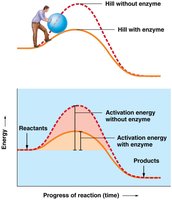
Enzymes are biological catalysts that lower activation energy, increasing reaction rates. Factors affecting reaction rates include concentration, temperature, particle size, and phase.
Biochemistry: Inorganic and Organic Compounds
Water
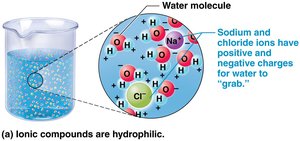
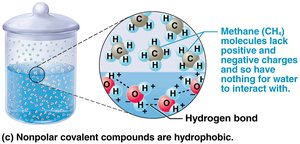
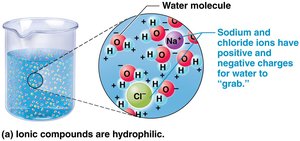
Water is the primary solvent in the body, with high heat capacity, cushioning, and lubricating properties. It dissolves hydrophilic (charged) solutes but not hydrophobic (uncharged) solutes.
Acids, Bases, and pH
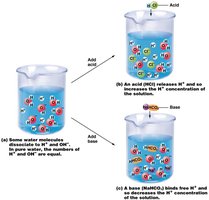
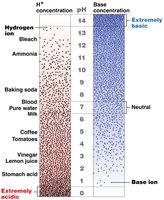
Acids release H+ ions in water, increasing acidity. Bases bind H+ ions, decreasing acidity. The pH scale measures hydrogen ion concentration, ranging from 0 (acidic) to 14 (basic).
Salts and Electrolytes
Salts are formed from metal cations and nonmetal anions held by ionic bonds. When dissolved in water, they form electrolytes capable of conducting electrical current.
Organic Molecules: Carbohydrates, Lipids, Proteins, and Nucleic Acids
Monomers and Polymers
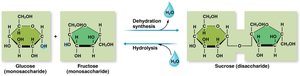
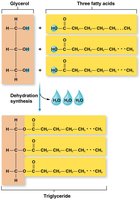
Organic compounds are polymers built from monomer subunits. Dehydration synthesis links monomers, forming water. Hydrolysis breaks polymers into monomers using water.
Carbohydrates
Carbohydrates are composed of carbon, hydrogen, and oxygen. They function as fuel and have structural roles. Types include:
Monosaccharides: Simple sugars (glucose, fructose).
Disaccharides: Two monosaccharides joined by dehydration synthesis.
Polysaccharides: Many monosaccharides joined together (e.g., glycogen, starch).
Lipids
Lipids are hydrophobic molecules composed mainly of carbon and hydrogen. Types include:
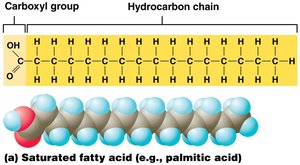
Saturated fatty acids: No double bonds, solid at room temperature.
Monounsaturated fatty acids: One double bond, liquid at room temperature.
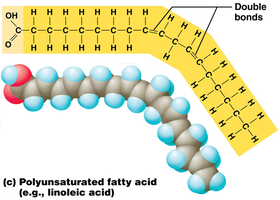
Polyunsaturated fatty acids: Two or more double bonds, liquid at room temperature.
Triglycerides: Three fatty acids linked to glycerol, storage form of fat.
Summary Table: Types of Chemical Bonds
Bond Type | Formation | Example | Strength |
|---|---|---|---|
Ionic | Transfer of electrons | NaCl | Moderate |
Covalent | Sharing of electrons | H2, O2, N2 | Strong |
Hydrogen | Attraction between dipoles | Water molecules | Weak |
Example: Water's unique properties, such as surface tension and solvent ability, are due to hydrogen bonding and polarity.
