 뒤로
뒤로The Chemistry of Life: Foundations for Anatomy & Physiology
스터디 가이드 - 스마트 노트
 자료에 맞춘 맞춤형 노트, 핵심 정의, 예시, 맥락을 확장해 제공합니다.
Ch. 2 The Chemistry of Life
Atoms and Subatomic Particles
The study of anatomy and physiology begins with understanding the chemical basis of life. All matter is composed of atoms, which are the smallest units of elements that retain their chemical properties. Atoms consist of a central nucleus containing protons (positively charged) and neutrons (neutral), surrounded by electrons (negatively charged) that occupy electron shells around the nucleus.
First electron shell: Holds up to 2 electrons.
Second electron shell: Holds up to 8 electrons.
Third electron shell: Also holds up to 8 electrons (additional shells exist for larger atoms).
Interaction of Atoms: Mixtures and Chemical Bonds
Atoms interact in two main ways: physically, by forming mixtures, and chemically, by forming chemical bonds. In mixtures, the chemical properties of atoms remain unchanged, while chemical bonds alter the chemical nature of the atoms involved.
Types of Mixtures
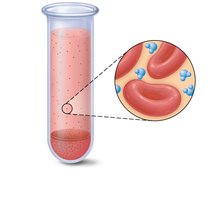
Suspensions: A mixture where solid particles are large enough to settle out if left undisturbed. Example: blood, where red blood cells settle out of plasma.
Colloids: Mixtures with solid particles too small to settle out or be seen, such as milk proteins in water.
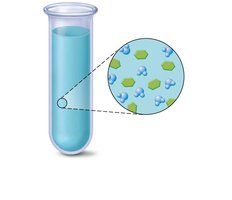
Solutions: Homogeneous mixtures where solutes (solid, liquid, or gas) are dissolved in a solvent (usually water). Example: glucose dissolved in water.
Chemical Bonds: Valence Shells and Valence Electrons
The valence shell is the outermost electron shell of an atom. The electrons in this shell, called valence electrons, determine the atom's chemical properties and reactivity. Atoms with full valence shells are inert (nonreactive), while those with unfilled valence shells are unstable and tend to interact with other atoms to achieve stability.
Types of Chemical Bonds
Ionic Bonds: Formed when one atom donates electrons to another, resulting in the formation of charged particles called ions. A positively charged ion is a cation, and a negatively charged ion is an anion. The electrostatic attraction between cations and anions forms an ionic bond. Example: sodium chloride (NaCl).
Covalent Bonds: Formed when atoms share electrons in their valence shells. Covalent bonds can be:
Nonpolar: Electrons are shared equally between atoms (e.g., H2 molecule).
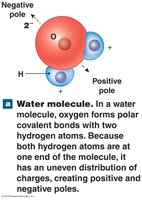
Polar: Electrons are shared unequally, resulting in partial charges (e.g., H2O molecule).
Hydrogen Bonds
Hydrogen bonds are weak attractions between the slightly positive hydrogen atom of one polar molecule and the slightly negative atom (usually oxygen or nitrogen) of another polar molecule. These bonds are crucial for the properties of water and the structure of biological molecules.
Hydrophilic and Hydrophobic Molecules
The polarity of molecules determines their interaction with water:
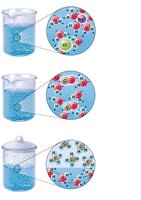
Hydrophilic ("water-loving"): Polar and ionic molecules that dissolve easily in water.
Hydrophobic ("water-hating"): Nonpolar molecules that do not dissolve in water.
Adenosine Triphosphate (ATP)
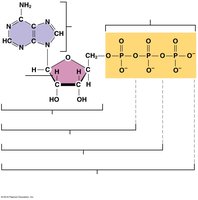
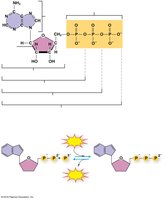
ATP is the primary energy carrier in cells. It consists of adenosine (adenine + ribose) and three phosphate groups. ATP is produced by adding a phosphate group to ADP (adenosine diphosphate), a process that stores energy. When ATP is hydrolyzed (broken down), energy is released for cellular activities.
pH, Acids, and Bases
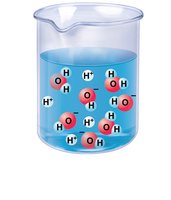
The pH of a solution measures its hydrogen ion (H+) concentration. Water can dissociate into H+ and OH− ions. In pure water, these concentrations are equal, resulting in a neutral pH of 7.
The pH scale ranges from 0 (most acidic) to 14 (most basic):
pH = -log[H+]
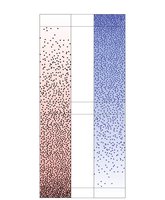
As [H+] increases, pH decreases (more acidic).
As [H+] decreases, pH increases (more basic).
Acids and Bases
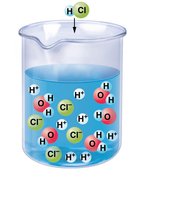
Acids: Substances that release H+ ions when dissolved in water, increasing [H+].
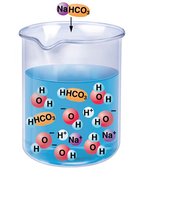
Bases: Substances that bind H+ ions, decreasing [H+].
Summary Table: Types of Mixtures
Type | Particle Size | Visibility | Settling | Example |
|---|---|---|---|---|
Suspension | Large | Visible | Settles out | Blood (red blood cells in plasma) |
Colloid | Intermediate | Not visible | Does not settle | Milk |
Solution | Small (molecules, ions) | Not visible | Does not settle | Glucose in water |
Key Equations
pH calculation:
Additional info: Understanding the chemistry of life is essential for grasping physiological processes such as nerve conduction, muscle contraction, and cellular metabolism, all of which depend on the interactions of atoms, ions, and molecules in aqueous environments.
