 뒤로
뒤로The Endocrine System: Hormonal Regulation and Activity
스터디 가이드 - 스마트 노트
 자료에 맞춘 맞춤형 노트, 핵심 정의, 예시, 맥락을 확장해 제공합니다.
The Endocrine System
General Background on Hormones
The endocrine system is a major regulatory system in the body, responsible for maintaining homeostasis through the secretion of hormones. Hormones are chemical messengers produced by specialized glandular cells and released into the bloodstream to affect distant target cells.
Intercellular Communication: Includes direct, synaptic, paracrine, autocrine, and endocrine communication.
Hormones: Chemical messengers that act on specific target cells with specialized receptors.
Receptors: Highly specific proteins that bind hormones; their expression can be regulated (down-regulation or up-regulation).
Endocrine Regulation
Hormonal regulation can be centralized or local, and involves complex feedback mechanisms to maintain physiological balance.
Central Control: The hypothalamus regulates the pituitary gland, which in turn controls other endocrine glands.
Local Control: Some glands self-regulate their hormone production.
Feedback Mechanisms: Negative feedback is the primary method for maintaining homeostasis.
Hormonal Modulation: Includes synergism, permissiveness, and antagonism.
Synergism, Permissiveness, and Antagonism
Synergism: Two hormones amplify each other's effects (e.g., glucagon and epinephrine).
Permissiveness: One hormone enables another to exert its full effect.
Antagonism: One hormone opposes the action of another (e.g., insulin vs. glucagon/epinephrine).
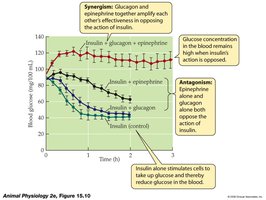
Example: The graph above illustrates how glucagon and epinephrine synergistically oppose insulin's action, raising blood glucose levels, while insulin alone lowers blood glucose. Epinephrine and glucagon together have a greater antagonistic effect than either alone.
Cells in the Endocrine System
Endocrine cells are typically epithelial in origin and can be squamous, cuboidal, or columnar depending on the gland. Hormones are synthesized within these cells using organelles such as the Golgi apparatus (GA) and endoplasmic reticulum (ER).
Production: Glandular cells synthesize hormones.
Movement: Hormones travel via blood and other body fluids to reach target tissues.
Reception: Any tissue with the appropriate receptor can respond to a hormone.
Hormone Classification
Hormones are classified based on their solubility and chemical structure, which determines their mechanism of action.
Lipid-Soluble Hormones: Steroids, thyroid hormones, nitric oxide (NO), eicosanoids. These hormones can cross cell membranes and bind to intracellular receptors.
Water-Soluble Hormones: Amine hormones, peptide/protein hormones. These hormones bind to membrane receptors and often use second messenger systems.
Hormone Activity
Hormones alter cellular function by activating genes, modifying protein function, or changing the rate of protein synthesis. Their effects depend on the type of receptor and the signaling pathway involved.
Gene Activation: Some hormones stimulate the synthesis of specific proteins by activating genes.
Protein Modification: Hormones can alter the function of existing proteins.
Rate of Synthesis: Hormones may increase or decrease the rate at which proteins are produced.
Receptor Binding: Hormones bind to receptors either on the cell membrane or inside the cell.
Second Messenger Systems (Water-Soluble Hormones)
Water-soluble hormones typically act through second messenger systems, which amplify the hormonal signal inside the cell.
G-Proteins: Activated by hormone-receptor binding, they stimulate intracellular enzymes.
Second Messengers: Include cAMP, cGMP, and Ca++.
Amplification: A single hormone molecule can trigger a large cellular response.
Example Equation:
Intracellular Receptors (Lipid-Soluble Hormones)
Lipid-soluble hormones require transport proteins in the blood and bind to intracellular receptors, often affecting gene expression and mitochondrial activity.
Transport Proteins: Carry lipid-soluble hormones in the bloodstream.
Free Fraction: The small portion of hormone not bound to transport proteins is biologically active.
Gene Regulation: Hormones can activate or deactivate genes, influencing protein synthesis.
Mitochondrial Activity: Some hormones affect cellular energy production.
Example Equation:
Additional info: Expanded explanations and equations were added for clarity and completeness based on standard academic context for endocrine physiology.
