 뒤로
뒤로The Endocrine System: Structure, Function, and Regulation
스터디 가이드 - 스마트 노트
 자료에 맞춘 맞춤형 노트, 핵심 정의, 예시, 맥락을 확장해 제공합니다.
The Endocrine System: Overview
Major Control Systems of the Body
The endocrine system is one of the body's two major control systems, working alongside the nervous system to coordinate and integrate the activity of most body cells. It uses hormones—chemical messengers transported in the blood—to influence metabolic activities. Endocrine responses are slower but longer lasting than nervous system responses.
Endocrinology: The study of hormones and endocrine organs.
Key functions: Reproduction, growth and development, maintenance of electrolyte, water, and nutrient balance, regulation of cellular metabolism and energy balance, mobilization of body defenses.
Comparison of Nervous and Endocrine Systems
Feature | Nervous System | Endocrine System |
|---|---|---|
Response Initiation | Rapid | Slow |
Duration | Short | Long |
Signal Type | Action potentials & neurotransmitters | Hormones in blood |
Target Location | Specific (axon pathways) | Diffuse (anywhere blood reaches) |
Distance | Short | Long |
Signal Strength | Frequency of action potentials | Hormone concentration |
Endocrine vs. Exocrine Glands
Exocrine glands: Produce nonhormonal substances (e.g., sweat, saliva); have ducts.
Endocrine glands: Produce hormones; ductless; hormones secreted directly into extracellular fluid.
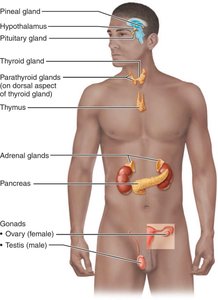
Major endocrine glands: Pituitary, thyroid, parathyroid, adrenal, pineal.
Other organs with endocrine tissue: Pancreas, gonads, placenta, stomach, intestine, heart, kidneys, skin, thymus, bone, adipose.
Hormone Structure and Classification
Chemical Structure Determines Hormone Action
The chemical structure of a hormone determines its solubility in water, which affects how it is transported in the blood, how long it takes to be degraded, and which receptors it acts upon.
Amino acid–based hormones: Includes amino acid derivatives, peptides, and proteins; mostly water soluble (except thyroxine); cannot cross plasma membrane.
Steroid hormones: Synthesized from cholesterol; lipid soluble; can cross plasma membrane; includes gonadal and adrenocortical hormones.
Eicosanoids: Sometimes considered hormones, but mostly classified as paracrines and autocrines due to localized effects.
Mechanisms of Hormone Action
Target Cells and Effects
Hormones circulate to virtually all tissues, but only cells with specific receptors for that hormone—called target cells—are affected. Hormones alter target cell activity by increasing or decreasing the rates of normal cellular processes.
Alter plasma membrane permeability and/or membrane potential
Stimulate synthesis of enzymes or other proteins
Activate or deactivate enzymes
Induce secretory activity
Stimulate mitosis
Second Messenger Systems (Water-Soluble Hormones)
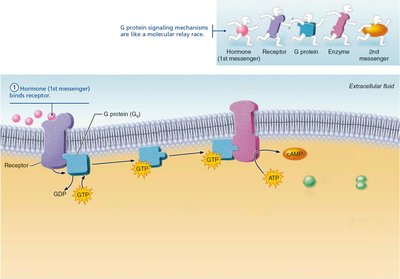
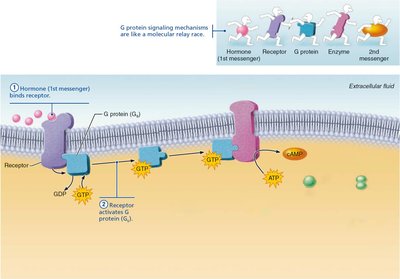
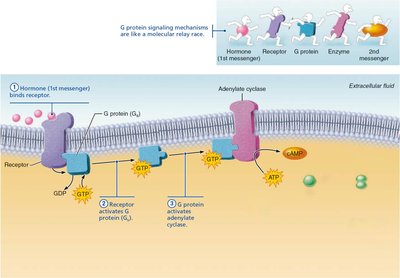
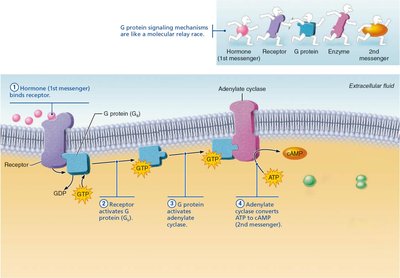
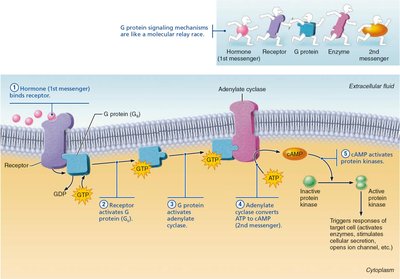
Water-soluble hormones (all amino acid–based hormones except thyroid hormone) act on plasma membrane receptors and are usually coupled via G proteins to second messengers.
Cyclic AMP (cAMP) mechanism:
Hormone (first messenger) binds to receptor.
Receptor activates a G protein.
G protein activates (or inhibits) adenylate cyclase.
Adenylate cyclase converts ATP to cAMP (second messenger).
cAMP activates protein kinases that phosphorylate other proteins.
PIP2-Calcium mechanism: Hormone-activated G protein activates phospholipase C, which splits PIP2 into DAG and IP3. DAG activates protein kinases; IP3 causes Ca2+ release, which acts as another second messenger.
Direct Gene Activation (Lipid-Soluble Hormones)
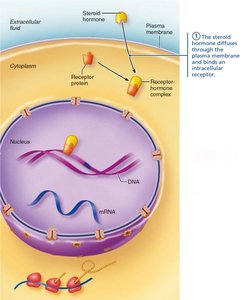
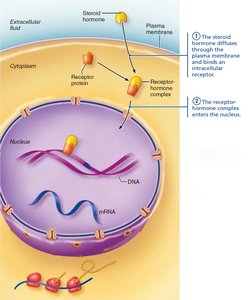
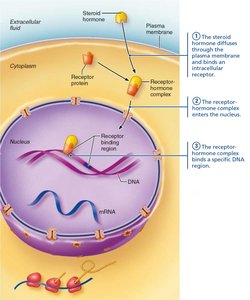
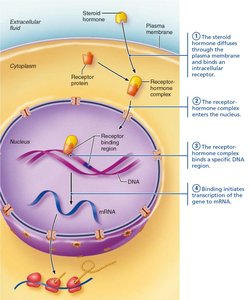
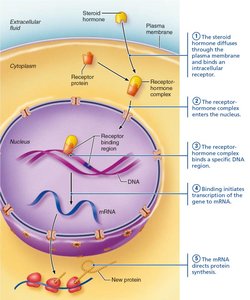
Lipid-soluble steroid hormones and thyroid hormone can diffuse into target cells and bind with intracellular receptors. The receptor-hormone complex enters the nucleus, binds to specific regions of DNA, and initiates transcription to produce mRNA, which is then translated into a specific protein.
Proteins synthesized may have metabolic, structural, or extracellular functions.
Regulation of Hormone Release
Types of Stimuli
Hormone release is controlled by negative feedback mechanisms and triggered by three types of stimuli:
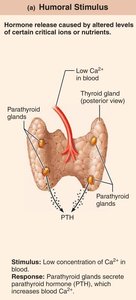
Humoral stimuli: Changing blood levels of ions and nutrients directly stimulate hormone release. Example: Low Ca2+ stimulates parathyroid hormone (PTH) release.
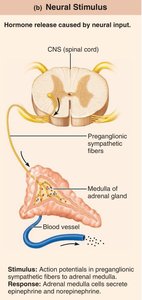
Neural stimuli: Nerve fibers stimulate hormone release. Example: Sympathetic nervous system stimulates adrenal medulla to secrete catecholamines.
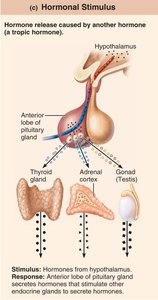
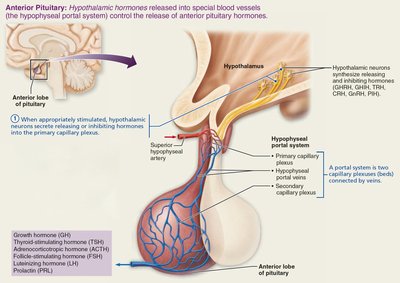
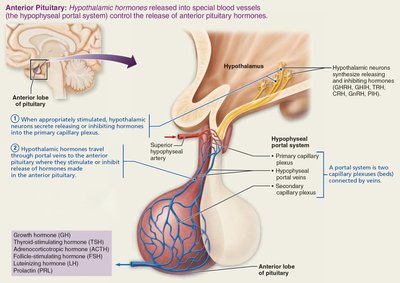
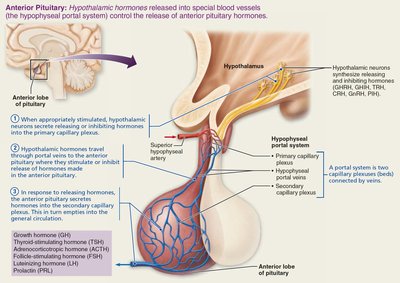
Hormonal stimuli: Hormones stimulate other endocrine organs to release their hormones. Example: Hypothalamic hormones regulate anterior pituitary hormones.
Nervous System Modulation
The nervous system can override normal endocrine controls, especially under stress, to adjust hormone levels as needed.
Hormone Receptors and Target Cell Activation
Factors Affecting Target Cell Activation
Blood levels of hormone
Relative number of target cell receptors
Affinity (strength) of binding between hormone and receptor
Up-Regulation and Down-Regulation
Up-regulation: Target cells add receptors in response to persistently low hormone levels.
Down-regulation: Cells remove receptors in response to persistently high hormone levels.
Summary Table: Lipid- vs. Water-Soluble Hormones
Feature | Lipid-Soluble Hormones | Water-Soluble Hormones |
|---|---|---|
Consist of | All steroid hormones and thyroid hormone | All amino acid–based hormones except thyroid hormone |
Sources | Adrenal cortex, gonads, thyroid gland | All other endocrine glands |
Stored in vesicles | No | Yes |
Transport in blood | Bound to plasma proteins | Usually free in plasma |
Half-life | Long | Short |
Receptor location | Inside cell | On plasma membrane |
Mechanism of action | Activate genes, cause protein synthesis | Second-messenger systems |
Interaction of Hormones at Target Cells
Permissiveness: One hormone cannot exert its effects without another hormone being present.
Synergism: More than one hormone produces the same effects, and combined effects are amplified.
Antagonism: One or more hormones oppose the action of another hormone.
Hypothalamus and Pituitary Gland
Hypothalamic Control of Pituitary Hormones
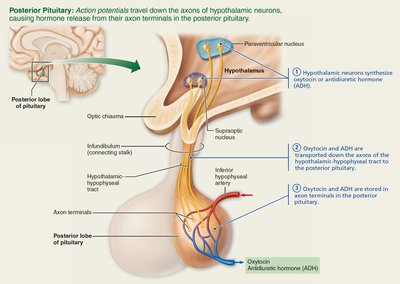
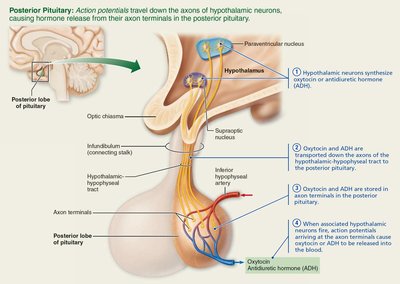
The hypothalamus is connected to the pituitary gland via the infundibulum. The pituitary has two major lobes:
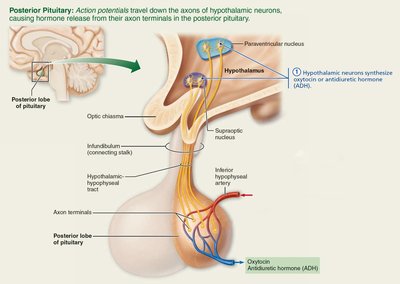
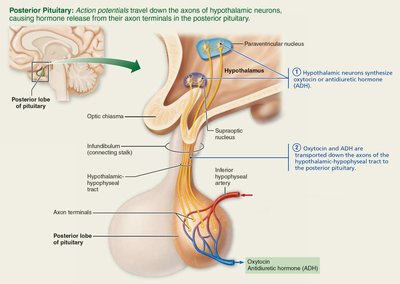
Posterior pituitary (neurohypophysis): Neural tissue; stores and secretes oxytocin and antidiuretic hormone (ADH).
Anterior pituitary (adenohypophysis): Glandular tissue; manufactures and secretes six hormones.
Posterior Pituitary Hormones
Oxytocin: Stimulates uterine contractions and milk ejection; uses PIP2-calcium second messenger system; acts as neurotransmitter in the brain.
Antidiuretic hormone (ADH): Stimulates kidney tubules to reabsorb water; high concentrations cause vasoconstriction (vasopressin); release triggered by high blood osmolarity, pain, low blood pressure, and certain drugs; inhibited by alcohol.
Anterior Pituitary Hormones
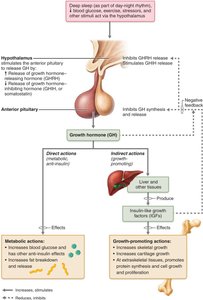
Growth hormone (GH): Direct actions on metabolism (glucose-sparing, lipolysis); indirect actions on growth (stimulates IGFs for cell division and bone growth); regulated by GHRH and GHIH (somatostatin).
Thyroid-stimulating hormone (TSH): Stimulates thyroid hormone release; regulated by TRH and negative feedback from thyroid hormones.
Adrenocorticotropic hormone (ACTH): Stimulates adrenal cortex to release corticosteroids; regulated by CRH and negative feedback from glucocorticoids.
Follicle-stimulating hormone (FSH) and Luteinizing hormone (LH): Stimulate gamete production and gonadal hormone production; regulated by GnRH and negative feedback from gonadal hormones.
Prolactin (PRL): Stimulates milk production; regulated by PIH (dopamine) and estrogen levels.
Thyroid and Parathyroid Glands
Thyroid Gland
Located on anterior trachea, just inferior to larynx; consists of follicles and parafollicular cells.
Thyroid hormone (TH): Major metabolic hormone; produced as T4 (thyroxine) and T3 (triiodothyronine); increases basal metabolic rate, regulates growth and development, and maintains blood pressure.
TH synthesis involves iodination of thyroglobulin and storage in colloid.
Regulated by TSH and negative feedback.
Parathyroid Glands
Four small glands embedded in the posterior thyroid; secrete parathyroid hormone (PTH).
PTH is the primary regulator of blood calcium levels; stimulates osteoclasts, enhances kidney reabsorption of Ca2+, and promotes activation of vitamin D.
Adrenal Glands
Adrenal Cortex
Mineralocorticoids (e.g., aldosterone): Regulate electrolyte balance; controlled by renin-angiotensin-aldosterone system, plasma K+, ACTH, and ANP.
Glucocorticoids (e.g., cortisol): Influence metabolism and stress response; regulated by CRH and ACTH.
Gonadocorticoids (androgens): Contribute to secondary sex characteristics and sex drive.
Adrenal Medulla
Secretes catecholamines (epinephrine and norepinephrine) during fight-or-flight response; increases heart rate, blood pressure, and blood glucose.
Pineal Gland
Secretes melatonin; regulates sleep-wake cycles and acts as an antioxidant.
Pancreas
Mixed gland with exocrine (digestive enzymes) and endocrine (insulin and glucagon) functions.
Insulin: Lowers blood glucose by promoting uptake and storage.
Glucagon: Raises blood glucose by promoting glycogen breakdown and gluconeogenesis.
Gonads and Other Organs
Ovaries: Produce estrogens and progesterone; regulate reproductive cycles.
Testes: Produce testosterone; regulate male reproductive function.
Placenta: Temporary endocrine organ during pregnancy.
Other organs (heart, kidneys, skin, thymus, bone, adipose) secrete hormones with various functions.
Developmental Aspects and Environmental Effects
Hormone-producing glands arise from all three primary germ layers.
Environmental pollutants can disrupt hormone function, especially sex hormones, thyroid hormone, and glucocorticoids.
Endocrine function generally declines with age, affecting metabolism, reproductive function, and glucose tolerance.
Clinical Imbalances
Diabetes insipidus: ADH deficiency; intense thirst and large urine output.
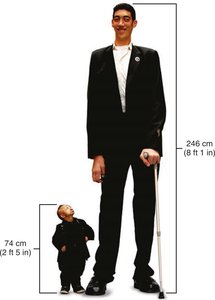
Gigantism/acromegaly: GH hypersecretion; excessive growth.
Pituitary dwarfism: GH hyposecretion; stunted growth.
Hypothyroidism: Low TH; myxedema, goiter, developmental issues.
Hyperthyroidism (Graves' disease): High TH; elevated metabolism, exophthalmos.
Hyperparathyroidism: Excess PTH; bone demineralization, kidney stones.
Hypoparathyroidism: Low PTH; tetany, convulsions.
Cushing's syndrome: Excess glucocorticoids; high blood glucose, muscle loss.
Addison's disease: Deficits in glucocorticoids and mineralocorticoids; weight loss, dehydration.
Adrenogenital syndrome: Excess androgens; masculinization.
Diabetes mellitus: Insulin deficiency or resistance; polyuria, polydipsia, polyphagia, ketoacidosis.
Hyperinsulinism: Excess insulin; hypoglycemia.
Summary Table: Selected Hormones and Their Effects
Hormone | Source | Trigger | Target Organ/Effect |
|---|---|---|---|
Leptin | Adipose tissue | Fat stores | Suppresses appetite, increases energy expenditure |
ANP | Heart | High blood pressure | Kidneys: increases Na+ excretion; Adrenal cortex: inhibits aldosterone |
Erythropoietin | Kidney | Low O2 | Stimulates red blood cell production |
Osteocalcin | Bone | Insulin | Increases insulin production and sensitivity |
Cholecalciferol | Skin | Activated by kidneys | Increases Ca2+ absorption in intestine |
Thymosins | Thymus | Unknown | T cell development |
