Ch. 15 The Special Senses
Amerman- Human Anatomy & Physiology 3e
Amerman3rd EditionHuman Anatomy & PhysiologyISBN: 9780138247201, 9780138247928, 9780138201814당신이 사용하는 게 아니라요?교과서 변경
15장, 문제 11c

Each of the following statements is false. Correct each statement to make it true.
In the dark, rods and cones produce action potentials.

검증된 단계별 안내
1
Understand the role of rods and cones in the retina: Rods are responsible for vision in low light (scotopic vision), while cones are responsible for color vision and function best in bright light (photopic vision). Neither rods nor cones produce action potentials; they generate graded potentials.
Learn about the process of phototransduction: In the dark, photoreceptor cells (rods and cones) are depolarized due to the presence of cyclic GMP (cGMP), which keeps sodium channels open. This leads to the release of neurotransmitters (glutamate) onto bipolar cells.
Correct the false statement: Replace 'produce action potentials' with 'generate graded potentials.' In the dark, rods and cones are depolarized and release neurotransmitters, but they do not produce action potentials. Action potentials occur in other retinal cells, such as ganglion cells.
Understand the difference between graded potentials and action potentials: Graded potentials are changes in membrane potential that vary in magnitude and occur in photoreceptors and bipolar cells. Action potentials are all-or-nothing electrical signals that occur in ganglion cells, which transmit visual information to the brain.
Revise the statement to reflect accurate physiology: 'In the dark, rods and cones generate graded potentials and release neurotransmitters, but they do not produce action potentials.'

비슷한 문제에 대한 검증된 영상 답변:

이 영상 해법은 위 문제에 도움이 된다고 튜터들이 추천한 것입니다.
도움이 되었나요?

주요 개념

질문에 올바르게 답하기 위해 반드시 이해해야 하는 핵심 개념들은 다음과 같습니다.

Photoreceptor Function

Photoreceptors, including rods and cones, are specialized cells in the retina that detect light. Rods are responsible for vision in low light conditions, while cones function in brighter light and are responsible for color vision. Both types of photoreceptors convert light into electrical signals, but they do not produce action potentials; instead, they generate graded potentials.
추천 영상:
06:04
Functional Groups

Graded Potentials vs. Action Potentials

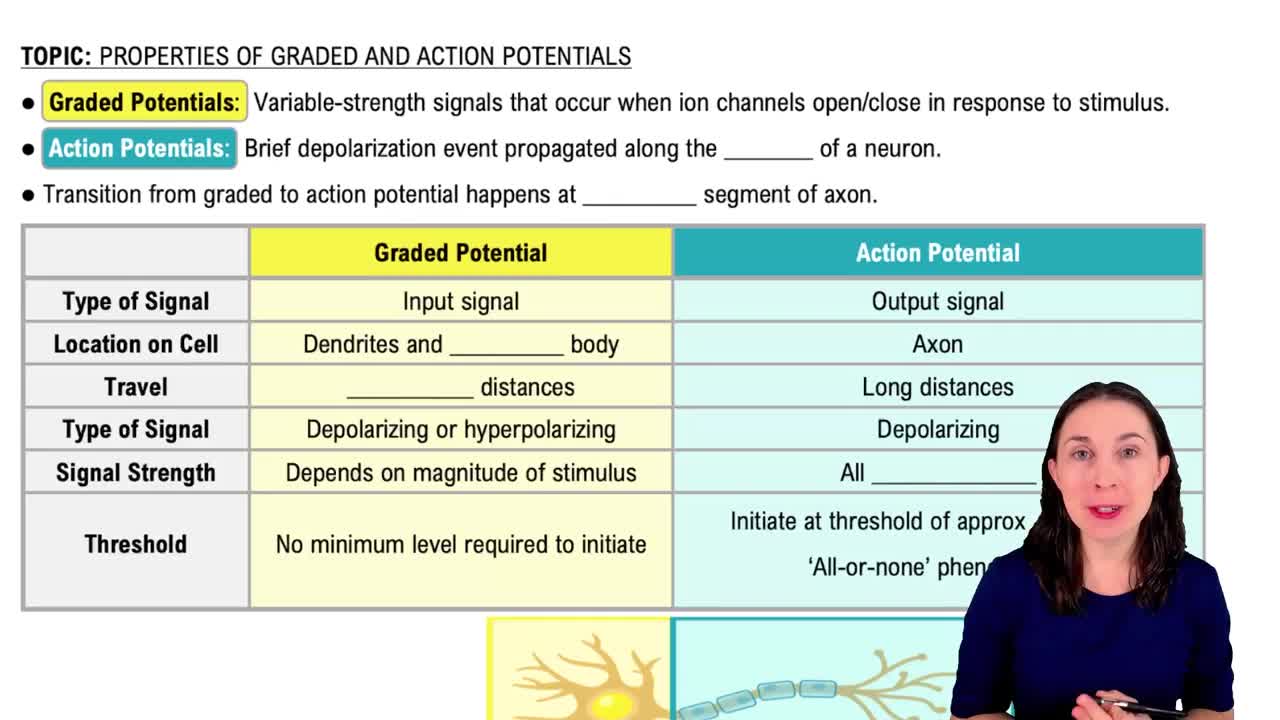
Graded potentials are changes in membrane potential that vary in size and are proportional to the strength of the stimulus. In contrast, action potentials are all-or-nothing signals that occur when a threshold is reached. In the context of photoreceptors, the graded potentials they generate influence the release of neurotransmitters to communicate with bipolar cells, which then can lead to action potentials in ganglion cells.
추천 영상:
05:17
Graded and Action Potentials

Neural Signal Transmission

Neural signal transmission involves the process by which sensory information is converted into electrical signals and relayed through the nervous system. In the visual pathway, after photoreceptors generate graded potentials, these signals are transmitted to bipolar cells, which then synapse with ganglion cells. The ganglion cells generate action potentials that travel along the optic nerve to the brain for visual processing.
추천 영상:
1:52
External Regulation – Neural Mechanisms