Ch. 15 The Special Senses
Amerman- Human Anatomy & Physiology 3e
Amerman3rd EditionHuman Anatomy & PhysiologyISBN: 9780138247201, 9780138247928, 9780138201814당신이 사용하는 게 아니라요?교과서 변경
15장, 문제 11b

Each of the following statements is false. Correct each statement to make it true.
Rods and cones are found in the fovea centralis.

검증된 단계별 안내
1
Understand the anatomy of the retina: The retina contains photoreceptor cells called rods and cones, which are responsible for detecting light and color. The fovea centralis is a specialized region of the retina.
Clarify the distribution of rods and cones: Rods are responsible for vision in dim light and are distributed throughout the retina, except in the fovea centralis. Cones are responsible for color vision and are concentrated in the fovea centralis.
Correct the statement: Rods are not found in the fovea centralis; only cones are present in this region, making it the area of highest visual acuity and color sensitivity.
Explain why cones dominate the fovea centralis: The fovea centralis is designed for sharp central vision, which is essential for tasks like reading and recognizing faces. This requires the high-resolution capabilities of cones.
Summarize the correction: The corrected statement should read, 'Cones are found in the fovea centralis, while rods are absent from this region and are distributed elsewhere in the retina.'

비슷한 문제에 대한 검증된 영상 답변:

이 영상 해법은 위 문제에 도움이 된다고 튜터들이 추천한 것입니다.
도움이 되었나요?

주요 개념

질문에 올바르게 답하기 위해 반드시 이해해야 하는 핵심 개념들은 다음과 같습니다.

Rods and Cones

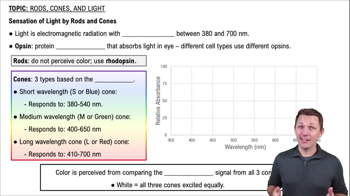
Rods and cones are the two types of photoreceptor cells in the retina of the eye. Rods are responsible for vision in low light conditions and do not detect color, while cones function in brighter light and are responsible for color vision. Understanding their distribution in the retina is crucial for comprehending visual processing.
추천 영상:
가이드 코스
9:08
Sensation of Light by Rods and Cones

Fovea Centralis

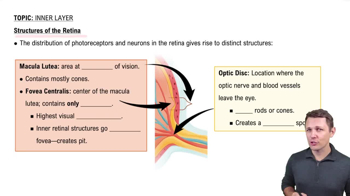
The fovea centralis is a small depression in the retina where visual acuity is highest. It is densely packed with cones, allowing for sharp central vision, particularly important for activities like reading and driving. Rods are absent in the fovea, which is essential to correct the false statement regarding their presence.
추천 영상:
05:45
Central Dogma

Visual Acuity

Visual acuity refers to the clarity or sharpness of vision, which is primarily determined by the density and distribution of photoreceptors in the retina. The fovea centralis, with its high concentration of cones, is critical for high visual acuity, while peripheral vision relies more on rods. This concept is key to understanding why the original statement about rods and cones is incorrect.
추천 영상:
가이드 코스
5:04
Structures of the Retina