Ch. 15 The Special Senses
Amerman- Human Anatomy & Physiology 3e
Amerman3rd EditionHuman Anatomy & PhysiologyISBN: 9780138247201, 9780138247928, 9780138201814당신이 사용하는 게 아니라요?교과서 변경
15장, 문제 10

Why can you see an object better in dim light by looking to the side of it instead of directly at it?

검증된 단계별 안내
1
Understand the structure of the retina: The retina contains two types of photoreceptor cells—rods and cones. Rods are responsible for vision in dim light, while cones are responsible for color vision and function best in bright light.
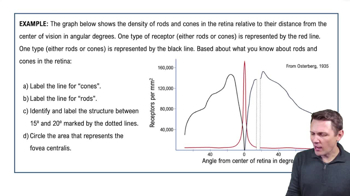
Learn the distribution of photoreceptors: Rods are concentrated in the peripheral regions of the retina, while cones are concentrated in the central region, particularly in the fovea, which is the area of sharpest vision.
Recognize the role of peripheral vision: When you look directly at an object, the image falls on the fovea, which has a high concentration of cones but few rods. In dim light, cones are less effective, so looking directly at the object may not provide optimal visibility.
Understand the advantage of looking to the side: By looking slightly to the side of the object, the image falls on the peripheral retina, where rods are more abundant. Rods are highly sensitive to low light levels, allowing you to see the object more clearly in dim conditions.
Apply this knowledge to real-world scenarios: This principle explains why astronomers often use averted vision to observe faint stars or objects in the night sky, as it maximizes the use of rod photoreceptors in low-light environments.

비슷한 문제에 대한 검증된 영상 답변:

이 영상 해법은 위 문제에 도움이 된다고 튜터들이 추천한 것입니다.
도움이 되었나요?

주요 개념

질문에 올바르게 답하기 위해 반드시 이해해야 하는 핵심 개념들은 다음과 같습니다.

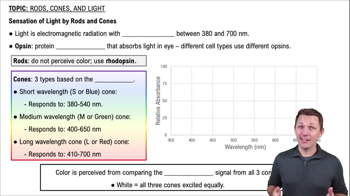
Rod Cells

Rod cells are photoreceptor cells in the retina that are highly sensitive to light and enable vision in low-light conditions. Unlike cone cells, which are responsible for color vision and function best in bright light, rod cells are more numerous and are concentrated in the peripheral regions of the retina. This makes them crucial for night vision and helps explain why objects are more visible when viewed indirectly in dim light.
추천 영상:
9:08
Sensation of Light by Rods and Cones

Peripheral Vision

Peripheral vision refers to the ability to see objects outside of your direct line of sight. This type of vision is primarily facilitated by rod cells, which are more densely packed in the peripheral areas of the retina. In dim lighting, relying on peripheral vision allows for better detection of objects, as the rod cells can pick up low levels of light more effectively than the cone cells that are concentrated in the center of the retina.
추천 영상:
3:33
Peripheral Nervous System

Scotopic Vision

Scotopic vision is the term used to describe vision under low-light conditions, primarily mediated by rod cells. In scotopic conditions, the eye adapts to darkness, enhancing the sensitivity of rod cells to detect faint light. This adaptation process explains why looking slightly away from a dim object can improve visibility, as it allows the brain to utilize the more light-sensitive areas of the retina.
추천 영상:
4:21
Inner Layer of the Eyeball Example 4