Ch. 15 The Special Senses
Amerman- Human Anatomy & Physiology 3e
Amerman3rd EditionHuman Anatomy & PhysiologyISBN: 9780138247201, 9780138247928, 9780138201814당신이 사용하는 게 아니라요?교과서 변경
15장, 문제 9

Which cells in the retina are depolarized in darkness?
a. Rods and cones
b. Bipolar cells
c. Retinal ganglion cells
d. All of the above
e. Only rods

검증된 단계별 안내
1
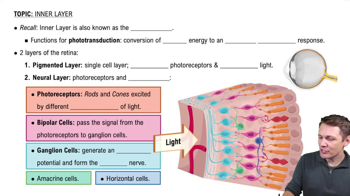
Understand the basic physiology of the retina: The retina contains photoreceptor cells (rods and cones), bipolar cells, and retinal ganglion cells. These cells work together to process visual information and transmit it to the brain.
Recall the behavior of photoreceptor cells (rods and cones) in darkness: In the absence of light, photoreceptor cells are depolarized because their sodium channels remain open due to the presence of cyclic GMP (cGMP). This allows a steady influx of sodium ions, known as the 'dark current.'
Understand the role of bipolar cells: Bipolar cells are not depolarized in darkness. Instead, they respond to the neurotransmitter glutamate released by depolarized photoreceptors. Depending on the type of bipolar cell (ON or OFF), they may be inhibited or activated in response to light.
Consider the retinal ganglion cells: Retinal ganglion cells are not directly depolarized in darkness. Their activity depends on the input they receive from bipolar cells, which is influenced by the presence or absence of light.
Conclude which cells are depolarized in darkness: Based on the above steps, only the photoreceptor cells (rods and cones) are depolarized in darkness due to the continuous influx of sodium ions through their open channels.

비슷한 문제에 대한 검증된 영상 답변:

이 영상 해법은 위 문제에 도움이 된다고 튜터들이 추천한 것입니다.
도움이 되었나요?

주요 개념

질문에 올바르게 답하기 위해 반드시 이해해야 하는 핵심 개념들은 다음과 같습니다.

Phototransduction

Phototransduction is the process by which light is converted into electrical signals in the retina. In darkness, photoreceptor cells (rods and cones) are depolarized due to the continuous influx of sodium ions, leading to the release of neurotransmitters that inhibit bipolar cells.
추천 영상:
7:59
Inner Layer

Rods and Cones

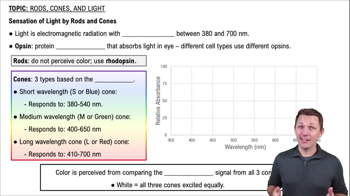
Rods and cones are the two types of photoreceptor cells in the retina. Rods are highly sensitive to light and enable vision in low-light conditions, while cones are responsible for color vision and function best in bright light. In darkness, rods remain depolarized, contributing to the overall response of the retina.
추천 영상:
9:08
Sensation of Light by Rods and Cones

Bipolar Cells

Bipolar cells are the intermediary neurons in the retina that connect photoreceptors to ganglion cells. In the dark, the inhibition from depolarized rods and cones prevents bipolar cells from depolarizing, which is essential for transmitting visual signals to the brain when light is present.
추천 영상: