Ch. 18 The Cardiovascular System II: The Blood Vessels
Amerman- Human Anatomy & Physiology 3e
Amerman3rd EditionHuman Anatomy & PhysiologyISBN: 9780138247201, 9780138247928, 9780138201814당신이 사용하는 게 아니라요?교과서 변경
18장, 문제 11

Capillaries consist of:
a. Three thin tunics
b. Only a thin tunica intima with a well-developed internal elastic lamina
c. A thin sheet of endothelium with a basal lamina
d. Stratified epithelium

검증된 단계별 안내
1
Step 1: Understand the structure of capillaries. Capillaries are the smallest blood vessels in the body and are specialized for the exchange of gases, nutrients, and waste products between blood and tissues.
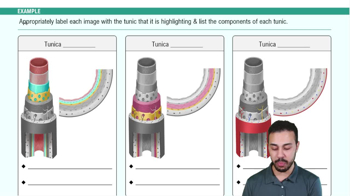
Step 2: Recall the layers of blood vessel walls. Larger blood vessels typically consist of three layers: tunica intima (inner layer), tunica media (middle layer), and tunica externa (outer layer). However, capillaries are unique in their structure.
Step 3: Focus on the composition of capillaries. Capillaries lack the tunica media and tunica externa layers found in larger vessels. Instead, they are composed of a single layer of endothelial cells supported by a basal lamina.
Step 4: Eliminate incorrect options. For example, capillaries do not have three tunics (option a), nor do they have a well-developed internal elastic lamina (option b). Additionally, capillaries are not made of stratified epithelium (option d).
Step 5: Identify the correct answer. Capillaries consist of a thin sheet of endothelium with a basal lamina, which matches option c.

비슷한 문제에 대한 검증된 영상 답변:

이 영상 해법은 위 문제에 도움이 된다고 튜터들이 추천한 것입니다.
도움이 되었나요?

주요 개념

질문에 올바르게 답하기 위해 반드시 이해해야 하는 핵심 개념들은 다음과 같습니다.

Capillary Structure

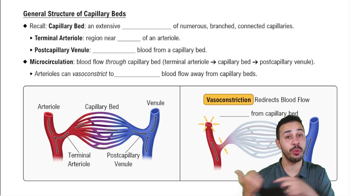
Capillaries are the smallest blood vessels in the body, primarily composed of a single layer of endothelial cells. This thin structure allows for efficient exchange of gases, nutrients, and waste products between blood and surrounding tissues. Unlike larger blood vessels, capillaries lack a tunica media and tunica externa, making them uniquely suited for their role in microcirculation.
추천 영상:
가이드 코스
5:59
General Structure of Capillary Beds

Tunica Intima

The tunica intima is the innermost layer of blood vessels, including capillaries. In capillaries, this layer consists solely of endothelial cells and a basal lamina, which provides structural support. This simplicity is crucial for facilitating the rapid exchange of substances, as it minimizes the distance that molecules must travel.
추천 영상:
가이드 코스
4:24
General Blood Vessel Structure Example 1

Endothelial Cells

Endothelial cells line the interior surface of blood vessels, including capillaries. They play a vital role in maintaining vascular health, regulating blood flow, and controlling the permeability of the vessel wall. In capillaries, the thinness of these cells is essential for allowing the diffusion of oxygen, carbon dioxide, and other small molecules between blood and tissues.
추천 영상: