Ch. 18 The Cardiovascular System II: The Blood Vessels
Amerman- Human Anatomy & Physiology 3e
Amerman3rd EditionHuman Anatomy & PhysiologyISBN: 9780138247201, 9780138247928, 9780138201814당신이 사용하는 게 아니라요?교과서 변경
18장, 문제 13

Which of the following structures is the 'leakiest'?
a. Continuous capillary
b. Sinusoidal capillary
c. Precapillary sphincter
d. Fenestrated capillary

검증된 단계별 안내
1
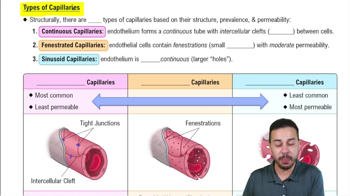
Understand the types of capillaries: Capillaries are small blood vessels that facilitate the exchange of substances between blood and tissues. There are three main types: continuous, fenestrated, and sinusoidal capillaries, each with varying permeability levels.
Define continuous capillaries: These capillaries have tightly joined endothelial cells with minimal gaps, making them the least permeable. They are found in areas like the brain (blood-brain barrier) and muscles.
Define fenestrated capillaries: These capillaries have small pores (fenestrations) in their endothelial cells, allowing for moderate permeability. They are commonly found in organs involved in filtration, such as the kidneys and intestines.
Define sinusoidal capillaries: These capillaries have large gaps between endothelial cells and an incomplete basement membrane, making them the 'leakiest' type. They are found in organs like the liver, spleen, and bone marrow, where extensive exchange of large molecules and cells occurs.
Clarify the role of precapillary sphincters: These are muscular structures that regulate blood flow into capillary beds but do not directly influence permeability. Therefore, they are not considered 'leaky' structures.

비슷한 문제에 대한 검증된 영상 답변:

이 영상 해법은 위 문제에 도움이 된다고 튜터들이 추천한 것입니다.
도움이 되었나요?

주요 개념

질문에 올바르게 답하기 위해 반드시 이해해야 하는 핵심 개념들은 다음과 같습니다.

Capillary Types

Capillaries are small blood vessels that facilitate the exchange of substances between blood and tissues. There are three main types: continuous, fenestrated, and sinusoidal. Continuous capillaries have tight junctions and are least permeable, fenestrated capillaries have pores for increased permeability, and sinusoidal capillaries have larger openings, allowing for the passage of larger molecules and cells.
추천 영상:
가이드 코스
9:42
Types of Capillaries

Permeability

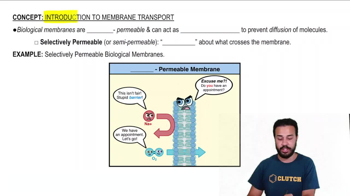
Permeability refers to the ability of substances to pass through a barrier, such as the walls of capillaries. Different types of capillaries exhibit varying levels of permeability based on their structural characteristics. Understanding permeability is crucial for determining how easily fluids and solutes can move between the bloodstream and surrounding tissues.
추천 영상:
가이드 코스
03:00
Introduction to Membrane Transport

Sinusoidal Capillaries

Sinusoidal capillaries are specialized blood vessels found in certain organs, such as the liver and spleen. They have a discontinuous endothelium, allowing for the free exchange of larger molecules and even cells between the blood and surrounding tissues. This makes them the 'leakiest' type of capillary, facilitating significant transport of substances.
추천 영상:
가이드 코스
9:42
Types of Capillaries