
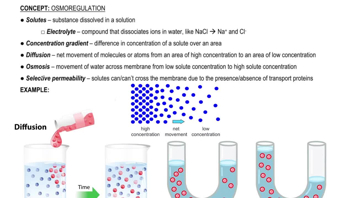

Your friend argues that all water conducts electricity, regardless of what it contains. You prepare three liquids to test this hypothesis: one with distilled water (with no solutes, only water molecules), one with 5% glucose in distilled water, and one with 5% sodium chloride in water. Which of these solutions, if any, will conduct an electric current? Explain.
Ch. 25 Fluid, Electrolyte, and Acid-Base Homeostasis
Amerman3rd EditionHuman Anatomy & PhysiologyISBN: 9780138247201, 9780138247928, 9780138201814당신이 사용하는 게 아니라요?교과서 변경
25장, 문제 2
How does an electrolyte differ from a nonelectrolyte?
검증된 단계별 안내1
Understand the definition of an electrolyte: An electrolyte is a substance that, when dissolved in water, dissociates into ions and conducts electricity. Examples include salts like sodium chloride (NaCl) and acids like hydrochloric acid (HCl).
Understand the definition of a nonelectrolyte: A nonelectrolyte is a substance that, when dissolved in water, does not dissociate into ions and therefore does not conduct electricity. Examples include substances like glucose (C₆H₁₂O₆) and ethanol (C₂H₅OH).
Compare the behavior of electrolytes and nonelectrolytes in water: Electrolytes dissociate into cations (positively charged ions) and anions (negatively charged ions), while nonelectrolytes dissolve as whole molecules without forming ions.
Relate the concept to conductivity: Since electrolytes produce free ions in solution, they allow the solution to conduct electricity. Nonelectrolytes, lacking free ions, do not enable electrical conductivity in their solutions.
Summarize the key difference: The primary distinction lies in the ability of the substance to dissociate into ions in water, which directly impacts its ability to conduct electricity.

비슷한 문제에 대한 검증된 영상 답변:
이 영상 해법은 위 문제에 도움이 된다고 튜터들이 추천한 것입니다.
도움이 되었나요?
주요 개념
질문에 올바르게 답하기 위해 반드시 이해해야 하는 핵심 개념들은 다음과 같습니다.
Electrolytes
Electrolytes are substances that dissociate into ions when dissolved in water, allowing them to conduct electricity. Common examples include salts like sodium chloride (NaCl) and acids like hydrochloric acid (HCl). The presence of free-moving ions in solution is what enables the conduction of electrical current, making electrolytes essential for various biological and chemical processes.
추천 영상:
Osmosis and Osmolarity
Nonelectrolytes
Nonelectrolytes are substances that do not dissociate into ions in solution and therefore do not conduct electricity. Examples include sugar (sucrose) and alcohols, which dissolve in water but remain as whole molecules. The lack of ion formation means that nonelectrolytes do not contribute to electrical conductivity, distinguishing them from electrolytes.
Conductivity
Conductivity refers to the ability of a solution to conduct electric current, which is primarily determined by the presence of ions. In electrolytic solutions, the movement of charged particles (ions) facilitates the flow of electricity. In contrast, nonelectrolytic solutions lack these charged particles, resulting in low or no conductivity, which is a key factor in differentiating between electrolytes and nonelectrolytes.
추천 영상:
가이드 코스
Conduction Pathway and Contraction
관련 실천
교과서 질문
49
views
교과서 질문
Explain how the amount of water in the body affects the concentration of ions and solutes in the ECF.
419
views
교과서 질문
Diabetic ketoacidosis is characterized by an increased level of ketone bodies, which causes metabolic acidosis. A patient in diabetic ketoacidosis will have an altered rate of ventilation. Will the patient be hyperventilating or hypoventilating? How will a change in the rate and depth of ventilation compensate for an acidosis that is metabolic in nature?
445
views
교과서 질문
List the effects of each of the following hormones on electrolyte balance. Note that some hormones affect more than one electrolyte.
a. Angiotensin-II
b. Aldosterone
c. Parathyroid hormone
d. Vitamin D
e. Atrial natriuretic peptide
402
views
