Ch. 4 Histology
Amerman- Human Anatomy & Physiology 3e
Amerman3rd EditionHuman Anatomy & PhysiologyISBN: 9780138247201, 9780138247928, 9780138201814당신이 사용하는 게 아니라요?교과서 변경
4장, 문제 14

Serous fluid functions in:
a. Providing temperature stability
b. Lubricating serous membranes as organs move in the cavity
c. Protecting the organs from mechanical trauma
d. Decreasing the weight of the organs and keeping them buoyant

검증된 단계별 안내
1
Understand the role of serous fluid: Serous fluid is a thin, watery fluid secreted by serous membranes, which line body cavities and cover organs. Its primary function is to reduce friction between moving organs and surrounding structures.
Analyze the options provided: Each option describes a potential function of serous fluid. Consider the physiological context of serous fluid and its interaction with serous membranes.
Evaluate option a: 'Providing temperature stability'—While body fluids can play a role in heat distribution, this is not the primary function of serous fluid. Its main role is mechanical, not thermal.
Evaluate option b: 'Lubricating serous membranes as organs move in the cavity'—This aligns with the primary function of serous fluid, which is to reduce friction and allow smooth movement of organs, such as the lungs during breathing or the heart during contraction.
Evaluate options c and d: 'Protecting the organs from mechanical trauma' and 'Decreasing the weight of the organs and keeping them buoyant'—These are not accurate descriptions of serous fluid's function. Protection from trauma is more related to other structures like the rib cage, and buoyancy is not relevant to serous fluid.

비슷한 문제에 대한 검증된 영상 답변:

이 영상 해법은 위 문제에 도움이 된다고 튜터들이 추천한 것입니다.
도움이 되었나요?

주요 개념

질문에 올바르게 답하기 위해 반드시 이해해야 하는 핵심 개념들은 다음과 같습니다.

Serous Fluid Function

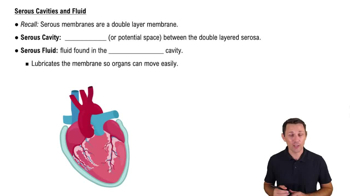
Serous fluid is a clear, pale yellow liquid found in the serous cavities of the body. Its primary functions include lubricating the surfaces of serous membranes, which reduces friction between organs as they move, and providing a cushioning effect that protects organs from mechanical trauma.
추천 영상:
가이드 코스
3:33
Serous Cavity and Fluid

Serous Membranes

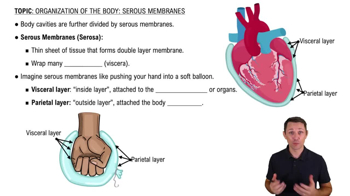
Serous membranes are thin layers of tissue that line body cavities and cover organs. They consist of two layers: the parietal layer, which lines the cavity, and the visceral layer, which covers the organs. The serous fluid between these layers facilitates smooth movement and reduces friction during organ motion.
추천 영상:
가이드 코스
4:09
Serous Membranes

Buoyancy and Weight Reduction

The presence of serous fluid contributes to the buoyancy of organs, allowing them to float within their cavities. This buoyancy helps to decrease the effective weight of the organs, reducing strain on supporting structures and allowing for greater mobility and function within the body.
추천 영상:
04:46
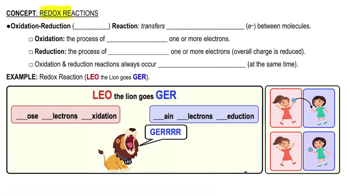
Redox Reactions