Ch. 22 The Respiratory System
Marieb - Human Anatomy & Physiology 11th Edition
Marieb, Hoehn11th EditionHuman Anatomy & PhysiologyISBN: 9780136874034당신이 사용하는 게 아니라요?교과서 변경
22장, 문제 8

Oxygen and carbon dioxide are exchanged in the lungs and through all cell membranes by:
a. Active transport
b. Diffusion
c. Filtration
d. Osmosis

검증된 단계별 안내
1
Understand the process of gas exchange in the lungs and across cell membranes, which involves the movement of oxygen and carbon dioxide molecules between areas of different concentrations.
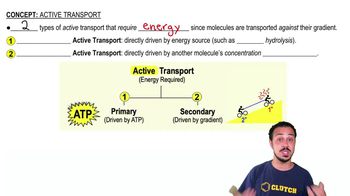
Recall that active transport requires energy to move substances against their concentration gradient, which is not typical for gases like oxygen and carbon dioxide during exchange.
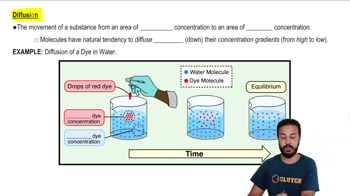
Consider diffusion, which is the passive movement of molecules from an area of higher concentration to an area of lower concentration, a process that fits how gases move in the lungs and cells.
Evaluate filtration, which involves the movement of water and solutes through a membrane due to pressure differences, generally not applicable to gas exchange.
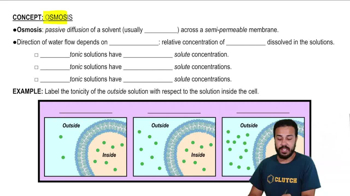
Review osmosis, which specifically refers to the movement of water across a semipermeable membrane, and is not the mechanism for gas exchange.

비슷한 문제에 대한 검증된 영상 답변:

이 영상 해법은 위 문제에 도움이 된다고 튜터들이 추천한 것입니다.
영상 길이:
3m
도움이 되었나요?

주요 개념

질문에 올바르게 답하기 위해 반드시 이해해야 하는 핵심 개념들은 다음과 같습니다.

Diffusion

Diffusion is the passive movement of molecules from an area of higher concentration to an area of lower concentration. In the lungs and across cell membranes, oxygen and carbon dioxide move by diffusion, allowing gas exchange without energy expenditure.
추천 영상:

Active Transport

Active transport is the energy-dependent process where molecules move against their concentration gradient using cellular energy (ATP). It is not typically involved in the exchange of gases like oxygen and carbon dioxide in the lungs.
추천 영상:
가이드 코스
02:37
Active Transport

Osmosis and Filtration

Osmosis is the diffusion of water across a semipermeable membrane, while filtration involves movement of fluids through membranes driven by pressure differences. Neither process primarily facilitates gas exchange in the lungs or cells.
추천 영상:
관련 실천
교과서 질문

In mouth-to-mouth artificial respiration, the rescuer blows air from his or her own respiratory system into that of the victim. Which of the following statements are correct?

(1) Expansion of the victim's lungs is brought about by blowing air in at higher than atmospheric pressure (positive-pressure breathing).

(2) During inflation of the lungs, the intrapleural pressure increases.

(3) This technique will not work if the victim has a hole in the chest wall, even if the lungs are intact.

(4) Expiration during this procedure depends on the elasticity of the alveolar and thoracic walls.

a. All of these

b. 1, 2, 4

c. 1, 2, 3

d. 1, 4

166
views
교과서 질문

When the inspiratory muscles contract:

a. The size of the thoracic cavity increases in diameter

b. The size of the thoracic cavity increases in length

c. The volume of the thoracic cavity decreases

d. The size of the thoracic cavity increases in both length and diameter

1187
views
교과서 질문

The nutrient blood supply of the lungs is provided by:

a. The pulmonary arteries

b. The aorta

c. The pulmonary veins

d. The bronchial arteries

131
views
교과서 질문

Which of the following determines the direction of gas movement?

a. Solubility in water

b. Partial pressure gradient

c. Temperature

d. Molecular weight and size of the gas molecule

1034
views
교과서 질문

Most oxygen carried in the blood is:

a. In solution in the plasma

b. Combined with plasma proteins

c. Chemically combined with the heme in red blood cells

d. In solution in the red blood cells

109
views
교과서 질문

Which of the following has the greatest stimulating effect on the respiratory centers in the brain?

a. Oxygen

b. Carbon dioxide

c. Calcium

d. Willpower

124
views