Ch. 9 Muscles and Muscle Tissue
Marieb - Human Anatomy & Physiology 11th Edition
Marieb, Hoehn11th EditionHuman Anatomy & PhysiologyISBN: 9780136874034당신이 사용하는 게 아니라요?교과서 변경
9장, 문제 8

Characteristics of isometric contractions include all but:
a. Shortening
b. Increased muscle tension throughout the contraction phase
c. Absence of shortening
d. Used in resistance training

검증된 단계별 안내
1
Step 1: Understand the definition of an isometric contraction. In an isometric contraction, the muscle generates tension without changing its length, meaning there is no visible shortening or lengthening of the muscle fibers.
Step 2: Analyze each option in the context of isometric contractions. Option (a) states 'Shortening,' which contradicts the definition because isometric contractions do not involve muscle shortening.
Step 3: Consider option (b) 'Increased muscle tension throughout the contraction phase.' This is true for isometric contractions, as the muscle tension increases while the length remains constant.
Step 4: Evaluate option (c) 'Absence of shortening.' This aligns with the definition of isometric contractions, where the muscle length stays the same.
Step 5: Review option (d) 'Used in resistance training.' Isometric exercises are commonly used in resistance training to build strength without joint movement, so this is also true.

비슷한 문제에 대한 검증된 영상 답변:

이 영상 해법은 위 문제에 도움이 된다고 튜터들이 추천한 것입니다.
영상 길이:
2m
도움이 되었나요?

주요 개념

질문에 올바르게 답하기 위해 반드시 이해해야 하는 핵심 개념들은 다음과 같습니다.

Isometric Contraction

Isometric contraction occurs when muscle tension increases but the muscle length remains constant, meaning there is no visible shortening or lengthening of the muscle during the contraction.
추천 영상:
4:53
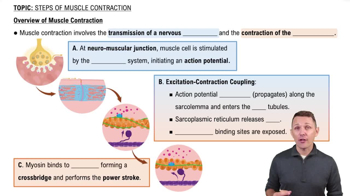
Overview of Muscle Contraction

Muscle Tension During Contraction

During isometric contractions, muscle tension rises and is maintained without changing muscle length, which differs from isotonic contractions where muscle length changes while tension may vary.
추천 영상:
4:53
Overview of Muscle Contraction

Applications of Isometric Contractions in Training

Isometric exercises are commonly used in resistance training to improve strength and stability by holding muscles in a fixed position against resistance without movement.
추천 영상:
4:53
Overview of Muscle Contraction
관련 실천
교과서 질문

The neurotransmitter released by somatic motor neurons is:

a. Acetylcholine

b. Acetylcholinesterase

c. Norepinephrine

1510
views
2
rank
교과서 질문

The sites where the motor nerve impulse is transmitted from the nerve endings to the skeletal muscle cell membranes are the

a. neuromuscular junctions

b. sarcomeres

c. myofilaments

d. Z discs

1447
views
1
rank
교과서 질문

A smooth, sustained contraction resulting from very rapid stimulation of the muscle, in which no evidence of relaxation is seen, is called:

a. A twitch

b. Temporal summation

c. Multiple motor unit summation

d. Fused tetanus

1247
views
2
rank
교과서 질문

Contraction elicited by a single brief stimulus is called:

a. A twitch

b. Temporal summation

c. Multiple motor unit summation

d. Fused tetanus

1134
views
1
rank
교과서 질문

The ions that enter the skeletal muscle cell during the generation of an action potential are

a. Calcium ions

b. Chloride ions

c. Sodium ions

d. Potassium ions

1194
views
1
rank
교과서 질문

During muscle contraction, ATP is provided by:

a. a coupled reaction of creatine phosphate with ADP

b. aerobic respiration of glucose, and

c. anaerobic glycolysis.

______ (1) Which provides ATP fastest?

______  (2) Which does (do) not require that oxygen be available?

______  (3) Which provides the highest yield of ATP per glucose molecule?

______  (4) Which results in the formation of lactic acid?

______  (5) Which has carbon dioxide and water products?

______  (6) Which is most important in endurance sports?

1469
views
2
rank