Ch. 15 The Urinary System
Marieb - Essentials of Human Anatomy & Physiology 13th Edition
Marieb13th EditionEssentials of Human Anatomy & PhysiologyISBN: 9780135624340당신이 사용하는 게 아니라요?교과서 변경
15장, 문제 13

What is the function of the glomerulus?

검증된 단계별 안내
1
Understand that the glomerulus is a network of capillaries located within the nephron of the kidney, and its primary role is filtration.
Learn that the glomerulus filters blood by allowing water, ions, and small molecules to pass through its walls while retaining larger molecules like proteins and blood cells.
Recognize that the filtration process occurs due to the high blood pressure within the glomerular capillaries, which forces substances through the filtration membrane.
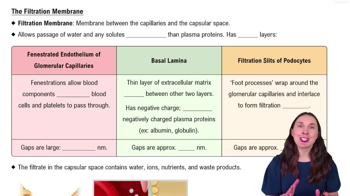
Explore the structure of the filtration membrane, which consists of three layers: the endothelium of the capillaries, the basement membrane, and the podocytes of the Bowman's capsule.
Understand that the filtrate produced by the glomerulus enters the Bowman's capsule and proceeds through the nephron for further processing into urine.

비슷한 문제에 대한 검증된 영상 답변:

이 영상 해법은 위 문제에 도움이 된다고 튜터들이 추천한 것입니다.
영상 길이:
2m
도움이 되었나요?

주요 개념

질문에 올바르게 답하기 위해 반드시 이해해야 하는 핵심 개념들은 다음과 같습니다.

Glomerulus Structure

The glomerulus is a network of tiny blood vessels (capillaries) located in the kidney's nephron. It is surrounded by Bowman's capsule and plays a crucial role in filtering blood. The structure allows for the efficient exchange of substances between the blood and the filtrate, which is essential for kidney function.
추천 영상:
가이드 코스
4:16
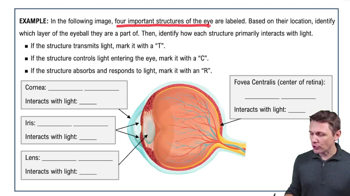
Structure of the Eyeball Example 1

Filtration Process

The primary function of the glomerulus is to filter blood, a process known as glomerular filtration. During this process, blood pressure forces water, ions, and small molecules through the capillary walls into Bowman's capsule, forming a filtrate. This initial filtration is critical for the subsequent reabsorption and secretion processes that occur in the nephron.
추천 영상:
4:30
The Filtration Membane

Role in Homeostasis

The glomerulus plays a vital role in maintaining homeostasis by regulating the composition of blood and the volume of bodily fluids. By filtering out waste products and excess substances, it helps to balance electrolytes, maintain blood pressure, and ensure the proper functioning of the body's systems. This regulation is essential for overall health and well-being.
추천 영상:
가이드 코스
01:59
Introduction to Homeostasis