Ch. 16 The Reproductive System
Marieb - Essentials of Human Anatomy & Physiology 13th Edition
Marieb13th EditionEssentials of Human Anatomy & PhysiologyISBN: 9780135624340당신이 사용하는 게 아니라요?교과서 변경
16장, 문제 24

Given that the uterine tubes are not continuous with the ovaries, how can you explain the fact that not all ovulated 'eggs' end up in the female's peritoneal cavity?

검증된 단계별 안내
1
Understand the anatomy of the female reproductive system: The uterine tubes (also called fallopian tubes) are not directly attached to the ovaries. Instead, they have finger-like projections called fimbriae at their ends, which play a crucial role in capturing the ovulated egg.
Explain the role of fimbriae: The fimbriae are lined with ciliated cells that create a sweeping motion. This motion helps guide the ovulated egg from the ovary into the opening of the uterine tube, preventing it from entering the peritoneal cavity.
Discuss the movement of the egg: Once the egg is captured by the fimbriae, it is transported through the uterine tube by the coordinated action of cilia and peristaltic contractions of the tube's smooth muscle walls.
Address the possibility of eggs entering the peritoneal cavity: While the system is efficient, it is not perfect. Occasionally, an ovulated egg may not be captured by the fimbriae and can end up in the peritoneal cavity. However, this is relatively rare due to the close proximity and active movement of the fimbriae.
Summarize the mechanism: The combination of anatomical structures (fimbriae) and physiological processes (cilia and peristalsis) ensures that most ovulated eggs are successfully captured and transported into the uterine tubes, minimizing the likelihood of them entering the peritoneal cavity.

비슷한 문제에 대한 검증된 영상 답변:

이 영상 해법은 위 문제에 도움이 된다고 튜터들이 추천한 것입니다.
영상 길이:
2m
도움이 되었나요?

주요 개념

질문에 올바르게 답하기 위해 반드시 이해해야 하는 핵심 개념들은 다음과 같습니다.

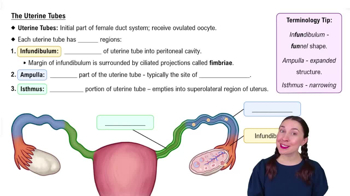
Uterine Tubes Anatomy

The uterine tubes, also known as fallopian tubes, are structures that connect the ovaries to the uterus. They are not directly attached to the ovaries, which means that ovulated eggs must be captured by the fimbriae, the finger-like projections at the end of the tubes. This anatomical arrangement is crucial for understanding how eggs are transported toward the uterus.
추천 영상:
3:58
The Uterine Tubes

Ovulation Process

Ovulation is the process by which an ovary releases an egg into the abdominal cavity. This event is tightly regulated by hormonal signals, and while the egg is released, it does not always enter the uterine tube. Factors such as the timing of the fimbriae's movement and the egg's position can influence whether the egg is successfully captured.
추천 영상:
가이드 코스
04:19
1) RNA Processing

Peritoneal Cavity and Egg Capture

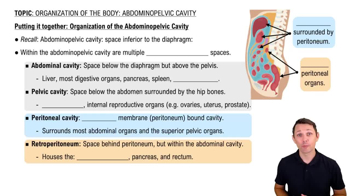
The peritoneal cavity is the space within the abdomen that houses various organs, including the reproductive organs. Although some eggs may be released into this cavity, the majority are captured by the fimbriae of the uterine tubes. The effectiveness of this capture mechanism is essential for successful fertilization and subsequent implantation in the uterus.
추천 영상:
5:46
Organization of the Abdominopelvic Cavity