Ch. 6 The Muscular System
Marieb - Essentials of Human Anatomy & Physiology 13th Edition
Marieb13th EditionEssentials of Human Anatomy & PhysiologyISBN: 9780135624340당신이 사용하는 게 아니라요?교과서 변경
6장, 문제 12

Describe the events that occur from the time calcium ions enter the axon terminal at the neuromuscular junction until muscle cell contraction occurs.

검증된 단계별 안내
1
Calcium ions (Ca²⁺) enter the axon terminal when an action potential reaches the presynaptic neuron at the neuromuscular junction. This triggers the opening of voltage-gated calcium channels, allowing Ca²⁺ to diffuse into the axon terminal.
The influx of Ca²⁺ causes synaptic vesicles containing the neurotransmitter acetylcholine (ACh) to fuse with the presynaptic membrane. Acetylcholine is then released into the synaptic cleft via exocytosis.
Acetylcholine diffuses across the synaptic cleft and binds to nicotinic acetylcholine receptors on the motor end plate of the muscle cell membrane (sarcolemma). This binding opens ligand-gated sodium (Na⁺) channels, leading to an influx of Na⁺ into the muscle cell and depolarization of the sarcolemma.
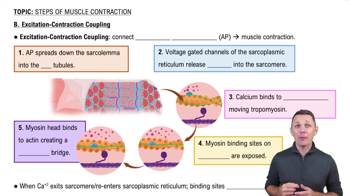
The depolarization triggers an action potential that propagates along the sarcolemma and down the T-tubules. This action potential stimulates the release of calcium ions (Ca²⁺) from the sarcoplasmic reticulum into the cytosol of the muscle cell.
The released Ca²⁺ binds to troponin on the thin filaments of the sarcomere, causing a conformational change that moves tropomyosin away from the myosin-binding sites on actin. This allows myosin heads to bind to actin, initiating the cross-bridge cycle and muscle contraction.

비슷한 문제에 대한 검증된 영상 답변:

이 영상 해법은 위 문제에 도움이 된다고 튜터들이 추천한 것입니다.
영상 길이:
2m

주요 개념

질문에 올바르게 답하기 위해 반드시 이해해야 하는 핵심 개념들은 다음과 같습니다.

Calcium Ion Role in Neurotransmission

Calcium ions (Ca²⁺) play a crucial role in neurotransmission at the neuromuscular junction. When an action potential reaches the axon terminal, voltage-gated calcium channels open, allowing Ca²⁺ to flow into the terminal. This influx triggers the release of neurotransmitters, specifically acetylcholine, into the synaptic cleft, which is essential for muscle contraction.
추천 영상:
2:30
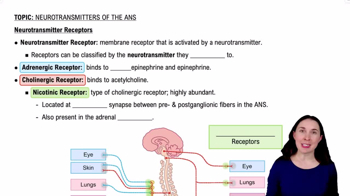
Neurotransmitter Receptors

Acetylcholine and Muscle Activation

Acetylcholine (ACh) is a neurotransmitter released at the neuromuscular junction that binds to receptors on the muscle cell membrane. This binding initiates a series of events, including the opening of sodium channels, leading to depolarization of the muscle cell membrane. This depolarization is critical for generating an action potential in the muscle fiber, ultimately resulting in muscle contraction.
추천 영상:
가이드 코스
02:37
Active Transport

Excitation-Contraction Coupling

Excitation-contraction coupling refers to the physiological process linking the electrical signal from the nerve to the mechanical response of muscle contraction. Following the generation of an action potential in the muscle fiber, calcium ions are released from the sarcoplasmic reticulum, leading to the interaction of actin and myosin filaments. This interaction causes the muscle fibers to contract, completing the process initiated by the entry of calcium ions at the axon terminal.
추천 영상:
5:47
B. Excitation-Contraction Coupling