 뒤로
뒤로Atoms, Molecules, and Water: Foundations for General Biology
스터디 가이드 - 스마트 노트
 자료에 맞춘 맞춤형 노트, 핵심 정의, 예시, 맥락을 확장해 제공합니다.
Nature of Atoms
Atomic Structure
Atoms are the fundamental units of matter, composed of three types of subatomic particles: protons (positively charged, located in the nucleus), neutrons (neutral, located in the nucleus), and electrons (negatively charged, found in orbitals surrounding the nucleus). Understanding atomic structure is essential for grasping the behavior of biological molecules.
Atomic number: The number of protons in an atom, which also equals the number of electrons in a neutral atom.
Atomic mass: The sum of protons and neutrons; each has a mass of approximately 1 dalton.
Element: A substance that cannot be broken down by ordinary chemical means.
Isotopes
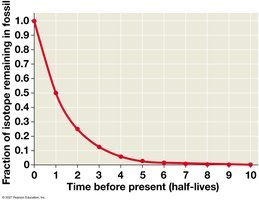
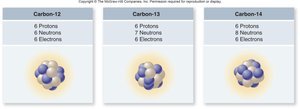
Isotopes are atoms of the same element with different numbers of neutrons. Some isotopes are radioactive and decay over time, emitting radiation.
Radioactive decay: The process by which unstable isotopes lose energy by emitting radiation.
Half-life: The time required for half of the atoms in a sample to decay.
Example: Carbon-12, Carbon-13, and Carbon-14 are isotopes of carbon with different neutron counts.
The Nature of Molecules and the Properties of Water
Electron Arrangement and Energy Levels
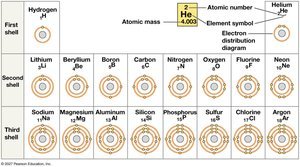
The arrangement of electrons in shells and orbitals determines the chemical properties of an atom. Electrons farther from the nucleus have higher potential energy. The periodic table organizes elements by their electron configuration.
Energy levels (shells): Electrons occupy energy levels, with those farther from the nucleus possessing more energy.
Orbitals: Three-dimensional regions where electrons are most likely found.
Redox Reactions
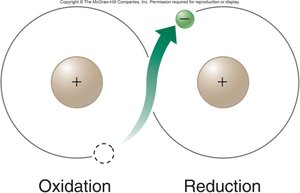
Redox reactions involve the transfer of electrons between atoms. Oxidation is the loss of electrons, while reduction is the gain of electrons. These reactions are fundamental to many biological processes.
Oxidation: Loss of an electron.
Reduction: Gain of an electron.
Elements and the Periodic Table
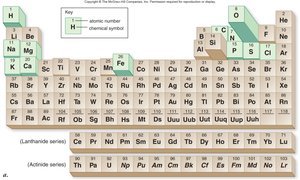
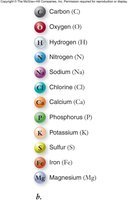
The periodic table displays elements according to their valence electrons. The octet rule states that atoms tend to fill their outermost energy level with eight electrons, making them stable. Only 12 elements are found in living organisms in substantial amounts, with carbon, hydrogen, oxygen, and nitrogen making up most of the human body.
Valence electrons: Electrons in the outermost shell, important for chemical bonding.
Inert elements: Have full outer shells and are nonreactive.
Chemical Bonds
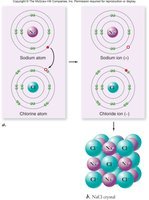
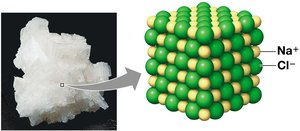
Molecules are groups of atoms held together by chemical bonds. Ionic bonds form from the attraction between oppositely charged ions, while covalent bonds involve the sharing of electrons. The strength and type of bond affect molecular stability and function.
Ionic bonds: Formed by the transfer of electrons, resulting in charged ions (cations and anions).
Covalent bonds: Formed by sharing electrons; can be single, double, or triple bonds.
Electronegativity and Bond Polarity
Electronegativity is an atom's affinity for electrons. Differences in electronegativity determine whether a covalent bond is polar (unequal sharing) or nonpolar (equal sharing). Polar bonds result in partial charges within molecules.
Nonpolar covalent bond: Equal sharing of electrons.
Polar covalent bond: Unequal sharing, leading to partial positive and negative charges.
Van der Waals Interactions
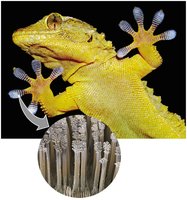
Van der Waals interactions are weak attractions between molecules due to temporary charge imbalances. Collectively, these interactions can be significant, such as in the adhesion of gecko toe hairs to surfaces.
Example: Gecko's ability to climb walls due to Van der Waals forces.
Chemical Reactions
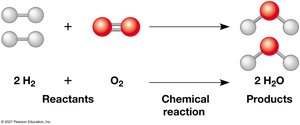
Chemical reactions involve the rearrangement of atoms by forming or breaking bonds. Reactants are the starting molecules, and products are the resulting molecules. Many reactions are reversible and influenced by temperature, concentration, and catalysts.
Example: Photosynthesis and the formation of water from hydrogen and oxygen.
Factors influencing reactions: Temperature, concentration, catalysts.
Water: The Solvent of Life
Structure and Properties of Water
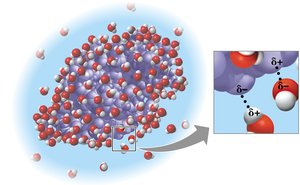
Water is essential for life due to its unique chemical properties, including its ability to form hydrogen bonds. The polarity of water molecules leads to partial charges, enabling hydrogen bonding between molecules.
Hydrogen bonds: Weak attractions between the partially negative oxygen and partially positive hydrogen atoms of adjacent water molecules.
Cohesion: Water molecules stick to each other.
Adhesion: Water molecules stick to other polar substances.
Physical Properties of Water
Water exhibits several important physical properties due to hydrogen bonding:
High specific heat: Water resists temperature changes.
High heat of vaporization: Evaporation cools surfaces.
Density: Solid water (ice) is less dense than liquid water, causing ice to float.
Water as a Solvent
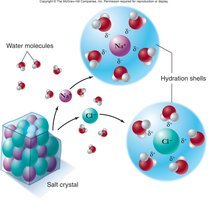
Water is an excellent solvent, dissolving polar molecules and ions. It organizes nonpolar molecules, leading to hydrophilic ('water-loving') and hydrophobic ('water-fearing') interactions. Water can also form ions, such as hydroxide (OH−) and hydrogen (H+) ions.
Aqueous solution: Water is the solvent.
Hydrophilic: Substances that dissolve in water.
Hydrophobic: Substances that do not dissolve in water.
Acids, Bases, and pH
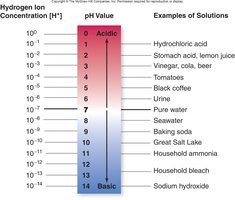
Acids increase the concentration of hydrogen ions (H+) in solution, lowering pH. Bases decrease H+, raising pH. The pH scale is a logarithmic measure of hydrogen ion concentration.
Acid: Dissociates in water to increase H+.
Base: Combines with H+ to decrease H+.
pH:
Buffers
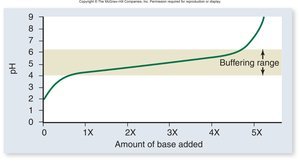
Buffers are substances that resist changes in pH by releasing or absorbing hydrogen ions. Most biological buffers consist of a pair of molecules, one acting as an acid and the other as a base, maintaining a stable internal pH.
Buffering range: The range of pH where a buffer is effective.
Types of Chemical Bonds: Summary Table
The following table summarizes the main types of chemical bonds found in biological systems:
Type of Bond | Formation | Example |
|---|---|---|
Ionic | Transfer of electrons | NaCl |
Covalent | Sharing of electrons | H2, O2, N2 |
Hydrogen | Attraction between partial charges | Water molecules |
Van der Waals | Temporary charge imbalances | Gecko toe hairs |
Additional info: The notes expand on the original content by providing definitions, examples, and equations for clarity and completeness, suitable for General Biology students.
